Hohenzollernbrücke
Germany's busiest railway bridge spanning the Rhine — a defining feature of Cologne's skyline alongside the Cathedral, and famous for thousands of love locks.
since 1911
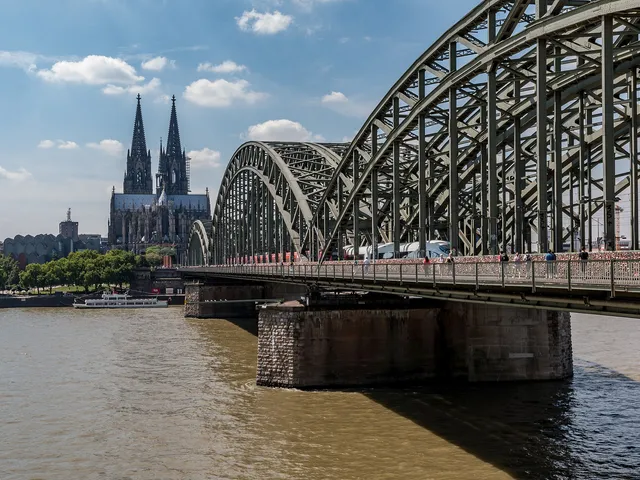
The Hohenzollernbrücke crosses the Rhine in Cologne, linking the central station with Deutz station. Together with Cologne Cathedral, it is an iconic part of the city's skyline.
At a Glance
- Type
- Railway and pedestrian bridge over the Rhine
- Location
- Altstadt-Nord, city centre; at river kilometre 688.5
- Connects
- Cologne Central Station and Deutz Station
- Construction
- 1907–1911, inaugurated 22 May 1911
- Portal architect
- Franz Schwechten, Neo-Romanesque style
- Traffic
- around 1,500 train movements per day
- Notable features
- four equestrian statues, countless love locks
- Protection
- listed monument in North Rhine-Westphalia
Between August 2 and 18, 1914, 2,150 trains crossed the bridge – an average of four per hour – transporting soldiers and supplies to the Western Front.
Things to do here
- Stroll across the bridge and enjoy the Rhine panorama of the cathedral and old town
- Marvel at the thousands of love locks along the railings
- Photograph the cathedral, bridge and skyline
- Watch the constant train traffic on Germany's busiest railway bridge
- Discover the four Hohenzollern equestrian statues at the ramps
- Cross to the right-bank Deutz side by bike or on foot
Length comparison
Length compared with other Cologne bridges.
Age comparison
Age compared with other places in Cologne.
Traffic and Significance
With roughly 1,500 train crossings every day, the Hohenzollernbrücke is the busiest railway bridge in Germany. Together with the central station it forms a key hub in the German and European rail network — and a well-known bottleneck for regional rail traffic.
History
A two-track predecessor, the Dombrücke, had stood on the same site since 1859, but could no longer cope with growing demand. The new bridge was built between 1907 and 1911, with involvement from the MAN plant in Gustavsburg, based on designs by engineer Friedrich Dircksen. Kaiser Wilhelm II officially inaugurated it on 22 May 1911. Like its predecessor, the bridge is aligned with the central axis of the Cathedral.
Wartime Destruction and Reconstruction
The original structure comprised three parallel sections carrying four railway tracks and a road. Franz Schwechten's tall Neo-Romanesque towers gave the portals a distinctive character. On 6 March 1945, Wehrmacht engineers blew up the piers; a provisional crossing reopened in 1948. During reconstruction the southern road bridge section was dropped, and the surviving portal buildings and towers were demolished in 1958. The outer spans that had carried road traffic were repurposed as walking and cycling paths.
Equestrian Statues
Four equestrian statues of Prussian kings and German emperors from the House of Hohenzollern flank the bridge ramps. On the right bank stand Frederick William IV and Wilhelm I; on the left, Frederick III and Wilhelm II — a reminder of Hohenzollern rule over the Rhine Province.
Today
The bridge has become famous for the thousands of love locks that visitors have fastened to the railings of its pedestrian and cycle paths, making it one of Cologne's most romantic landmarks.
Timeline
- 1859Two-track Dom Bridge built at the same location
- 1907–1911Construction of Hohenzollernbrücke under Fritz Beermann
- 22. Mai 1911Inauguration by Emperor Wilhelm II
- Aug. 19142,150 trains carry soldiers to the Western Front (2–18 Aug.)
- 6. März 1945Bridge piers blown up by retreating German Wehrmacht engineers
- 8. Mai 1948Provisional reconstruction completed; bridge reopened to traffic
- 1958Portal buildings and bridge towers demolished
- 1959Complete reconstruction of the bridge finished
Gallery
Map
Blue dots: other places nearby — tap to explore.
You might also like — related or nearby
Comments
- Loading comments…
Sources & links
- Official website
- Official website (retrieved 2026-07-06)
- Wikidata (retrieved 2026-06-23)
- Wikipedia (retrieved 2026-06-23, rev 268008047)
Auto-generated, last verified: 2026-06-26
How this page is made
This page draws on open sources — Wikipedia, Wikidata, official websites and the city’s open data. Every statement is checked against the sources linked here, and pages are refreshed regularly.
Spotted a mistake anyway? Tell us below — we read every submission.