Alt St. Maternus
Romanesque 'little chapel' on the Rhine — one of 13 small former village churches outside Cologne's medieval city walls.
since 950
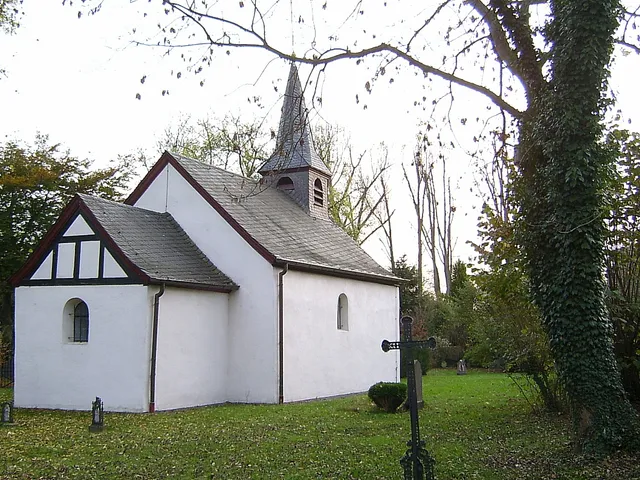
Standing close to the Rhine in the historic heart of Cologne-Rodenkirchen, the church of Alt Sankt Maternus is affectionately known to locals as the "Kapellchen" — the little chapel. It is one of 13 small Romanesque former village churches lying outside Cologne's medieval city walls.
At a Glance
- Type
- Former village church, Romanesque
- Layout
- Two naves with chancel and sacristy
- Oldest part
- Central nave with semicircular apse, likely 10th century
- Dedicated to
- Saint Maternus
- Stewardship
- Friends of Cologne's Romanesque Churches association
The massive 17th-century church tower had several rooms fitted out as living quarters for the sexton — making it not just a bell tower, but also a home.
Things to do here
- Marvel at the little Romanesque chapel right on the banks of the Rhine
- Spot the figure of Saint Maternus at the helm in the choir niche
- Take a closer look at the Rodenkirchen coat of arms with anchor, key and lion
- Explore the different building eras from the Romanesque nave to the Gothic windows
- Discover the heavily weathered gravestones in the small remnant of the old churchyard
- Photograph the picturesque church by the water
Age comparison
Age compared with other places in Cologne.
Building History
The church evolved across several construction phases. A side nave with Gothic-style windows was added to the older central nave in the 15th century, followed by a tower built at the western end in the 17th century. This solid tower contained rooms that served as the sexton's living quarters for centuries.
Early Origins
During renovation work in 1925, early Christian memorial stones came to light embedded in the masonry. Such stones were typically used only in churches that held baptismal and burial rights — privileges reserved for parish churches — making an early Christian predecessor building possible, if not likely.
Maternus at the Helm
The chancel wall facing the Rhine holds a niche with a figure of Saint Maternus standing at a boat's tiller, holding a mitre in one hand. Passing sailors once directed their prayers to him. Below, a wave wreath frames the coat of arms of Rodenkirchen, featuring an anchor, Cologne's St. Peter's key, and the Berg lion. A Madonna from 1470 that once stood here has since been moved to the new church.
Life by the Water
Although the church and its adjoining churchyard sit slightly elevated, the building has never been spared from flooding. A protective wall was built around the church between 1764 and 1766, its foundations reinforced with oak beams and interlocking timbers. A small remnant of the churchyard that once surrounded the building survives nearby; its gravestones are heavily weathered, their inscriptions barely legible.
The Bell
A bell for the church was cast by Andreas Rodenkirchen in 1873. With a diameter of 411 mm and a weight of around 40 kg, it rings at the strike tone B♭5. The second bay of the small wooden bell frame remains empty.
Timeline
- 10. JahrhundertOldest nave with semicircular apse constructed
- 15. JahrhundertSide aisle with Gothic windows added
- 17. JahrhundertMassive west tower with sexton quarters built
- 1673Bell cast (inscription: "Maria heißen ich … anno 1673")
- 1731Tabernacle broken open, older monstrance stolen
- 1764–1766Protective wall around church and churchyard built
- 1854New cemetery established west of the village
- 1925–1929Renovation by Heinrich Renard; early Christian memorial stones found in walls
Map
Blue dots: other places nearby — tap to explore.
Address
Steinstraße 1
50996 Köln
You might also like — related or nearby
Comments
- Loading comments…
Sources & links
- Official website
- Official website (retrieved 2026-07-17)
- Wikidata (retrieved 2026-06-26)
- Wikipedia (retrieved 2026-06-26)
- offenedaten-koeln.de (retrieved 2026-06-30)
Auto-generated, last verified: 2026-06-26
How this page is made
This page draws on open sources — Wikipedia, Wikidata, official websites and the city’s open data. Every statement is checked against the sources linked here, and pages are refreshed regularly.
Spotted a mistake anyway? Tell us below — we read every submission.