St. Maria ad Gradus
Demolished Romanesque collegiate church east of Cologne Cathedral — today only the 'Cathedral Column' at the east choir survives as a reminder.
since 1062
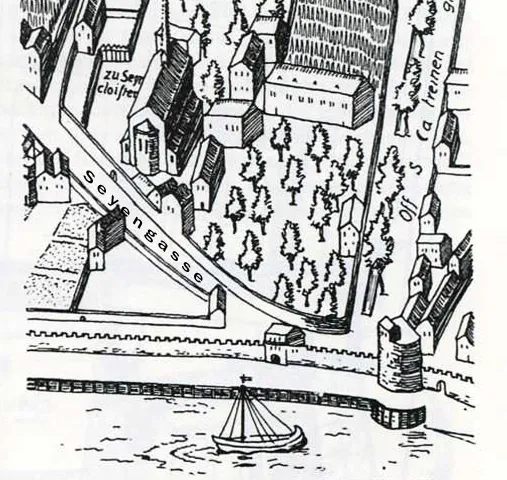
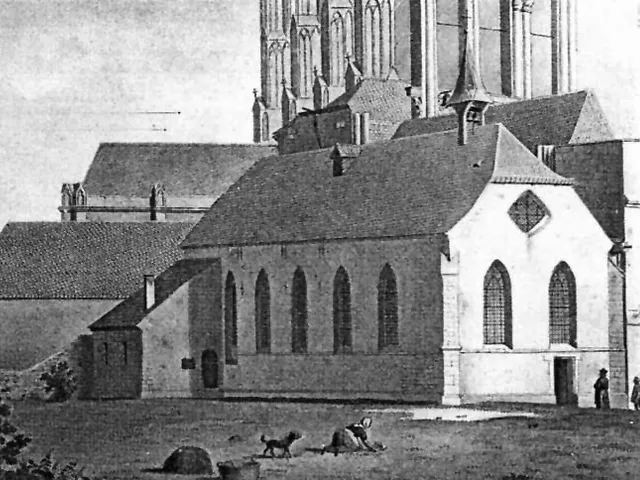
East of Cologne Cathedral, between the cathedral and the Rhine, once stood the Romanesque collegiate church of St. Maria ad Gradus ('Mary of the Steps', popularly known as St. Mariengraden). It had its own immunity precinct and has since vanished without trace.
Source: Wikipedia
At a Glance
- Type
- Former Romanesque collegiate church with its own immunity precinct
- Location
- Altstadt-Nord, between the Cathedral and the Rhine
- Completion
- presumably around 1062
- Dimensions
- approx. 55 m long, 42 m wide
- Form
- Two-choir basilica with west and east transepts
- Founder
- Archbishop Hermann II
- Demolished
- 1817
Of the entire collegiate church of St. Maria ad Gradus, only a single column with capital survives today – it stands at the east choir of Cologne Cathedral and is known as the 'Domsäule', the last visible remnant of a church that once measured 55 metres in length before being demolished in 1817.
Age comparison
Age compared with other places in Cologne.
History
The church arose on the site of a baptistery belonging to the cathedral. Archbishop Anno II confirmed by charter in 1075 that the collegiate foundation had been built according to Hermann's plans and at his expense; construction had already begun under Hermann himself. The translation of the relics of St. Agilolph marked its approximate completion around 1062. In 1085 the church fell victim to fire, was subsequently rebuilt, and later extended in the Gothic style.
Connection to the Cathedral
A double arcade, open towards the interior, connected the building directly to the cathedral. The two transepts were situated to the west and east of the nave.
Dissolution and Demolition
In 1794 the French occupied the Rhineland, and in the aftermath collegiate foundations and monasteries were dissolved. Unlike elsewhere, this church could not be saved by a parish community: Groß St. Martin, the Cathedral, and St. Andreas stood too close together, making an additional parish church superfluous. Used briefly as a warehouse, the building was demolished in 1817; when the Cathedral mound was levelled in 1827, even the foundations were lost.
What Survived
A single column with its capital from the former arcade — the so-called Cathedral Column (Domsäule) — still stands at the east choir of the Cathedral, the sole physical remnant of the building. Until 1817 the church held the remains of Blessed Richeza, Queen of Poland and granddaughter of Emperor Otto II and Theophanu; these were transferred to the Cathedral, as were the Altar and Shrine of St. Agilolph. A crucifix from the workshop of Master Tilman went to the parish church of St. Lambertus in Bliesheim. Two manuscripts survive elsewhere: a Gospel Book (Ms. 1a) in the Diocesan Library of Cologne and the Richeza Gospel Book (Ms. 544) in the State and University Library of Darmstadt.
The Scattered Bells
At least three bells were in place at the time of demolition. A bell dedicated to the Mother of God and All Saints, cast in 1356 with a diameter of 1.17 metres, was transferred to St. Mauritius in Bachem, where it is preserved to this day. Two further bells, cast in 1416 and 1424 by Christian Duisterwalt and likewise dedicated to the Mother of God, were rehung at St. Peter; the smaller of the two survived the Second World War and was welded in 1960.
Timeline
- um 1062Construction completed; relics of St. Agilolf transferred
- 1075Charter of Archbishop Anno II confirms foundation by Hermann II
- 1085Church burns down; subsequently rebuilt
- 1356Bell dedicated to the Virgin Mary cast (diameter 1.17 m)
- 1794French occupation: collegiate foundation dissolved
- 1817Church demolished; relics of Richeza transferred to Cologne Cathedral
- 1827Foundations lost during removal of the cathedral mound
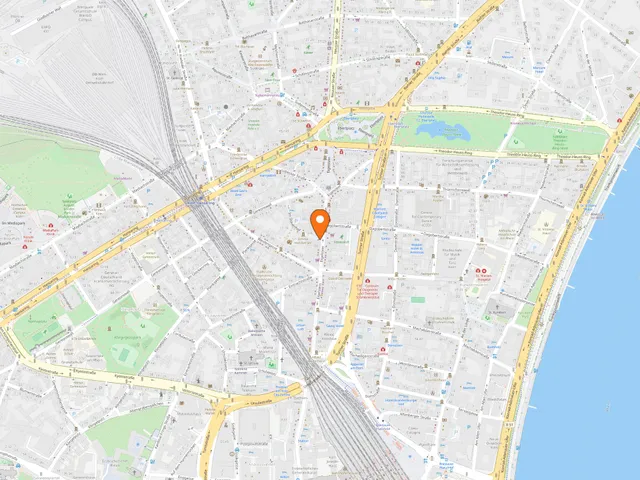
Map
Blue dots: other places nearby — tap to explore.
You might also like — related or nearby
Comments
- Loading comments…
Sources & links
Auto-generated, last verified: 2026-06-27
How this page is made
This page draws on open sources — Wikipedia, Wikidata, official websites and the city’s open data. Every statement is checked against the sources linked here, and pages are refreshed regularly.
Spotted a mistake anyway? Tell us below — we read every submission.