St. Maria Ablass
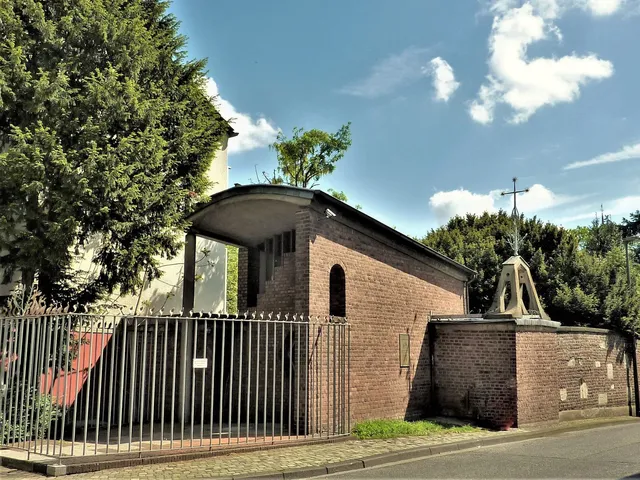
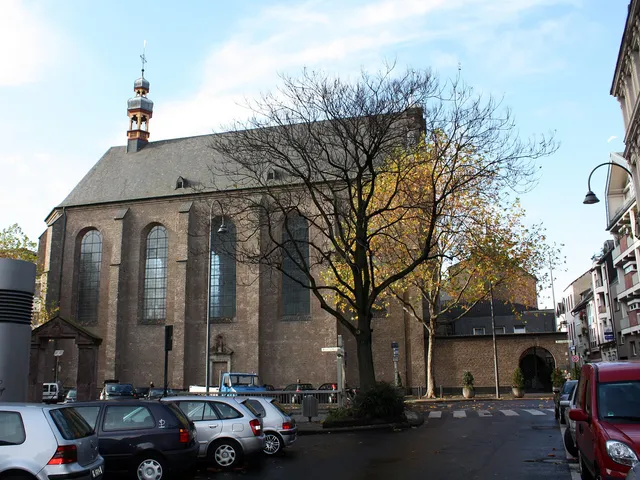
Of the demolished parish church of St. Maria Ablass, only the chapel of grace survives — today the Russian Orthodox Church of Saints Constantine and Helena.
since 1431
Of the medieval church of St. Maria Ablass in Cologne's Altstadt-Nord, only a small chapel of grace has survived, now serving the Russian Orthodox community.
At a Glance
- Type
- Preserved chapel of grace of a demolished parish church
- Location
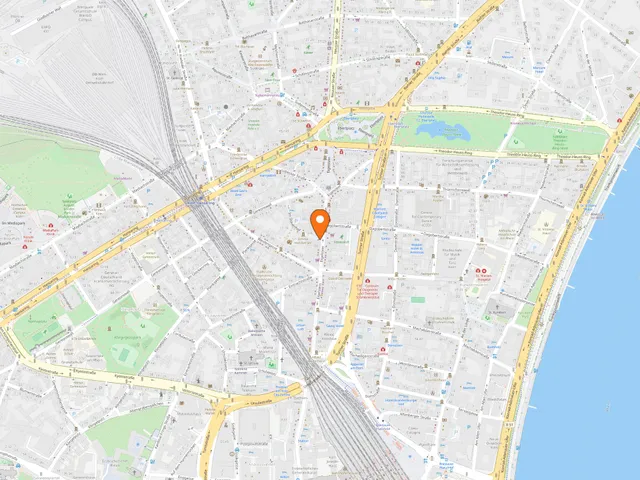
- Altstadt-Nord district, Innenstadt borough
- First mentioned
- 927 as a Marian church
- Chapel
- Extension built around 1431, first mentioned in 1528
- Architecture
- Three-bay, cross-ribbed vaulted chapel with ridge turret
- Current use
- Church of Saints Constantine and Helena (Russian Orthodox community)
- Listed status
- Listed building and cultural monument in North Rhine-Westphalia
The Maria-Ablass Chapel was originally built around 1431 for one sole purpose: to protect a Marian fresco on the church's outer wall from the weather – from this simple shelter grew the devotional chapel that still stands today.
Age comparison
Age compared with other places in Cologne.
From Parish Church to Chapel
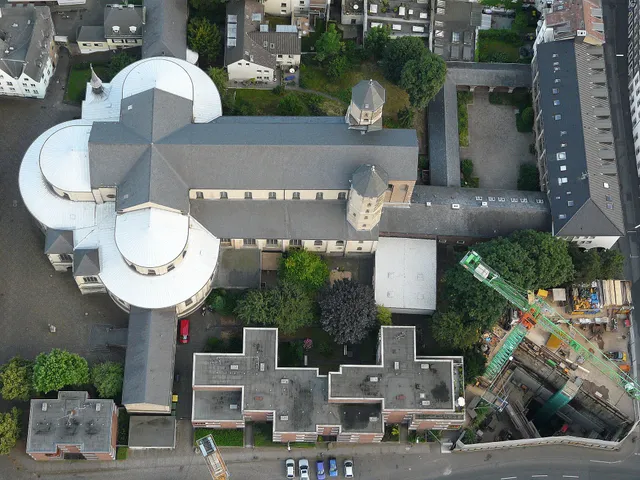
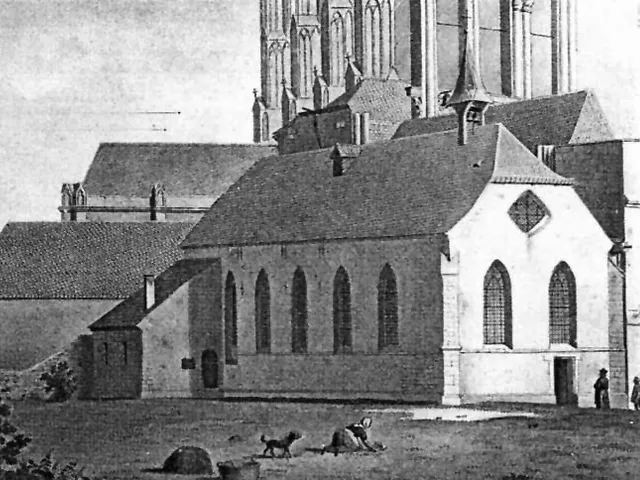
The original church was a three-aisled basilica with a square western tower in the northern suburb of Niederich. In 927, Archbishop Wichfrid of Cologne donated the Marian church to the women's collegiate church of St. Ursula, founded in 922; it remained its parish church until 1804. During the secularisation and dissolution of the collegiate chapter, it was demolished in 1808. Over the centuries it bore various Latin names, including around 1300 the "Church of St. Mary of the Indulgence."
The Name and Its Origin
The name recalls a Cologne episcopal tradition: every Palm Sunday, a procession wound between the cathedral and St. Gereon. After the blessing of the palms, it entered the Marian church, where a sermon was preached before a venerated image of Mary and the associated indulgence (Ablass) was proclaimed — before the procession continued to High Mass at the cathedral.
The Chapel
The extension on the north side of the parish church was built to shelter a Marian fresco on the outer wall from the weather; from this grew the surviving chapel of grace. After the demolition of the parish church, its remaining outer wall became the chapel's south wall. The slate-roofed building with a ridge turret is three-bayed with cross-ribbed vaulting; three Gothic windows on the north side admit daylight. In the 19th century, the west front received a Neo-Gothic façade by Cologne architect Vincenz Statz, the remains of which were cleared in 1945. Since then, the plain west wall has been centred on the surviving Renaissance portal of 1687.
The Icon and Current Use
The Marian image, restored several times, was reworked after the Second World War by Cologne artist Rita Paasche-Hecker. The interior has remained largely unchanged; only the altar stone was repositioned and the furnishings adapted to the Orthodox rite. A painted panel from the 18th century depicts the legend of Bruno, Knight of Mauenheim, who according to tradition was captured as a crusader in the 13th century and freed by the Virgin Mary — upon his return, he prayed before the image and hung his leg-iron beside it.
Timeline
- 922Foundation of the collegiate church of St. Ursula in Cologne
- 927First documented mention: donation of the church to St. Ursula
- 1172Mentioned again as "s. Marie prope virgines"
- um 1220Name "eclesia beate dei genitricis Mariae" documented
- um 1300Renamed "eclesia s. Marie ad indulgentiam"
- um 1431Chapel annex built to protect the Marian fresco
- 1528First documented mention of the votive chapel
- 1808Parish church demolished following secularisation
Gallery
Map
Blue dots: other places nearby — tap to explore.
Address
Maria-Ablaß-Platz 14
50668 Köln
Hours
Sa: 09:30–12:00
Sa: 17:00–18:30
So: 09:00–13:00
Contact
You might also like — related or nearby
Comments
- Loading comments…
Sources & links
- Official website
- Official website (retrieved 2026-07-19)
- Wikidata (retrieved 2026-06-26)
- Wikipedia (retrieved 2026-06-26)
- offenedaten-koeln.de (retrieved 2026-06-30)
Auto-generated, last verified: 2026-06-27
How this page is made
This page draws on open sources — Wikipedia, Wikidata, official websites and the city’s open data. Every statement is checked against the sources linked here, and pages are refreshed regularly.
Spotted a mistake anyway? Tell us below — we read every submission.