St. Maria in Lyskirchen
The smallest of Cologne's twelve great Romanesque churches — the only one with largely intact 13th-century vault frescoes.
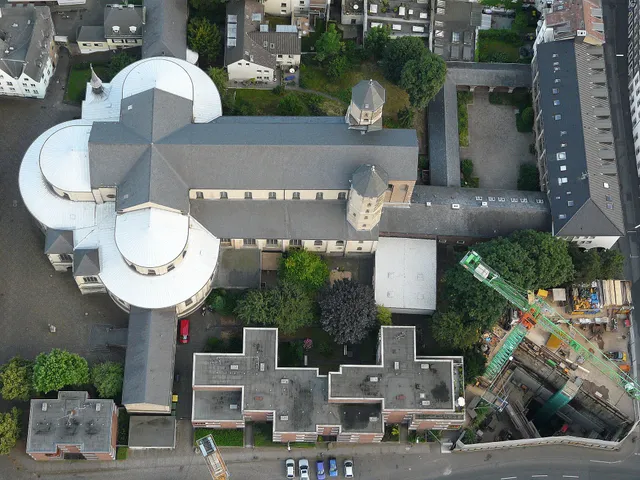
St. Maria in Lyskirchen is the smallest of Cologne's twelve great Romanesque churches. This Catholic parish church stands in the Altstadt-Süd district close to the Rhine and is unique among the twelve for its largely intact vault frescoes from the 13th century.
At a Glance
- Type
- Roman Catholic parish church, Archdiocese of Cologne
- Location
- Altstadt-Süd, Innenstadt district, near the Rhine
- Address
- An Lyskirchen 10, 50676 Cologne
- Construction of present form
- between 1198/1200 and 1225
- Architectural type
- three-aisled gallery basilica, modelled on St. Kunibert
- Distinctive feature
- the only one of the twelve great Romanesque churches with largely intact 13th-century vault frescoes
- Listed status
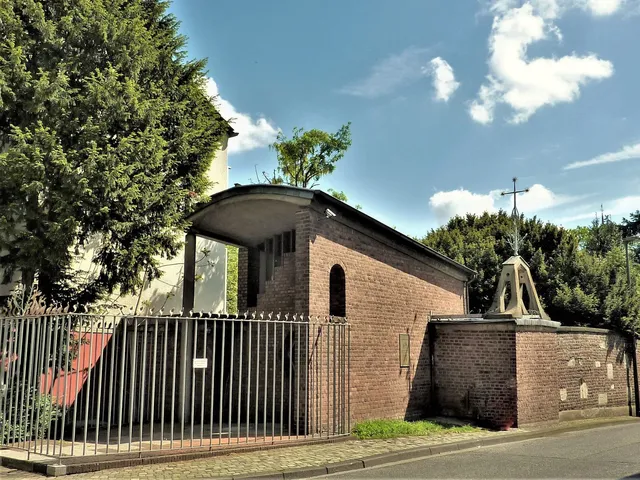
- the church, verger's house and sacristy are all listed monuments
As the smallest of Cologne's twelve great Romanesque churches, St. Maria in Lyskirchen is also the only one to have preserved its 13th-century vault frescoes largely intact.
History
The site was first documented in 948 as a private Marian chapel — a simple hall church, most likely built by a man named Lisolvus or Lysolfus as his own proprietary church; the name "Lyskirchen" evolved from the Old German "Lisolfikyrken". In 1067, Archbishop Anno II incorporated the building into the collegiate church of St. Georg as a parish church under the name St. Maria in Noithusen. The present church was built between 1198/1200 and 1225; before construction, the ground level was raised to counter the constant threat of flooding from the Rhine.
Architecture
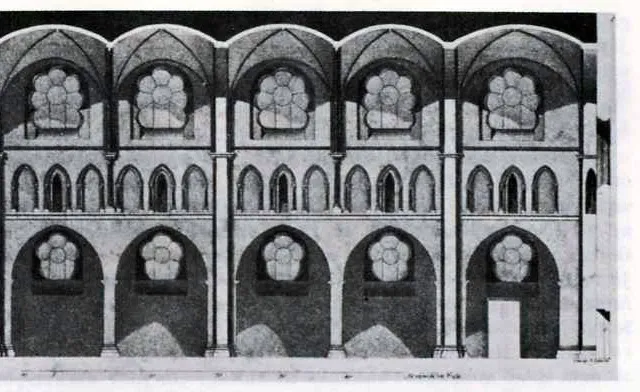
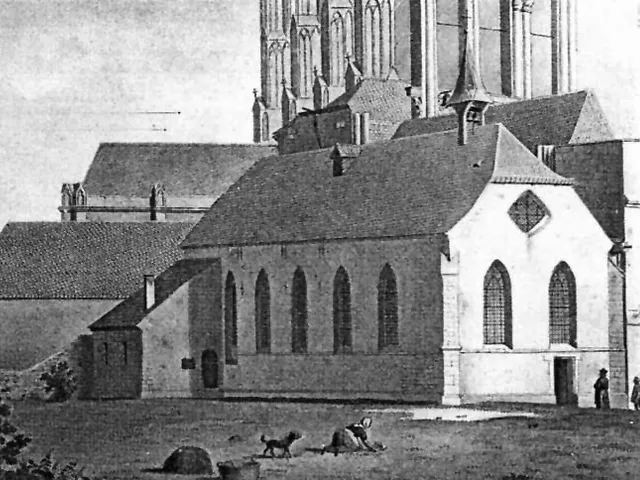
The church was completed as a three-aisled gallery basilica with a slightly irregular floor plan. On the Rhine-facing side it received an east end planned with two towers flanking a central apse, following the model of St. Kunibert and St. Severin. Presumably due to lack of funds, only the north tower was ever finished. Later alterations — notably in the 16th and 17th centuries — changed the windows, vaulting and the shape of the apse.
Significance and Use
Because of its location directly on the Rhine, the church served primarily as a place of worship for Rhine boatmen; it is closely associated with the veneration of the so-called Schiffermadonna (Sailors' Madonna). After the secularisation of the collegiate church of St. Georg, St. Maria in Lyskirchen became an independent parish church in 1804. The name St. Maria in Lyskirchen is documented from as early as 1528.
Timeline
- 948First documented mention as a private Marian chapel (hall church)
- 1067Incorporated into the collegiate church of St. Georg by Archbishop Anno II
- 1198/1200Construction begins on the church in its current form
- um 1225Completed as a gallery basilica with twin-towered east end
- 1528First recorded use of the name 'St. Maria in Lyskirchen'
- 1658–1662Extensive interior renovation; apse raised, gothicising windows inserted
- 1784Flood and ice drift destroy parts of the church furnishings
- 1804Secularisation of St. Georg; St. Maria in Lyskirchen becomes a parish church
Gallery
Map
Blue dots: other places nearby — tap to explore.
Address
An Lyskirchen 10
50676 Köln
Hours
Mo: 10:00–18:00
Di: 10:00–18:00
Mi: 10:00–18:00
Do: 10:00–18:00
Fr: 10:00–18:00
Sa: 10:00–18:00
So: 10:00–16:00
You might also like — related or nearby
Comments
- Loading comments…
Sources & links
- Official website
- Wikidata (retrieved 2026-06-24)
- Wikipedia (retrieved 2026-06-24, rev 264218802)
- Official website (retrieved 2026-06-24)
Auto-generated, last verified: 2026-06-27
How this page is made
This page draws on open sources — Wikipedia, Wikidata, official websites and the city’s open data. Every statement is checked against the sources linked here, and pages are refreshed regularly.
Spotted a mistake anyway? Tell us below — we read every submission.