St. Maria ad Ortum
Lost late-Romanesque convent church of Cologne's Cistercian nuns — the "Mariengarten" community grew from an earlier settlement in the Riehl district.
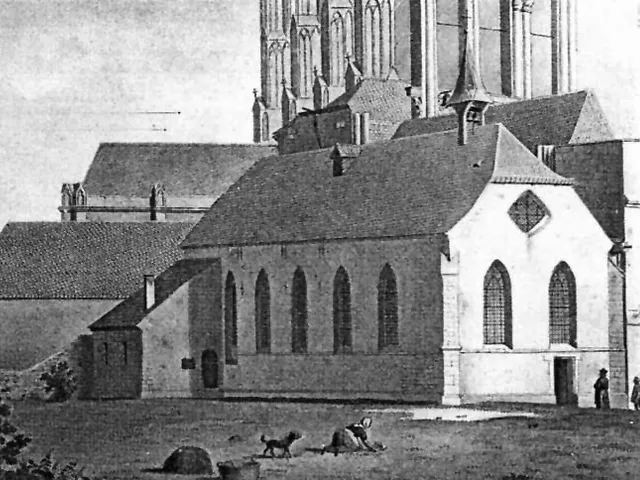
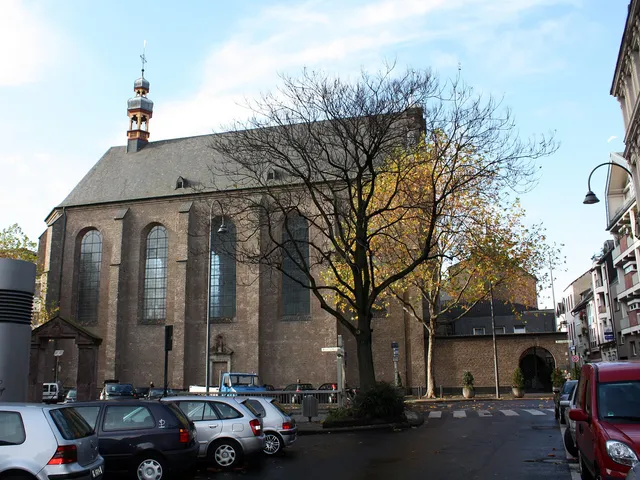
Maria ad Ortum (Latin for "Mary of the Garden") was the convent church of the Cistercian nunnery known as the "Mariengarten" in Cologne's city centre. Founded as a community in Riehl in 1220, the convent later relocated to its garden site near St. Columba's parish; after secularisation, both church and monastery were demolished, leaving behind only a street name and a chapel that still bear the old Latin name.
At a Glance
- Type
- Former church of a Cistercian nunnery
- Location
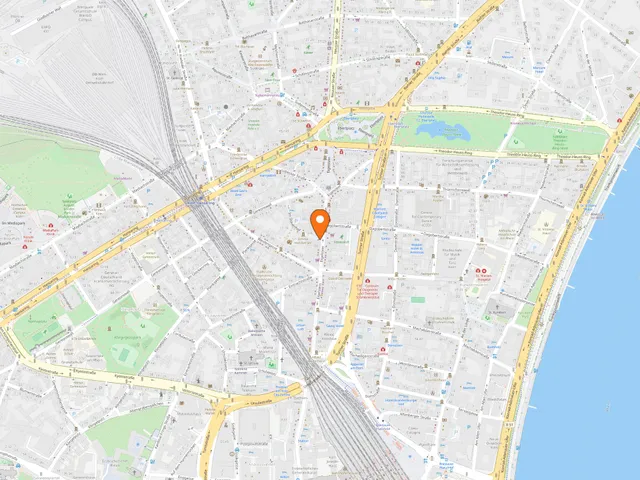
- Cologne, Altstadt-Nord (city centre district), on today's Mariengartengasse
- Origins
- Documented as the convent "de Rile" (Riehl) in 1220; established at the Mariengarten site around 1233
- Church built
- Between 1244 and 1260
- Architecture
- Three-aisled, late Romanesque, with a semicircular choir and ridge turret
- End
- Convent dissolved in 1802; church and buildings demolished after 1805
Just three years after its founding, in 1236, thirty-one nuns left the Mariengarten convent all at once to populate a newly founded Cistercian house nearby in Burbach – a mass exodus that illustrates how overwhelmed the Cologne convent was almost immediately after its establishment.
From Riehl to the Mariengarten
The community first appears in 1220 as the "conventus de Rile"; at the same time, Cologne's property registers mention nuns "of the Mariengarten". Archbishop Engelbert I facilitated their resettlement onto archiepiscopal land in St. Columba's parish, meaning two houses briefly coexisted. Around 1233 the Cistercian nunnery formally constituted itself at the Mariengarten; a register entry from around 1246 confirms that this community had previously been known as "from Riehl" and had been located there.
Setting and Surroundings
The church and convent buildings stood within the Roman city walls, close to a defensive tower of the northern wall known as the "Lysolphturm". Surrounded by orchards and gardens, the complex lay between today's Mariengartengasse and Burgmauer street. The convent's precinct stretched from Röhrergasse and Kupfergasse in the south to An der Burgmauer in the north, bounded by Langgasse to the west. Despite its quiet position on the then-outskirts, the High Street, the city's main markets and Cologne Cathedral were all within easy reach.
History of the Convent
Around 1233 Archbishop Heinrich von Müllenark placed the community under the Abbot General of Cîteaux, granting it the same privileges as a male monastery. Spiritual oversight passed to the father-abbots of neighbouring abbeys — from the sixteenth century onwards consistently to Kamp Abbey. Many of the nuns came from noble, patrician and burgher families, and the convent accumulated considerable wealth through inheritances and donations. In 1236, thirty-one nuns transferred to found the new house of Marienborn in Burbach. In 1244 Pope Innocent IV took the convent under his special protection.
The Late-Romanesque Church
The three-aisled church was built between 1244 and 1260, replacing an earlier small chapel. An indulgence granted by Archbishop Conrad of Hochstaden helped the Cistercian nuns complete the construction. The Counts of Neuenahr, whose manor stood at the corner of Lang- and Schwalbengasse, were among its principal patrons.
Worth Knowing
Around 1323–24, Meister Eckhart very likely preached to the Cistercian nuns of Cologne. Under Abbess Elisabeth Titz the convent was reformed in 1452 and strict enclosure rigorously reinstated.
Timeline
- 1220Monastery first mentioned as 'conventus de Rile'
- 1233Constituted as Cistercian nunnery; incorporated into the Order
- 123631 nuns relocate to the newly founded Marienborn monastery in Burbach
- 1244Pope Innocent IV places the monastery under special papal protection
- 1244–1260Construction of the three-aisled Late Romanesque church Maria ad Ortum
- 1323/24Meister Eckhart probably preaches at the Cologne Cistercian nuns
- 1452Monastery reform under Abbess Elisabeth Titz; enclosure reinstated
- 1802Monastery dissolved as a result of secularization
- nach 1805Church and monastery buildings are demolished
Map
Blue dots: other places nearby — tap to explore.
Address
Burgmauer 28
50667 Köln
You might also like — related or nearby
Comments
- Loading comments…
Sources & links
Auto-generated, last verified: 2026-06-27
How this page is made
This page draws on open sources — Wikipedia, Wikidata, official websites and the city’s open data. Every statement is checked against the sources linked here, and pages are refreshed regularly.
Spotted a mistake anyway? Tell us below — we read every submission.