St. Cäcilien – Museum Schnütgen
One of Cologne's twelve great Romanesque churches — home to the Museum Schnütgen for medieval art since 1956.
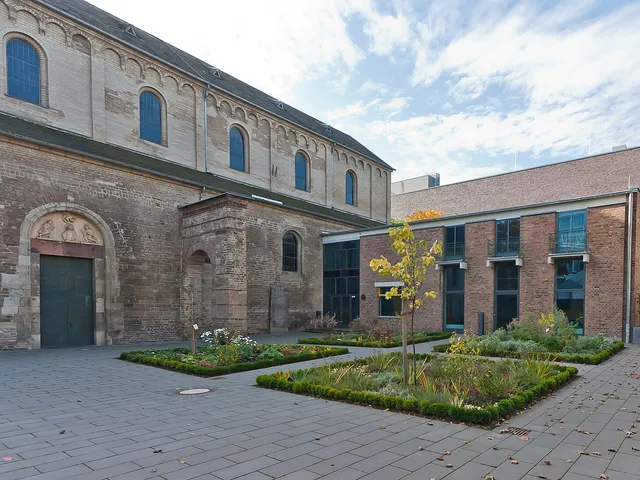
St. Cäcilien is one of Cologne's twelve great Romanesque churches and once served as the place of worship for a women's collegiate foundation. Since 1956 it has housed the city's Museum Schnütgen, dedicated to medieval art.
At a Glance
- Type
- Romanesque collegiate church, now a museum space
- Location
- Altstadt-Süd, Innenstadt district
- Origins
- Women's collegiate foundation, established in the late 9th century
- Architecture
- Towerless three-aisled pier basilica with choir and semicircular apse, no transept
- Named after
- Cecilia of Rome
- Listed status
- Protected monument in North Rhine-Westphalia
- Current use
- Museum Schnütgen (since 1956)
In 1980, the 'Sprayer of Zurich', Harald Naegeli, painted his famous Dance of Death on the church wall – a graffiti so significant it was placed under historic preservation; in 2024, city cleaning crews tasked with removing illegal graffiti accidentally erased nearly the entire protected artwork.
Age comparison
Age compared with other places in Cologne.
History
The site began as a women's collegiate foundation in the late 9th century, named after Saint Cecilia of Rome. For many years it was believed to be the location of Cologne's first cathedral, but excavations disproved this theory and instead uncovered the foundations of a rectangular church likely belonging to the foundation. In 965, Archbishop Bruno bequeathed 50 pounds of silver to the foundation in his will to complete the building. The second Christmas Mass of the Cologne archbishop was celebrated here, after St. Maria im Kapitol. In the 12th century a new Hohenstaufen structure replaced the Ottonian complex, and in 1474 the building passed to the Augustinian nuns of the dissolved convent of Maria zum Weiher.
Architecture
The Hohenstaufen church is a towerless three-aisled pier basilica with a choir and semicircular apse, built without a transept. The southern aisle ends in a rounded apse, while the northern aisle leads into a sacristy added in 1479. The nave is covered by a flat wooden ceiling, and the side aisles are vaulted with cross-groin vaults. Frescoes survive in the choir, though they were badly damaged in the Second World War. The tympanum of 1160, dedicated to Saint Cecilia, can be seen above the north portal as a copy — the original is kept in the museum.
Points of Interest
When the neighbouring monastic buildings were demolished in the 19th century, Cologne's first hospital was built in their place, with St. Cäcilien serving as its church for many years. In 1980 the street artist Harald Naegeli painted his "Dance of Death" on the neo-Romanesque west façade — a work now protected as a listed monument in its own right. Masses are held in the church at Christmas and on the feast day of Saint Cecilia.
Timeline
- 888Foundation of the collegiate church of St. Cecilia (Wikidata building date)
- 965Archbishop Brun bequeaths 50 pounds of silver to complete the church
- 1160Tympanum created in honour of St. Cecilia
- 1474Augustinian nuns of the dissolved Kloster Maria zum Weiher take over
- 1479Sacristy built in place of the original apse
- 1802Secularisation; the convent is dissolved
- 1849Cathedral sculptor Christian Mohr creates the neo-Romanesque west facade reliefs and tympanum
- 1956Museum Schnütgen for medieval art opens in the church
Map
Blue dots: other places nearby — tap to explore.
Address
Cäcilienstraße 29
50676 Köln
Hours
Di: 10:00–18:00
Mi: 10:00–18:00
Do: 10:00–20:00
Fr: 10:00–18:00
Sa: 10:00–18:00
So: 10:00–18:00
You might also like
Comments
- Loading comments…
Sources & links
- Official website
- Wikidata (retrieved 2026-06-24)
- Wikipedia (retrieved 2026-06-24, rev 264208425)
- Official website (retrieved 2026-06-24)
Auto-generated, last verified: 2026-06-27