Museum Ludwig
20th- and 21st-century art on Cologne's Cathedral Plateau — home to Europe's largest Pop Art collection and the world's third-largest Picasso collection.
since 1976
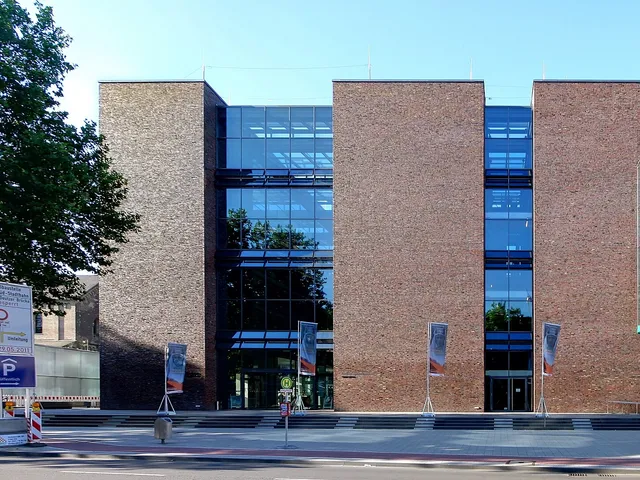
The Museum Ludwig in Cologne is dedicated to twentieth- and twenty-first-century art and ranks among the most significant art museums in Europe. It sits on the Domplatte, southeast of the Cathedral and the main railway station.
At a Glance
- Type
- Art museum for 20th- and 21st-century art
- Location
- Domplatte, Heinrich-Böll-Platz, Altstadt-Nord (Innenstadt district)
- Exhibition space
- approximately 9,000 m²
- Photography collection
- around 70,000 works
- Named after
- Peter and Irene Ludwig
- Building complex
- also houses the Kölner Philharmonie, the Kunst- und Museumsbibliothek, and Filmforum NRW
The Museum Ludwig holds the third-largest Picasso collection in the world – and remarkably, the works donated by Peter and Irene Ludwig were originally intended only as long-term loans before the city of Cologne decided to establish a dedicated museum around them.
Things to do here
- Discover Europe's largest Pop Art collection
- Marvel at works by Picasso from the world-famous collection
- Stroll through the halls of 20th- and 21st-century art
- View historic photographs from the vast image collection
- Photograph the striking architecture on the Domplatte
Age comparison
Age compared with other places in Cologne.
The Collections
The museum brings together several major strengths under one roof. These include Europe's largest Pop Art collection and the world's third-largest Picasso collection. The holdings also span German Expressionism, key works of the Russian avant-garde, and a photography archive of around 70,000 works.
History
The museum's origins lie in an Expressionist collection donated by Cologne citizen Josef Haubrich, which entered the Wallraf-Richartz-Museum and gradually grew to encompass more twentieth-century works. When collectors Peter and Irene Ludwig gifted the city around 350 works — predominantly Pop Art — Cologne decided under director Gerhard Bott to establish a dedicated museum for twentieth-century art. The plan called for two collections under one roof in a shared new building between the Cathedral and the Rhine. Later donations added Russian avant-garde works and several hundred Picassos, initially as long-term loans. The museum's former premises now house the Museum für Angewandte Kunst.
Urban Context
The new building was also intended to solve an urban planning problem: a gap had formed between the edge of the Domplatte and the Rhine waterfront road, an idle space used as a bus depot. By concentrating cultural institutions here, the city aimed to activate the area — giving rise to the idea of a complex combining two museums and a concert hall, which is why the museum, the Kölner Philharmonie, the Kunst- und Museumsbibliothek, and Filmforum NRW all share a single building today.
Architecture and Design Competition
In 1974 the city launched an ideas competition for the area between the Cathedral and the main railway station. The field was broad: international architects such as James Stirling were specially invited alongside Cologne-based figures including Gottfried Böhm and Oswald Mathias Ungers. From 63 submitted entries, the jury chaired by Rudolf Hillebrecht reached its decision in January 1976. First prize went to the design by Cologne architects Busmann + Haberer — a scheme reinstated into the competition at the urging of Arnold Wolff and awarded unanimously. Construction followed in the years after 1976.
Timeline
- 1974Competition brief issued for "Dom–Hauptbahnhof area / Wallraf-Richartz new building"
- 1975Gerhard Bott takes office as director; city launches architectural ideas competition
- Januar 1976Competition decided: Busmann + Haberer awarded first prize
- 1976Museum Ludwig opens
Gallery
Map
Blue dots: other places nearby — tap to explore.
Address
Heinrich-Böll-Platz
50667 Köln
Hours
Di: 10:00–18:00
Mi: 10:00–18:00
Do: 10:00–18:00
Fr: 10:00–18:00
Sa: 10:00–18:00
So: 10:00–18:00
You might also like — related or nearby
Comments
- Loading comments…
Sources & links
- Official website
- Official Instagram (@museumludwig)
- Wikidata (retrieved 2026-06-23)
- Wikipedia (retrieved 2026-06-23, rev 267912073)
- Official website (retrieved 2026-06-23)
Auto-generated, last verified: 2026-06-26
How this page is made
This page draws on open sources — Wikipedia, Wikidata, official websites and the city’s open data. Every statement is checked against the sources linked here, and pages are refreshed regularly.
Spotted a mistake anyway? Tell us below — we read every submission.