Römerbrücke
The first permanent bridge across the Rhine near Cologne — built under Emperor Constantine I from 310 AD, at the site of today's Deutzer Brücke.
since 310
The Römerbrücke was the first permanent bridge across the Rhine in the area of present-day Cologne. Built under Emperor Constantine I by the Legio XXII Primigenia, it is also commonly known as the Constantine Bridge or Constantinian Bridge.
Source: Wikipedia
At a Glance
- Type
- Roman Rhine bridge
- Built
- Construction began 310 AD, by the Legio XXII Primigenia
- Commissioner
- Emperor Constantine I
- Construction
- 19 masonry piers with timber frames spanning between them
- Dimensions
- Superstructure just over 400 metres long, roadway approximately 11 metres wide
- Location
- In the area of today's Deutzer Brücke, Deutz district
- Finds
- Pile remains and a reconstruction on display at the Romano-Germanic Museum
The Roman bridge, stretching roughly 400 metres across 19 stone piers, was the very first permanent crossing of the Rhine at this location – and its construction served primarily to build a fortress deep in Frankish enemy territory, deterring attacks even before the bridge was finished.
Length comparison
Length compared with other Cologne bridges.
Age comparison
Age compared with other places in Cologne.
Origins
That construction began in 310 AD can be inferred from a speech by Eumenius in Trier in honour of Constantine. Preliminary confirmation came from the outermost tree rings of eight heavy oak piles now on display at the Romano-Germanic Museum. Alongside oak, the Romans also used fir and beech timber in the bridge's construction.
Construction
Fifteen of the river piers have been archaeologically confirmed through excavated pile remains. The foundations consisted of oak piles driven deep into the riverbed, with the gaps filled with mortar and stone. A ship passage and a central bridge tower are mentioned in historical descriptions but have not been confirmed by archaeological finds.
Purpose and Location
The bridge connected the left-bank city near today's Salzgasse with the right bank at the site of the present-day Lanxess Tower, and thus with the Roman bridgehead fort Castrum Divitia, completed between 312 and 315 AD. Its primary purpose was to allow rapid troop movements across the Rhine, as Frankish forces were threatening Roman territory from the right bank.
Worth Knowing
When exactly the bridge was demolished remains unclear. One theory suggests it stood for only around 100 years; other accounts point to demolition around 960 AD, while its timber construction also makes gradual decay from around 400 AD a plausible scenario.
Timeline
- 310 n. Chr.Construction of the Roman bridge begins under Emperor Constantine I.
- 312–315 n. Chr.Completion of the right-bank Roman fort Castrum Divitia
- um 400 n. Chr.Possible decay of the bridge's timber structure
- um 960 n. Chr.Possible demolition of the bridge according to some sources
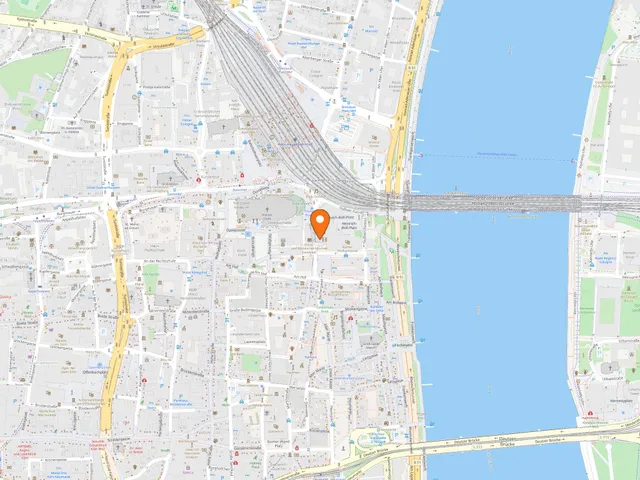
Map
Blue dots: other places nearby — tap to explore.
You might also like — related or nearby

Comments
- Loading comments…
Sources & links
Auto-generated, last verified: 2026-06-27
How this page is made
This page draws on open sources — Wikipedia, Wikidata, official websites and the city’s open data. Every statement is checked against the sources linked here, and pages are refreshed regularly.
Spotted a mistake anyway? Tell us below — we read every submission.