Thurner Hof
A historic manor farm in Cologne-Dellbrück with a 16th-century timber-framed manor house and a freely accessible teaching garden.
since 1150
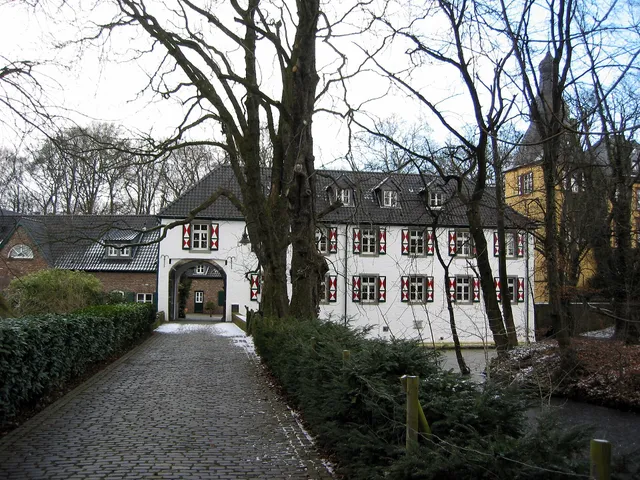
The Thurner Hof is a former manor farm and knight's seat in the Dellbrück district of Cologne. The complex includes a timber-framed manor house, a four-winged courtyard, a corner tower and a publicly accessible teaching garden.
At a glance
- Location
- Cologne-Dellbrück, on the Strunde stream
- Period
- manor house probably late 16th century (timber-frame)
- Owner
- owned by the City of Cologne since 1911
- Current use
- adult-education (VHS) outpost, riding stables, teaching garden
- Garden
- around 7,200 m² with a cottage garden, moat and orchard meadow
- Access
- the garden is open to all visitors
- Highlight
- hosts Cologne's annual plant-swap market on the first Sunday in May
Age comparison
Age compared with other places in Cologne.
History
The name "Thurn" derives from an Old High German word for tower and points to the site's origins as a motte. The earliest known owner is Heinrich von Thurn, around 1150. The land register of St. Pantaleon's Benedictine abbey records a Thurner mill in 1322 and 1324. Ownership and tenancy changed hands repeatedly over the centuries, involving families such as von Quadt zu Haus Buschfeld, von Brambach, von Hatzfeld and von der Leyen. In 1627 Adolf von Quadt had the surviving courtyard gate built, bearing the Quadt-Pallant alliance coat of arms. The estate passed to the Neuhöffer family in 1818 before the City of Cologne acquired it in 1911.
Manor house & architecture
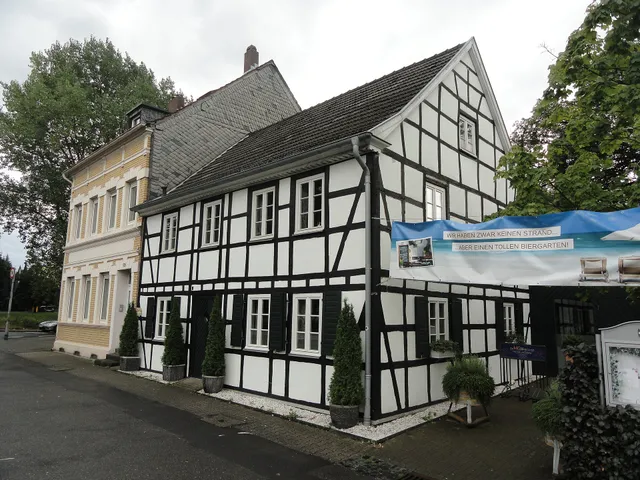
The former manor house was probably built in the late 16th century. On a partly sunken, stone-vaulted base storey rises a two-storey timber-framed post construction with a steep, slate-covered gable roof, accessed from the north by an external staircase. Its post frame is built without diagonal bracing — a technique typical of the large timber-framed houses of the Bergisches Land in the 16th and 17th centuries, but otherwise unique within Cologne's city area. The building was first restored around 1958/59, converted into a VHS outpost between 1972 and 1979, and refurbished again from 2010 to 2017 as part of the "Win-Win für Köln" programme.
Garden
A garden of around 7,200 m² surrounds the courtyard to the east and south. It serves as a teaching garden for the adult education centre and is tended on a voluntary basis by the VHS organic-garden working group. Its heart is the cottage garden, with box-edged beds arranged around an old pear tree, where old-fashioned ornamentals such as pasque flower, red foxglove and columbine grow alongside almost-forgotten crops like orache, parsnip and Jerusalem artichoke — some cultivated as teaching examples of different growing methods. The ecological centrepiece is the re-flooded historic moat: varying water depths and an adjoining dry-stone wall created a habitat for aquatic and marsh plants such as yellow and white water lilies, as well as grass frogs, dragonflies, kingfishers and herons. The largest area is taken up by the orchard meadow, where old regional apple varieties such as the Rheinischer Bohnapfel and Rheinischer Krummstiel grow beside plums, cherries and medlars.
Beekeeping
A beekeeping working group runs an apiary on the orchard meadow. The stand comprises up to 20 colonies, seven of which are cared for by participants in VHS courses.
Current use
Today the estate serves several purposes: the manor house is an outpost of the Cologne adult education centre, while the farm buildings house the stables of the Kornspringer Köln riding club, which also uses the corner tower. The garden is freely accessible and is opened up to the public through courses and events such as the annual plant-swap market.
Gallery
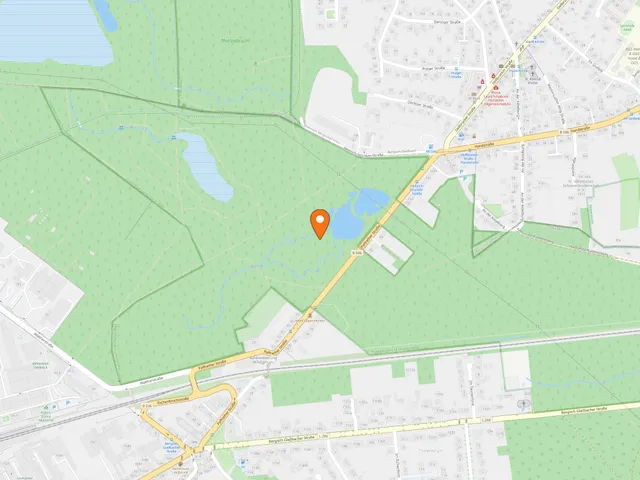
Map
Blue dots: other places nearby — tap to explore.
You might also like — related or nearby
Comments
- Loading comments…
Sources & links
- Official website
- Official website (retrieved 2026-08-10)
- Wikipedia (retrieved 2026-08-10, rev 248683903)
- Wikidata (retrieved 2026-08-10)
Auto-generated, last verified: 2026-08-10
How this page is made
This page draws on open sources — Wikipedia, Wikidata, official websites and the city’s open data. Every statement is checked against the sources linked here, and pages are refreshed regularly.
Spotted a mistake anyway? Tell us below — we read every submission.