Deutz Gas Engine Factory
On this historic industrial site in Cologne-Mülheim, regarded as the „birthplace of global motorisation“, the raum13 cultural initiative is now at work – amid listed buildings such as the Möhring Pavilion at the Mülheim harbour.
since 1864
The Deutz Gas Engine Factory (Gasmotorenfabrik Deutz) is a historic company and industrial site in Cologne-Mülheim that is described as the „birthplace of global motorisation“. As the eponymous predecessor of today's Deutz AG, the location remains a landmark of the city's industrial history.
Source: Wikipedia
At a Glance
- Founded
- 1864, built at this location from 1867 onwards
- Location
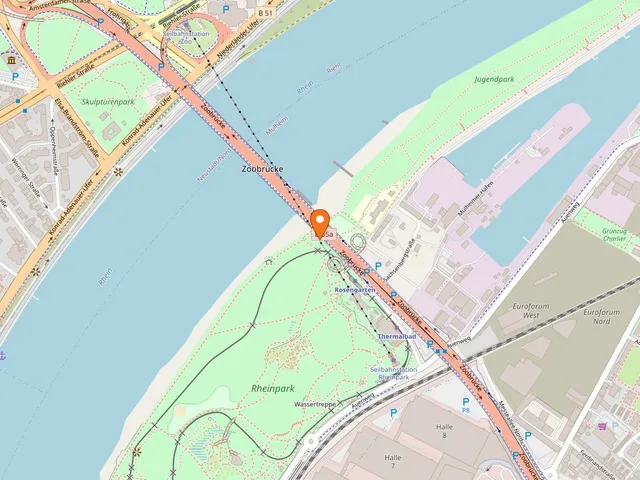
- Cologne-Mülheim, between Auenweg and Deutz-Mülheimer Straße near the Mülheim harbour
- Significance
- eponymous predecessor of Deutz AG, today based in Cologne-Porz
- Corporate history
- part of the Klöckner-Humboldt-Deutz group from 1959 to 1997
- Architecture
- Möhring Pavilion (Bruno Möhring), small-engine assembly halls, administration building bearing the letters G.F.D.
- Use today
- „raum13/Deutzer Zentralwerk der Schönen Künste“
- Access
- open to the public on occasion, including the Day of the Open Monument (Tag des offenen Denkmals)
- Status
- parts of the site are heritage-listed
Age comparison
Age compared with other places in Cologne.
History and Founding
The factory was founded in 1864 and built at its Mülheim location from 1867 onwards. It is the eponymous predecessor of Deutz AG, today based in Cologne-Porz. From 1959 to 1997 the works belonged to the Klöckner-Humboldt-Deutz group. From the 1990s the plant was gradually shut down, and the site passed into the ownership of the State of North Rhine-Westphalia.
Location and Factory Grounds
The original factory grounds lie in the south of Mülheim between Auenweg and Deutz-Mülheimer Straße near the Mülheim harbour, with the main façade running along Deutz-Mülheimer Straße. Around 1880 the land east of the street was also developed; around 1890 a hall complex for small-engine construction was built there, later followed by the halls for large-engine construction with the striking rounded north gable that bore the company name.
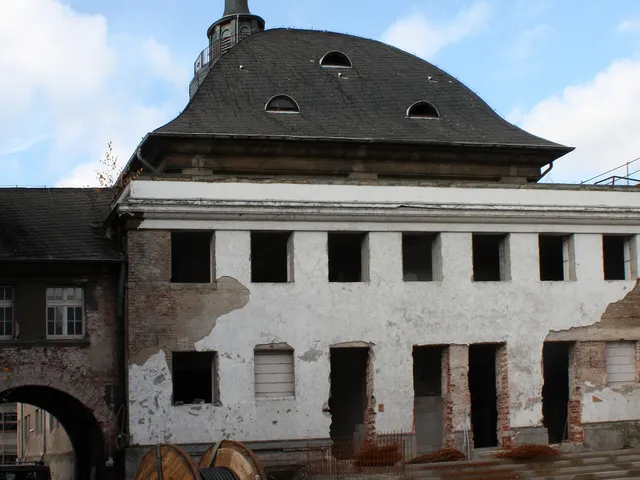
Of the original buildings from the 1860s and 1870s, probably nothing survives above ground after the redevelopment from 1890 onwards; part may have been incorporated into the administration building erected from 1890 in the northern area. On the closed south side of a rear wing, the masonry still shows the large letters G.F.D. for Gasmotorenfabrik Deutz. The elaborate roof and gable landscape was likely lost in the Second World War or during the subsequent reconstruction.
Architecture and Heritage Buildings
To the north, the former administration adjoins a two-storey, elongated screen building with large-scale vertical articulation, built around 1911 to conceal the foundry complex behind it. At roughly the same time, the still-surviving small-engine hall complex was built east of Deutz-Mülheimer Straße, consisting of a raised central hall and shed halls on both sides, each with four aisles.
After the 1902 Düsseldorf Industrial and Trade Exhibition, the factory's exhibition pavilion – an annex of the GHH pavilion – was re-erected south of the small-engine works near Auenweg. Both structures were designed by Bruno Möhring and built in the steel-construction workshop of the Gutehoffnungshütte in Oberhausen-Sterkrade under Reinhold Krohn. The Möhring Pavilion is clearly visible from the Mülheim harbour and once bore the company name on its gable end. Around 1910 the grounds of the first factory were built over with a new foundry, into which the Möhring Pavilion was also incorporated.
Present and Future Use
Today the block along Deutz-Mülheimer Straße, owned by a property developer, is used as „raum13/Deutzer Zentralwerk der Schönen Künste“ and is opened to the public on various occasions, including the Day of the Open Monument. As part of an urban-design ideas competition held by the City of Cologne, the site together with the Mülheim harbour was newly planned by two teams of architects and landscape planners. The heritage-listed buildings – the Möhring Pavilion and the block along Deutz-Mülheimer Straße including the old administration building – are to be integrated and repurposed.
Gallery
Map
Blue dots: other places nearby — tap to explore.
Address
Deutz-Mülheimer Straße
Köln
You might also like — related or nearby
Comments
- Loading comments…
Sources & links
Auto-generated, last verified: 2026-08-04
How this page is made
This page draws on open sources — Wikipedia, Wikidata, official websites and the city’s open data. Every statement is checked against the sources linked here, and pages are refreshed regularly.
Spotted a mistake anyway? Tell us below — we read every submission.