Pfaffenpforte (North Gate)
Cologne's Roman north gate – once a three-arched main entrance, today preserved as a fragment on the Domplatte and in the Roman-Germanic Museum.
since 100
The Pfaffenpforte, also known as the North Gate, was one of Cologne's most important Roman city gates and stood between what are now the streets Unter Fettenhennen and Burgmauer in the Altstadt-Nord district. Its southern counterpart in the Roman city wall was the Hohe Pforte.
At a Glance
- Location
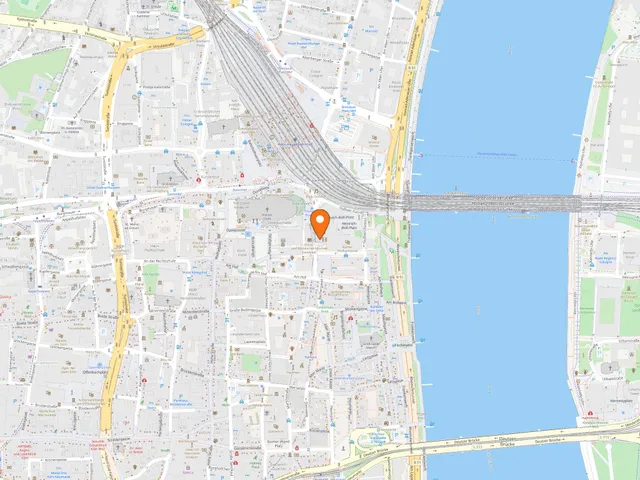
- Altstadt-Nord, Unter Fettenhennen / Burgmauer, at the edge of today's Domplatte
- Date of construction
- disputed – much points to the Flavian period (around AD 50–90), while some evidence suggests the 3rd century
- Design
- three-arched gate structure, roughly 30.50 m wide and 11.60 m deep, with two square towers (each 7.60 m per side)
- Function
- the city's main entrance; the Cardo Maximus ran through the central passage towards Novaesium (Neuss)
- Origin of the name
- named after the "Pfaffen" (cathedral clergy) who visited the cathedral – meant positively at the time
- Current state
- one surviving side passage (a replica) stands on the Domplatte; original fragments are held in the Roman-Germanic Museum
Age comparison
Oldest place in this comparison
Age compared with other places in Cologne.
History and Structure
The North Gate was a mighty, tunnel-like structure: the central passage was over 11 metres long, around 5.60 metres wide and designed for wagons as well as entire troop units. Two narrower side passages, each 1.90 metres wide, were reserved for pedestrians. The gate was built from Roman lime mortar and dressed stone of basalt, trachyte, greywacke and limestone; reconstructed, it reached a height of 27.50 metres up to the ridge of the roof.
The central arch spanning the gate could be reconstructed. In the 3rd century, the letters CCAA (Colonia Claudia Ara Agrippinensium) were subsequently chiselled into the archivolt on its northern side. Fluted pilasters framed the passages, remains of which are still visible on the surviving side gate. A groove on the western side of the gate remnant shows where the portcullis of the central passage hung – evidence that the gate had two storeys. Officially it was called "Porta clericorum" or "Porta paphia", the latter pointing to a veneration of the goddess Venus.
The Legend of the Fight with the Lion
Above the gate is a lion's head that recalls a Cologne legend. According to it, in the year 1262 Mayor Hermann Gryn was to be thrown to a lion to be devoured, at the instigation of two cathedral canons of Archbishop Engelbert II of Falkenburg. Gryn, however, killed the beast. When the future King Rudolf I came to Cologne the next day and learned of this, he had the two canons hanged from a beam of the Pfaffenpforte. The tale stands as a symbol of the long conflict between the city and the archbishop. Only after this episode did the name "Pfaffenpforte" become established – first recorded in writing in the Koelhoff Chronicle of 1499, while Arnold Mercator's city view of 1570 lists it as "Paffen pforts".
Alterations and Demolition
As early as around 1076 the gate was built over with a solarium – a sun terrace with an oriel window – and the adjoining medieval cathedral deanery altered it further over the centuries; renovations are documented for 1606, 1616 and 1621. The North Gate remained largely intact until 1657, with the central arch continuing to serve as a passageway, though no longer as a city entrance. As the surroundings of the cathedral were cleared and the street Unter Fettenhennen was widened, the structure was demolished from 1826 onwards.
The Fate of the Remains
After the demolition, the components went their separate ways. The land-side main gate arch passed into the Wallraf Museum in 1827, was built into a school wall on Pipinstraße from 1883 and even survived the destruction of the school in the Second World War; since March 1974 these original fragments have been on display in the Roman-Germanic Museum. The eastern side arch – the pedestrian gate – was rediscovered in 1892, first relocated in 1896 and later returned to a site near its original findspot.
Today
A surviving part of the gate stands as a replica on the Domplatte, right next to Cologne Cathedral, giving a sense of the scale of the Roman structure. The associated original fragments are shown in the nearby Roman-Germanic Museum. The foundations of the North Gate have survived to this day at their original location – they now lie in the underground car park beneath the Domplatte.
Gallery
Map
Blue dots: other places nearby — tap to explore.
You might also like — related or nearby
Comments
- Loading comments…
Sources & links
- Official website
- Official website (retrieved 2026-08-13)
- Wikidata (retrieved 2026-08-12)
- Wikipedia (retrieved 2026-08-12)
Auto-generated, last verified: 2026-08-12
How this page is made
This page draws on open sources — Wikipedia, Wikidata, official websites and the city’s open data. Every statement is checked against the sources linked here, and pages are refreshed regularly.
Spotted a mistake anyway? Tell us below — we read every submission.