St. Kunibert
Youngest of Cologne's twelve Romanesque churches — with original 13th-century windows preserved in wartime storage, rising just north of the Cathedral.
since 1215
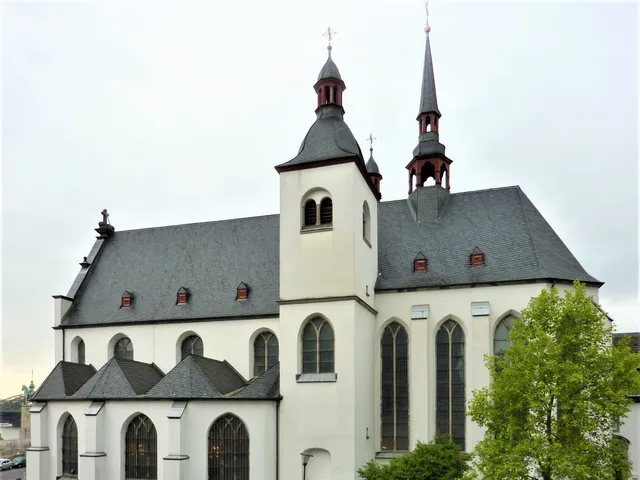
St. Kunibert stands near the Rhine in Cologne's northern old town and is one of the city's twelve Romanesque churches. It takes its name from Kunibert of Cologne, who according to legend founded a church on this site and was buried here.
At a Glance
- Type
- Romanesque collegiate church, three-aisled basilica
- Location
- Altstadt-Nord, inner city district, near the Rhine
- Style
- Romanesque architecture
- Highlight
- Original windows from the early 13th century (c. 1230)
- Protection
- Listed monument in North Rhine-Westphalia
- Named after
- Kunibert of Cologne
- Classification
- Youngest of Cologne's major Romanesque churches
Beneath the choir of the church lies a well from pre-Christian times – the so-called Kunibertspütz – whose water is said by tradition to bestow the blessing of children.
Age comparison
Age compared with other places in Cologne.
History
Construction began before 1210 at the initiative of Provost Theoderich von Wied, later Archbishop of Trier. The chancel was complete by 1226, and in 1247 — one year before the foundation stone of the Gothic Cathedral was laid — the church was consecrated as a collegiate church. The west tower had a turbulent history: it burned in 1376, collapsed after a storm in 1830, and was rebuilt by 1860.
Wartime Destruction and Rebuilding
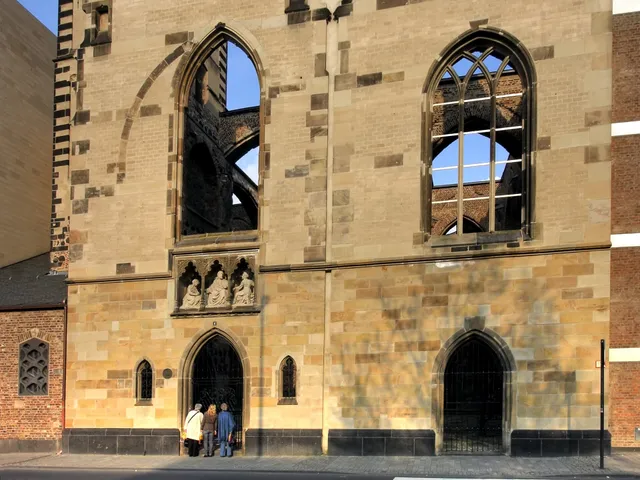
In World War II, St. Kunibert was reduced to rubble: the roofs burned in 1944, a bomb struck the west tower, which collapsed along with parts of the transept. Under the direction of Karl Band, the chancel and nave were rebuilt by 1955; the west end followed later, completed in 1993 to designs by Otmar Schwab and Leo Hugot. The building's current form deliberately draws on different historical phases rather than restoring any single one. The support organisation Förderverein Romanische Kirchen Köln was founded specifically to drive the rebuilding of the west end and has since supported all of the city's Romanesque churches.
Architecture and Interior
The apse rises in two slender storeys beneath a dwarf gallery. Inside, the eastern section is a bright hall ending in the apse, where column-supported galleries run on two levels within double-shell masonry — a feature that sets St. Kunibert apart from Cologne's other Romanesque churches.
The Original Windows
The early 13th-century windows survived the war because they had been placed in storage beforehand. The central upper window focuses on the life of Christ; the cycle begins with Jesse but follows Christ's life rather than his lineage, so it is not a conventional Tree of Jesse. The flanking windows depict the legends of Saints Kunibert and Clement; the lower zone shows Saints Ursula and Cordula. The central ornamental window was created by Cologne artist Will Thonett in the 1950s.
Worth Knowing
Beneath the chancel lies a crypt supported by a single central column, containing the Kunibertspütz — a well of probable pre-Christian origin whose waters are said to grant the blessing of children. In the nave stands a polychrome stone Annunciation group donated in 1439.
Timeline
- um 600Kunibert of Cologne born; according to legend founds a church dedicated to Clement at the site
- vor 1210Construction of new collegiate church begun at the instigation of provost Theoderich of Wied
- 1226Choir completed
- 1247Consecration as collegiate church by auxiliary bishop Arnold of Semgallen
- 1376First west tower destroyed by fire in June; rebuilt in Gothic style with bent spire
- 1830West tower collapses after storm; rebuilt by 1860
- 194429 June: roofs burn; west tower hit by bomb and collapses
- 1993Reconstruction of the west section (transept and tower) completed to plans by Otmar Schwab and Leo Hugot
Gallery
Map
Blue dots: other places nearby — tap to explore.
Address
Kunibertsklostergasse 2
50668 Köln
Hours
Mo: 10:00–18:00
Di: 10:00–18:00
Mi: 10:00–18:00
Do: 10:00–18:00
Fr: 10:00–18:00
Sa: 10:00–18:00
You might also like — related or nearby

Comments
- Loading comments…
Sources & links
- Official website
- Wikidata (retrieved 2026-06-24)
- Wikipedia (retrieved 2026-06-24, rev 266308101)
- Official website (retrieved 2026-06-24)
- offenedaten-koeln.de (retrieved 2026-06-30)
Auto-generated, last verified: 2026-06-27
How this page is made
This page draws on open sources — Wikipedia, Wikidata, official websites and the city’s open data. Every statement is checked against the sources linked here, and pages are refreshed regularly.
Spotted a mistake anyway? Tell us below — we read every submission.