Alt St. Paul
Romanesque parish church in medieval Cologne, dissolved in 1803 and demolished in 1807 — remnants of its furnishings survive today in St. Andreas.
Alt St. Paul was a Romanesque parish church with its own parish in medieval Cologne; canonically it fell under the collegiate church of St. Andreas. During the French occupation it was dissolved in 1803 and demolished in 1807.
Source: Wikipedia
At a Glance
- Type
- Former Romanesque parish church
- Location
- East of St. Andreas, Altstadt-Nord, Innenstadt district
- Origins
- Initially a single-nave hall church, c. 980 according to Gelenius
- Hall dimensions
- Approx. 7 × 14 m
- Later form
- Three-aisled on a trapezoidal plan
- Dedicated to
- Paul of Tarsus
- End
- Dissolved 1803, demolished 1807
According to the medieval scholar Gelenius, the small church was founded around 980 at the behest of Archbishop Warin – and grew over centuries from a tiny single-nave hall measuring just 7 × 14 metres into a three-aisled ensemble, only to be demolished during the French occupation in 1807.
Things to do here
- Stroll through the northern Old Town following the traces of the vanished church
- Discover the preserved furnishings at the nearby church of St. Andreas
- Track down the former site east of St. Andreas and picture medieval Cologne
- Trace the story from Romanesque hall church to its demolition in 1807
History
A parish of St. Paul may have been associated with St. Andreas even before Cologne's city expansion of 1106. According to the chronicler Gelenius, the small church dates to around 980 and a decree by Archbishop Warin. It first appears in documents in 1151/65 as "S. Pauli Hermanus." The parish was linked to a St. Michael's vicariate of the Andreas chapter.
Architecture and Expansions
The original hall church abutted the street line flush with its east gable. A south aisle was added in 1369, and the nave was enlarged in 1472; the south aisle was subsequently replaced by a new structure, and a north aisle was also added. The resulting three-aisled church was consecrated in 1476 by papal legate Alexander. In 1491 the building received vaulting and a sacristy to the north, above which sat a chapel dedicated to St. Erasmus. A plan from 1702 shows three parallel saddle roofs; a squat tower with a curved helm rose at the west end of the nave.
Surroundings
To the south stood a two-arched immunity gate of the chapter, flanked by bronze figures of boys. The entrance and churchyard lay west of the lane known as Andreaskloster. The rectory stood first on Komödienstraße, and from 1479 on Marzellenstraße.
Legacy and Surviving Traces
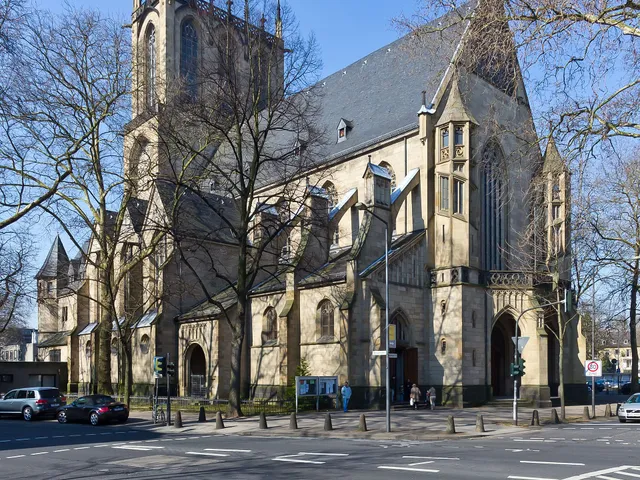
Since 1908 the name has been carried on by the Neo-Gothic parish church of St. Paul in central Cologne, to which the patronage was transferred. Excavations in 1936 revealed the remains of a once semicircular apse on the west side of the vanished building. Surviving pieces of the original furnishings are preserved today in the church of St. Andreas.
Timeline
- um 980Built on orders of Archbishop Warin (according to Gelenius)
- 1151/65First documentary mention as "S. Pauli Hermanus"
- 1369Addition of a southern aisle
- 1472Extension of the nave
- 1476Consecration of the now three-aisled church by papal legate Alexander
- 1491Vaulted; sacristy with Chapel of St. Erasmus added on north side
- 1803Church closed during the French occupation
- 1807Demolition of the church
Map
Blue dots: other places nearby — tap to explore.
You might also like — related or nearby
Comments
- Loading comments…
Sources & links
Auto-generated, last verified: 2026-06-26
How this page is made
This page draws on open sources — Wikipedia, Wikidata, official websites and the city’s open data. Every statement is checked against the sources linked here, and pages are refreshed regularly.
Spotted a mistake anyway? Tell us below — we read every submission.