Antoniterkirche
A Gothic Protestant church in the middle of the Schildergasse – Cologne's most visited church after the cathedral, known for Barlach's ‘Hovering Angel'.
since 1350
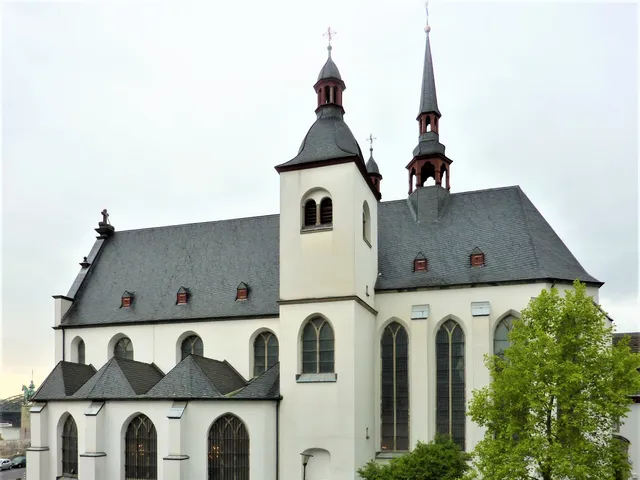
The Antoniterkirche is a Gothic Protestant church in the middle of the Schildergasse shopping street. Its central location makes it Cologne's most visited church after the cathedral – an oasis of calm amid the bustle.
At a glance
- Built
- 1350–1378 as the church of the Antonine order
- Denomination
- Protestant (since 1802/1805)
- Location
- Schildergasse, the main shopping street
- Form
- three-aisled Gothic basilica with a roof turret instead of a tower
- Famous for
- Ernst Barlach's "Der Schwebende" ("The Hovering Angel")
- Notable
- since 2016 a member of the Coventry Cross of Nails community
- Entry
- free
The Antoniterkirche was originally a Catholic monastery church until the French occupiers handed it over to Cologne's Protestants in 1802 – until then, Protestant services had to be held in secret or moved to neighbouring towns like Mülheim and Frechen.
Things to do here
- Step out of the bustle of the Schildergasse into the quiet church
- Marvel at Ernst Barlach's "Hovering Angel"
- Take in the Gothic architecture of the three-aisled basilica
- Find a moment of calm and quiet reflection
- Photograph the interior and the memorial
Age comparison
Age compared with other places in Cologne.
From monastery to city church
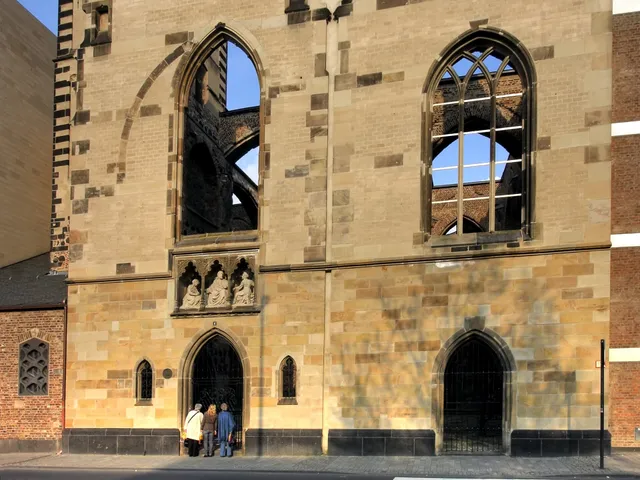
The basilica originally belonged to the monastery of the Antonine order and was dedicated to Saint Anthony the Great. During the French occupation the monasteries were dissolved in 1794 and Cologne's Protestants were allowed to hold public services – before that they had to meet in secret or in neighbouring towns such as Mülheim and Frechen. In 1802 the French handed the Antoniterkirche to the Protestant congregation, and in 1802–1805 it was remodelled for Protestant worship under Ferdinand Franz Wallraf. After severe destruction by an air raid in 1942 it was rebuilt by 1952 under Georg Eberlein; Federal President Theodor Heuss attended the reconsecration.
Architecture
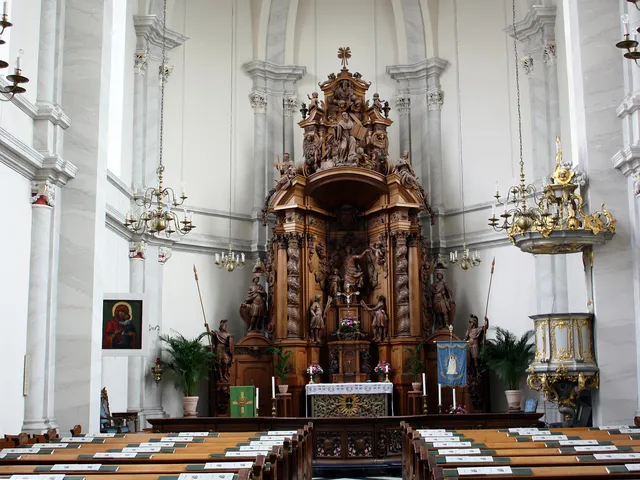
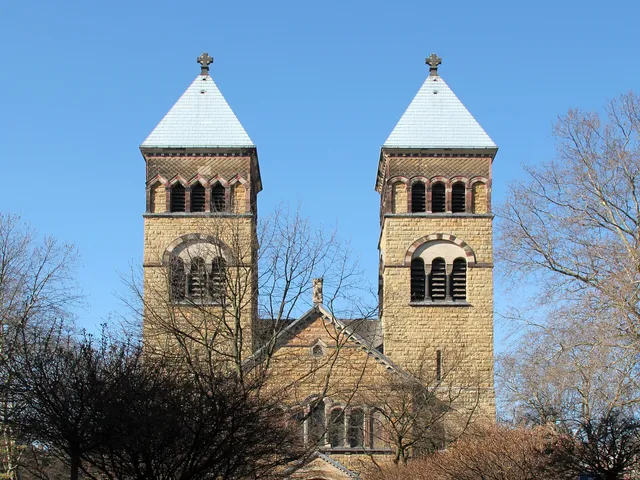
The three-aisled, vaulted basilica was built in the style of a mendicant-order church and has a polygonal choir; the northern aisle has its own end choir. Instead of a tower the church carries a roof turret, rebuilt in 1954 after the wartime destruction. In 1979/1980 the interior regained its medieval-style colour scheme.
Barlach's "Der Schwebende"
The best-known artwork is the bronze sculpture "Der Schwebende" by Ernst Barlach, hung in the northern side chapel and regarded by many as his masterpiece. It is a second cast of the figure created in 1927, whose original in Güstrow Cathedral was melted down by the Nazis as "degenerate art". The hovering figure bears the features of the artist Käthe Kollwitz and hangs above a stone slab with the years of the First World War and of Nazi rule, 1933–1945. In 2011 two further works by Barlach were added: the "Kruzifix II" and the "Teaching Christ".
Further furnishings
The southern aisle holds a Romanesque baptismal font of 12th-century Namur bluestone, provided to the congregation by the Museum Schnütgen. The organ was built in 1969 by the Willi Peter company; it has 45 stops across three manuals and pedal and was restored and expanded in 2013. The church also became widely known as the venue of the "Political Night Prayer", and it is the baptismal church of the resistance figure Freya von Moltke.
Timeline
- 1350–1378Antonite Order builds Gothic monastery with church
- 1794French occupation: monasteries dissolved, religious freedom granted
- 6. Aug. 1802Church handed over to Cologne's Protestant community
- 1802–1805Conversion for Protestant worship under Ferdinand Franz Wallraf
- 1805Reopening as Protestant church (Rogation Sunday), approx. 800 seats
- 31. Mai 1942Air raid largely destroys the church
- 1946–1952Reconstruction under architect Georg Eberlein
- 18. Mai 1952Reconsecration attended by Federal President Theodor Heuss
Gallery
Map
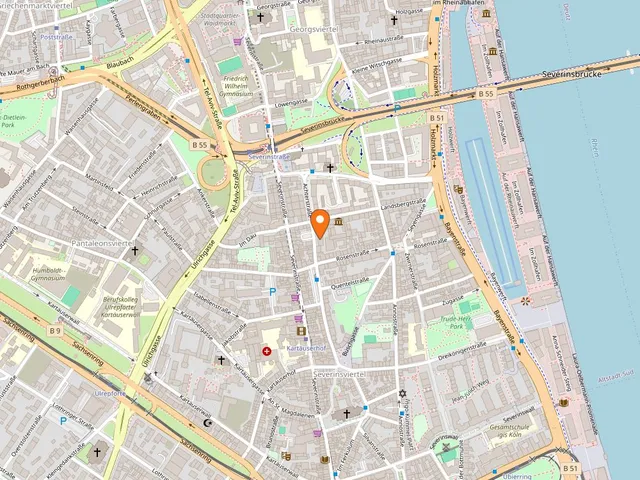
Blue dots: other places nearby — tap to explore.
Address
Schildergasse 57
50667 Köln
Hours
Di: 11:00–18:00
Mi: 11:00–18:00
Do: 11:00–18:00
Fr: 11:00–18:00
Sa: 12:00–17:00
So: 12:00–17:30
You might also like — related or nearby
Comments
- Loading comments…
Sources & links
- Official website
- Wikidata (retrieved 2026-06-23)
- Wikipedia (retrieved 2026-06-23, rev 268009535)
- Official website (retrieved 2026-06-24)
Auto-generated, last verified: 2026-07-02
How this page is made
This page draws on open sources — Wikipedia, Wikidata, official websites and the city’s open data. Every statement is checked against the sources linked here, and pages are refreshed regularly.
Spotted a mistake anyway? Tell us below — we read every submission.