Groß St. Martin
Romanesque basilica in Cologne's Old Town with a cloverleaf-shaped east choir and striking crossing tower — built over Roman foundations.
since 1150
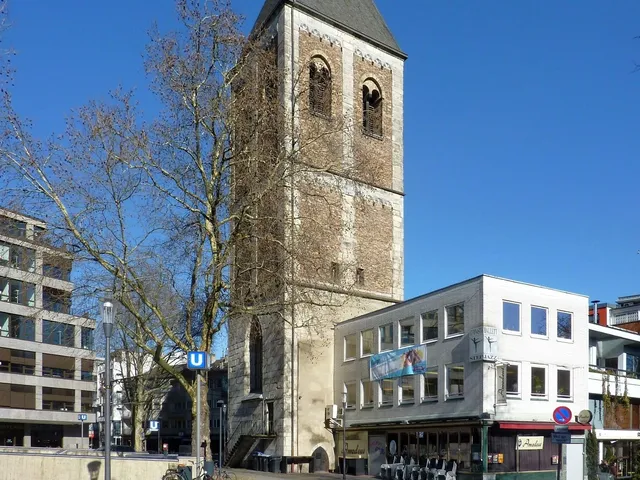
Groß St. Martin is one of Cologne's twelve great Romanesque churches, its crossing tower a defining feature of the city's left-bank skyline. It stands in the Old Town close to the Rhine, framed by residential and commercial buildings from the 1970s and 80s.
At a Glance
- Type
- Romanesque basilica, former Benedictine abbey church
- Location
- Altstadt-Nord, near the Rhine
- Construction
- begun around 1150, completed in the 13th century
- Form
- three-aisled nave, cloverleaf-shaped east choir, square crossing tower with four corner turrets
- Style
- Romanesque architecture
- Protected
- listed monument in North Rhine-Westphalia
- Notable feature
- Roman excavations visible in the crypt
Beneath the church once lay a mysterious Roman complex featuring a basin over 34 metres long – whether it served as a swimming pool, a fish pond for Rhine fishermen, or part of a sacred precinct remains unknown to this day, and no comparable structure has been found north of the Alps.
Things to do here
- Admire the striking crossing tower with its four corner turrets
- Explore the Romanesque basilica inside and soak up the calm
- Discover the Roman excavations in the crypt
- Photograph the church as part of the old town near the Rhine
- Admire Cologne's skyline on a stroll through the old town
Age comparison
Age compared with other places in Cologne.
History
Construction began around 1150 on the remains of a Roman warehouse and an early medieval predecessor church, continuing into the 13th century. The building served as the church of the Benedictine abbey of the same name until secularisation in 1802. After the abbey buildings were demolished, it took on the role of a parish church.
Destruction and Rebuilding
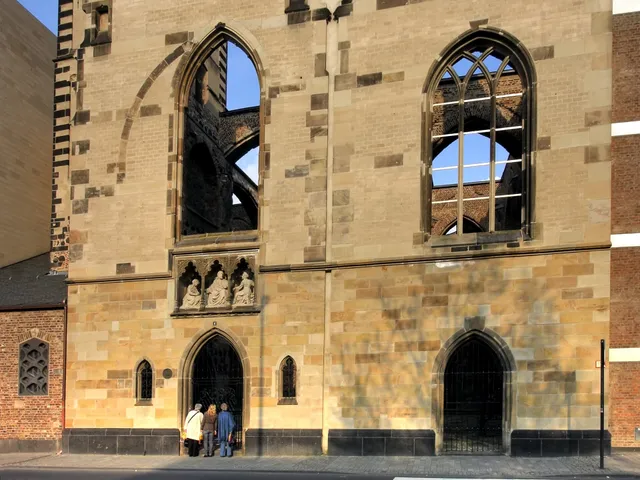
The church was heavily damaged during World War II, especially in the air raids of 1942–43, which destroyed large sections of the nave and vaulting. The tower was restored by 1965, but the full reconstruction took until 1985 — four decades after the war's end, the church was reconsecrated.
Roman Origins
The site originally stood on a Rhine island east of the Roman city's praetorium and had been built upon since the first century AD. Excavations uncovered three-aisled halls whose position on the riverbank suggests use as warehouses for traded goods. Finds from the Roman period are on display in the newly created crypt.
Today
Since 2009, the Fraternité de Jérusalem community has cared for the church, which has once again become a place of monastic life and is open to worshippers and visitors alike. The prefix "Groß" (Great) distinguishes the basilica from the smaller Klein St. Martin — another church dedicated to St. Martin — of which only the tower survives.
Timeline
- 1. Jh. n. Chr.First construction on the Rhine island with Roman plaza complex
- Mitte 2. Jh.Conversion to Roman warehouses (horreae) along the Rhine
- ab ~1150Construction of the basilica begins on Roman foundations
- 13. Jh.Completion of the church after several construction phases
- 1802Secularisation: end of Benedictine abbey, converted to parish church
- 1942/43Severe war damage from bombing raids (nave and vaults)
- 1965Tower reconstruction completed
- 1985Reconstruction completed, church reconsecrated
- 2009Fraternité de Jérusalem takes over; church becomes monastery church again
Gallery
Map
Blue dots: other places nearby — tap to explore.
Address
An Groß St. Martin
50667 Köln
You might also like — related or nearby

Comments
- Loading comments…
Sources & links
- Official website
- Wikidata (retrieved 2026-06-24)
- Wikipedia (retrieved 2026-06-24, rev 266952832)
- Official website (retrieved 2026-06-24)
- offenedaten-koeln.de (retrieved 2026-06-30)
Auto-generated, last verified: 2026-06-26
How this page is made
This page draws on open sources — Wikipedia, Wikidata, official websites and the city’s open data. Every statement is checked against the sources linked here, and pages are refreshed regularly.
Spotted a mistake anyway? Tell us below — we read every submission.