St. Andreas
One of Cologne's twelve great Romanesque churches — home to the tomb of Albertus Magnus in its crypt and stained-glass art by Markus Lüpertz.
since 974
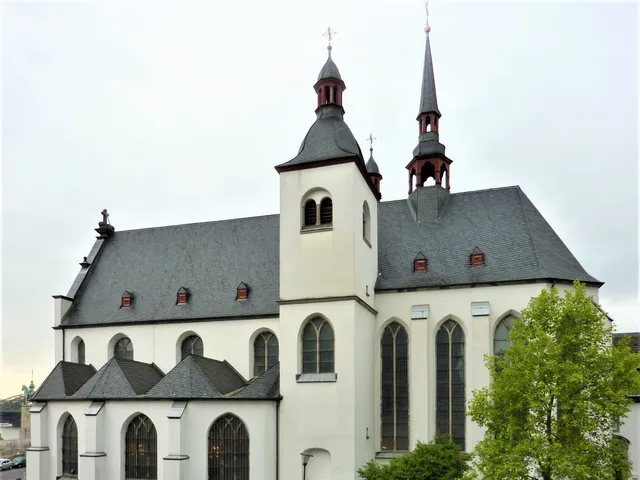
Just a few minutes' walk from Cologne Cathedral, in the Altstadt-Nord neighbourhood, stands the Catholic church of St. Andreas. It is one of the city's twelve great Romanesque churches and is today served as a branch church by the parish of St. Aposteln.
At a Glance
- Type
- Catholic church
- Location
- Altstadt-Nord, city district Innenstadt, near the Cathedral
- Structure
- Three-aisled pier basilica with Romanesque and Gothic elements
- Consecration
- 974
- Distinctive feature
- Romanesque crossing tower with folded roof
- Interior
- Medieval sculptures and murals, late-Gothic Apostles' shrine
- Listed status
- Protected monument in North Rhine-Westphalia
On 25 November 1954, the remains of Albertus Magnus – the great medieval polymath – were interred in a Roman sarcophagus in the crypt of St. Andreas, and Pope John Paul II personally visited this tomb on the 700th anniversary of his death in 1980.
Age comparison
Age compared with other places in Cologne.
History
An early Christian chapel known as St. Matthaeus in fossa is thought to have once stood on this site. In the late tenth century a collegiate chapter was established here under the patronage of St. Andrew; the early Romanesque building, initiated by Archbishop Bruno, was consecrated by Archbishop Gero in 974. Secularisation of the chapter in 1802 brought sweeping changes: before the nearby Dominican church was demolished, the remains of Albertus Magnus and the shrine containing the Maccabean relics were transferred here, after which St. Andreas became a parish church.
Architecture
The western part of the building preserves substantial sections of the late Romanesque, Hohenstaufen structure from the twelfth and thirteenth centuries. Gothic chapels were added to the aisles in the fourteenth century, and the Romanesque east choir and crypt were later replaced by a Gothic choir hall modelled on Aachen Cathedral. The Romanesque tower with its folded roof rises above the crossing; the two staircase towers survive from the earlier Salian building, their outer facades now embedded within the fabric after successive medieval alterations. Remarkably, the medieval murals in the chapels survived the destruction of the Second World War.
Interior
Alongside the murals, the medieval furnishings include sculptures of St. Christopher and the Archangel Michael by Master Tilman, which stand before the west gallery. The high altar holds the late-Gothic Apostles' shrine, originally from St. John's Church in Niederlahnstein, shaped like a miniature Gothic chapel.
The Dominicans and Albertus Magnus
In 1947 Archbishop Joseph Frings entrusted the pastoral care of St. Andreas to the Dominicans, and from 1957 the church served them as a priory church — in a sense returning the Dominican Albertus Magnus to his own order. Between 1953 and 1955, Karl Band partially opened the eleventh-century crypt beneath the east choir and added a burial chapel for the theologian and natural philosopher. Since 25 November 1954 his remains have rested there in a Roman sarcophagus. On the 700th anniversary of his death in 1980, Pope John Paul II visited the tomb.
Today
Since 1933 the church has served as the order church of the German lieutenancy of the Equestrian Order of the Holy Sepulchre of Jerusalem. Between 2005 and 2010, Markus Lüpertz designed a colourful twelve-part stained-glass cycle for the Gothic windows of the north and south transepts, replacing the plain post-war glazing. In the choir, the historic windows of 1899 and 1917–18 were spared by the war.
Timeline
- 974Consecration by Archbishop Gero, dedicated to St. Andrew
- 12./13. JahrhundertLate Romanesque Hohenstaufen reconstruction of the nave
- 14. JahrhundertGothic chapels added to the side aisles
- 1492Southern transept entirely rebuilt in Late Gothic style
- 1802Secularisation; relics of Albertus Magnus and Maccabees shrine transferred
- 1947War damage largely repaired; Dominicans take over pastoral care
- 1953–1955Crypt excavated; funerary chapel for Albertus Magnus created
- 1992–1997Comprehensive interior and exterior restoration
Gallery
Map
Blue dots: other places nearby — tap to explore.
Address
Komödienstraße 6-8
50667 Köln
Hours
Mo: 07:30–18:00
Di: 07:30–18:00
Mi: 07:30–18:00
Do: 07:30–18:00
Fr: 07:30–18:00
Sa: 08:30–18:00
So: 08:30–18:00
You might also like — related or nearby
Comments
- Loading comments…
Sources & links
- Official website
- Wikidata (retrieved 2026-06-23)
- Wikipedia (retrieved 2026-06-23, rev 265498678)
- Official website (retrieved 2026-06-24)
Auto-generated, last verified: 2026-06-27
How this page is made
This page draws on open sources — Wikipedia, Wikidata, official websites and the city’s open data. Every statement is checked against the sources linked here, and pages are refreshed regularly.
Spotted a mistake anyway? Tell us below — we read every submission.