St. Georg
11th-century Romanesque collegiate church rising above a columned crypt with Roman spolia — one of Cologne's twelve great Romanesque basilicas.
since 1059
St. Georg is a former collegiate church in Cologne's Altstadt-Süd district and one of the city's twelve great Romanesque basilicas. Construction began in 1059, and the church was most likely consecrated in 1067.
At a Glance
- Type
- Romanesque column basilica, former collegiate church, now a parish church
- Location
- Altstadt-Süd, Innenstadt borough
- Built
- Started 1059, consecrated c. 1067
- Style
- Romanesque architecture, listed monument in North Rhine-Westphalia
- Highlight
- Hall crypt on columns salvaged from Roman buildings; nicknamed "Ravenna on the Rhine"
- Today
- Diocesan centre for the hearing-impaired and an inclusive congregation
The columns in St. Georg's crypt were taken from Roman buildings – and on one of the capitals near the main altar, a medieval stonemason left his personal mark: "herebrat me fecit" (Herebrat made me), an exceptionally rare personal signature from the 11th century.
Age comparison
Age compared with other places in Cologne.
History
The church stands on the site of a Roman beneficiarius post that once monitored traffic between Bonn and the southern gate of the Roman colony. A Caesarius oratory, probably built during the Merovingian period, rose on part of those foundations. Under Archbishop Anno II, an 11th-century three-aisled column basilica with a transept and tripartite east choir was erected above a hall crypt. On the day of consecration, Anno II presented the foundation with an arm relic of St. George from St. Pantaleon.
Architecture
The three naves lead beyond the transept into three apses positioned higher than the nave — a result of the five-aisled columned crypt beneath the eastern sections, whose columns are Roman spolia topped with cubic capitals. One capital beside the high altar bears the inscription herebrat me fecit ("Herebrat made me"), a rare surviving medieval builder's inscription. The cubic west block, added in the Hohenstaufen period, was never completed as a tower; inside, a tall pendentive dome rises above the base storey.
Alterations and Reconstruction
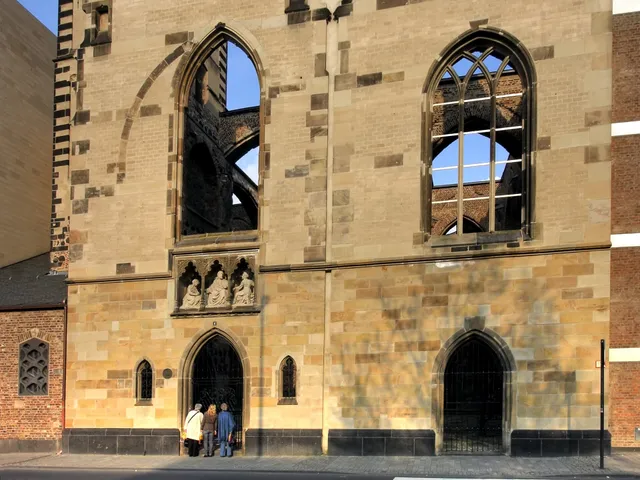
The northern porch, built in 1551–52, originally connected St. Georg to the parish church of St. Jakob, which was demolished in 1825 during the construction of Georgstraße, after which St. Georg took over as parish church. Closed after World War I due to the risk of collapse, the building was restored between 1928 and 1930, when Jan Thorn Prikker created its celebrated window cycle. The southern Renaissance porch of 1536 and the Baroque roof of the west block were lost in World War II; the damaged sections were rebuilt by 1964.
Today
Alongside its Romanesque fabric, St. Georg is Cologne's centre for deaf pastoral care, home to an inclusive congregation of deaf, hard-of-hearing, and hearing members. Services are celebrated in both spoken language and sign language.
Timeline
- 5.–8. Jh.Caesarius oratory built on Roman foundations (Merovingian period)
- 1059Construction of the three-aisled column basilica begun under Archbishop Anno II
- 1067Church consecration; Anno II transfers relic of St George from St Pantaleon
- 1536Southern Renaissance porch built (destroyed in World War II)
- 1551/52Northern porch built, connecting St Georg with the parish church of St Jakob
- 1825St Jakob demolished for Georgstraße; St Georg becomes parish church
- 1928–1930Major restoration following risk of structural collapse
- bis 1964Reconstruction of crossing, transept apses, and windows; new crossing altar
Gallery
Map
Blue dots: other places nearby — tap to explore.
Address
Georgspl. 17
50676 Köln
Hours
Mo: 08:00–18:00
Di: 08:00–18:00
Mi: 08:00–18:00
Do: 08:00–18:00
Fr: 08:00–18:00
Sa: 08:00–18:00
So: 08:00–18:00
Contact
You might also like — related or nearby
Comments
- Loading comments…
Sources & links
- Official website
- Official website (retrieved 2026-06-25)
- Wikidata (retrieved 2026-06-24)
- Wikipedia (retrieved 2026-06-24, rev 266961464)
- offenedaten-koeln.de (retrieved 2026-06-30)
Auto-generated, last verified: 2026-06-27
How this page is made
This page draws on open sources — Wikipedia, Wikidata, official websites and the city’s open data. Every statement is checked against the sources linked here, and pages are refreshed regularly.
Spotted a mistake anyway? Tell us below — we read every submission.