St. Ursula
Romanesque basilica near Cologne Cathedral housing the Golden Chamber — the largest ossuary north of the Alps, with roots in Roman Cologne.
since 401
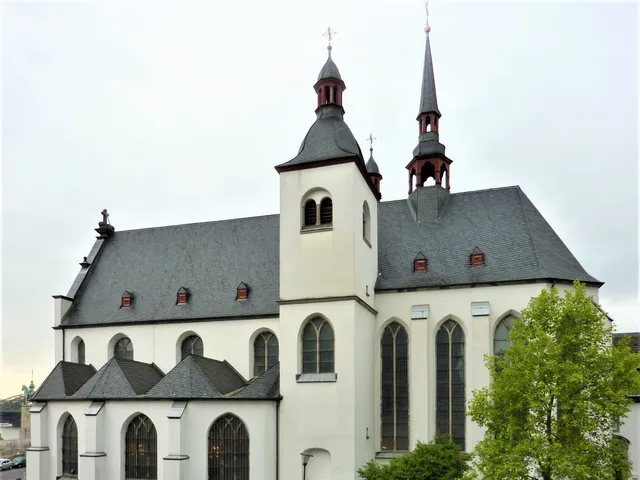
The Roman Catholic Basilica of St. Ursula is one of Cologne's twelve great Romanesque churches, located in the Altstadt-Nord district not far from the Cathedral. It is dedicated to Saint Ursula, Cologne's patron saint, and her companions.
At a Glance
- Type
- Romanesque basilica (Basilica minor since 1920)
- Location
- Ursulaplatz, Altstadt-Nord, Innenstadt district
- Origins
- Roman burial ground outside the city walls; places of worship since the 4th century
- Patron saint
- Ursula of Cologne, patron saint of the city
- Highlight
- The "Golden Chamber" — the largest ossuary north of the Alps
- Status
- Listed monument in North Rhine-Westphalia
The Golden Chamber at St. Ursula is considered the largest charnel house north of the Alps – and the legendary figure of 11,000 martyrs may simply stem from a medieval translation error, since the original tradition spoke of only 11 companions.
Age comparison
Age compared with other places in Cologne.
The Golden Chamber
This walk-in reliquary chamber was endowed in 1643 by a merchant to bring together the bones that had previously been scattered throughout the church interior. According to legend, these are the remains of Ursula's 11,000 companions. Also on display are reliquary busts — gilded and silver-adorned wooden busts containing actual skulls and bones inside. Despite the widespread destruction of Cologne's city centre during World War II, the room survived largely intact and remains almost entirely in its 17th-century original state.
History
A succession of sacred buildings stood on the Roman burial ground from the 4th century onwards; the earliest three-aisled structure is said to have been expanded around 400 by the Roman senator Clematius. Around 922, Archbishop Hermann I established a noble women's convent here, which at its height in the High Middle Ages housed up to 40 canonesses. The current Romanesque building was constructed in the second quarter of the 12th century as a three-aisled gallery basilica; around 1247–1267 the large Gothic choir was added on the eastern side, its eleven windows encasing it like a "glass shrine."
The Clematius Inscription
Set into the south wall of the long choir since the 13th century, the Clematius Inscription is considered the earliest written evidence of Christianity in Cologne. It forbids, under threat of eternal damnation, the burial of anyone other than the holy virgins within the basilica. It is seen as the seed from which the legend of Ursula grew — though how the original eleven companions eventually became 11,000 remains unexplained.
Today
The basilica has been a pilgrimage destination for centuries and serves today as a memorial to the martyrdom of Christian men and women. The legend of Ursula lives on in Cologne's coat of arms.
Timeline
- um 400Senator Clematius expands the basilica (Clematius inscription)
- 866First mention of a canonical foundation by Archbishop Gunthar
- 881/882Norman raid damages the basilica
- 922Archbishop Hermann I. establishes a noble women's collegiate foundation
- 1106City walls extended; large burial ground discovered
- um 1247/1267Gothic choir added to the east side of the basilica
- 1643Golden Chamber donated by a wealthy merchant
- 1920Pope Benedict XV elevates St. Ursula to a basilica minor
Gallery
Map
Blue dots: other places nearby — tap to explore.
Address
Ursulapl. 24
50668 Köln
Hours
Mo: 10:00–12:00
Di: 15:00–17:00
Mi: 15:00–17:00
Do: 10:00–12:00
Fr: 10:00–12:00
Sa: 15:00–17:00
So: 15:00–17:00
You might also like — related or nearby
Comments
- Loading comments…
Sources & links
- Official website
- Wikidata (retrieved 2026-06-24)
- Wikipedia (retrieved 2026-06-24, rev 266277477)
- Official website (retrieved 2026-06-24)
Auto-generated, last verified: 2026-06-27
How this page is made
This page draws on open sources — Wikipedia, Wikidata, official websites and the city’s open data. Every statement is checked against the sources linked here, and pages are refreshed regularly.
Spotted a mistake anyway? Tell us below — we read every submission.