Gereonstor
Medieval twin-tower gate of Cologne's city wall — bricked up for over 400 years, once the city's strictest prison, demolished in 1881.
since 1215
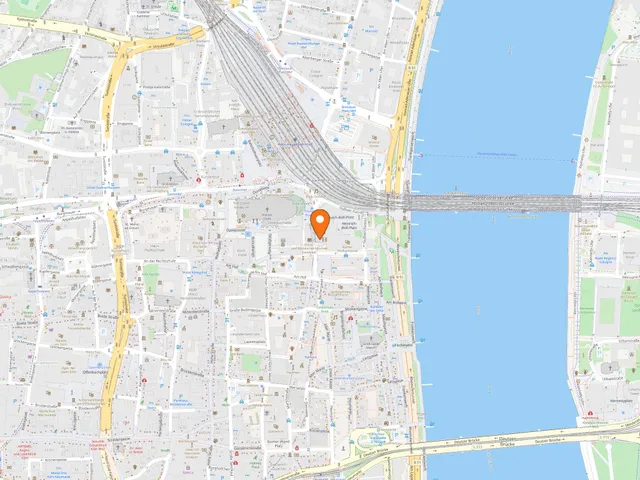
The Gereonstor was a twin-tower gate in Cologne's medieval city wall. It stood in the Altstadt-Nord district at what is now the junction of Christophstraße and Von-Werth-Straße, and was torn down in 1881.
Source: Wikipedia
At a Glance
- Type
- City gate (twin-tower gate) of the left-bank fortifications
- Location
- Altstadt-Nord, Innenstadt borough
- Named after
- the nearby Church of St. Gereon
- City fortifications
- built from 1180, semicircular, approx. 7.5 km
- Prison cells
- six
- Demolished
- 1881
The Gereonstor was walled up for over 400 years as it was apparently designed purely as decoration with no road connection – and one of its prison cells had no staircase at all, accessible only by rope through the warden's kitchen.
Things to do here
- Walk the trail of the vanished gate along Christophstraße and Von-Werth-Straße
- Follow the gripping story from decorative gate to the city's strictest prison
- Explore the course of the medieval city wall, over 7 km long
- Discover the nearby church of St. Gereon, which gave the gate its name
- See the thumbscrew from the gate's prison days at the Cologne City Museum
Age comparison
Age compared with other places in Cologne.
One of Seven Twin-Tower Gates
The structure was one of seven twin-tower gates in the city's fortifications, setting it apart from the others, which were central-tower gates with side terraces — the type seen at the Friesentor and Severinstorburg. The Gereonstor had three storeys, rounded flanking towers, and an outer and inner gate with a gatehall between them. The medieval machicolations along the upper battlements suggest construction began around 1215; Cologne's city gates are generally considered complete by 1260.
Name and Early Records
The gate is first attested in 1259 and appears in a document of June 1401 as „poerthen …off Sente Gereon." In medieval Latin it was known as „Porta Sancti Gereonis." The area on the city side of the gate remained largely uninhabited well into the late Middle Ages.
Ornament Without Traffic
The Gereonstor is among the oldest gates in the city wall and was likely conceived as a decorative feature from the outset. With no direct road connection, it was bricked up for over 400 years; only a narrow, low postern was left in the wall, and that was usually kept locked. The closure on the city side probably dates to the 14th century. Arnold Mercator's 1570 panorama of Cologne already shows the gate sealed and labels it „S. Gereons loch" — St. Gereon's hole.
The City's Strictest Prison
The gate later served as a city prison — as did the Hahnentor and Bayenturm — until the 18th century, and was reputed to be the harshest in Cologne. Mercator's nickname „S. Gereons loch" reflects this, since prisons were commonly called „Löcher" (holes) at the time. One of the six cells could only be reached by rope through the warden's kitchen. Serious criminals were known in Cologne as „Kettenmänner" — chain men — because they were shackled with heavy irons. Torture was practiced here; a thumbscrew from that era survives in the Cologne City Museum. In 1683, Colonel Gerhard von Kiberin was held here as a political prisoner during the Gülich Revolution before the prison was stormed and he was freed.
Re-Opening and Demolition
The Gereonstor was not reopened as a passageway until 1830. On 22 September 1871, returning Prussian troops marched through the gate toward the Neumarkt. The city fortifications belonged to the Prussian military treasury; after the City of Cologne acquired the fortress grounds in 1881, the gate was demolished that same year.
Timeline
- ab 1180Construction of Cologne's left-bank city fortification begun
- ab 1215Construction of Gereonstor begun (machicolations suggest date from 1215)
- 1259First attestation of Gereonstor
- Juni 1401First documentary mention as 'gate of St. Gereon'
- 2. Juni 1683Colonel Gerhard von Kiberin imprisoned as political prisoner
- 24.–27. Sep. 1683City prison stormed, Kiberin and other prisoners freed
- 1830Gereonstor reopened as a passage
- 1881City council resolves purchase; gate demolished
Gallery
Map
Blue dots: other places nearby — tap to explore.
You might also like — related or nearby
Comments
- Loading comments…
Sources & links
Auto-generated, last verified: 2026-06-26
How this page is made
This page draws on open sources — Wikipedia, Wikidata, official websites and the city’s open data. Every statement is checked against the sources linked here, and pages are refreshed regularly.
Spotted a mistake anyway? Tell us below — we read every submission.