Appellhofplatz
Cologne square named after the Court of Appeal — built on the site of a Roman gate tower and shaped by centuries of landmark court cases.
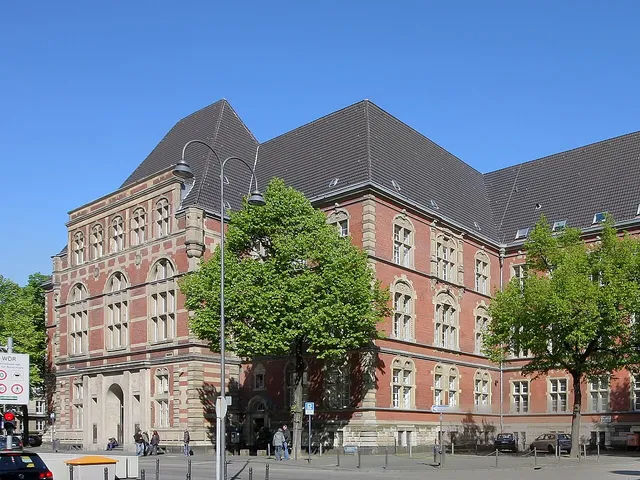
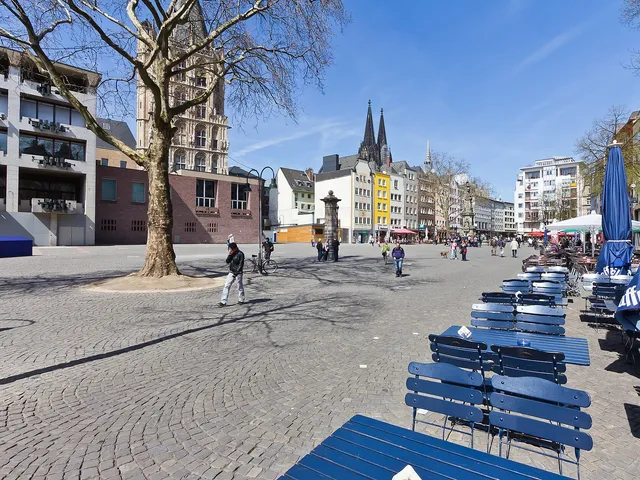
Appellhofplatz in Cologne's Innenstadt district takes its name from a courthouse that locals nicknamed the "Appellhof". Spectacular jury trials before and after the war defined the square's identity for generations of Cologne residents.
At a Glance
- Type
- Inner-city square
- Location
- Cologne-Altstadt-Nord, Innenstadt district
- Surrounding street
- 268 metres long, encircling the square — except for a section of Burgmauer street
- Expansion
- Enlarged in 1890 with the site of a demolished chapel
- Transport
- Light rail stop (lines 3, 4, 5, 16, 18)
The site of today's Appellhofplatz was once home to a Roman gate tower that later served as a medieval convent cell — a single cell for two Beguines in 1316 grew into a full monastery by 1334. During construction of the courthouse in 1824, Roman stone monuments were unearthed, including a Diana altar dedicated between 89 and 120 AD.
Things to do here
- Stroll across the history-rich square
- Admire the imposing courthouse façade
- Walk in the footsteps of the Roman city wall
- Photograph the architecture and the square
- Take a short break on the square
Name and Legal History
The "Rhenish Court of Appeal in Cologne", designed by Johann Peter Weyer, was handed over on 6 November 1826. Construction had begun in 1824 in the vineyard of the Mariengarten convent, secularised before 1820. The building was soon informally called the "Appellhof"; the name spread to the square to the south and eventually became the official street name.
Roman Traces
Before the courthouse, this site held a Roman gate tower — an early subsidiary gate of the northern gate in the Roman city wall. Its passageway was 4.40 metres wide, narrowing to 3.78 metres at the top, and a Roman road led from here north-westward towards Longerich, Bocklemünd and Stommeln. Excavations uncovered Roman stone monuments, including a Diana altar dedicated between AD 89 and 120, found in 1828.
From Tower to Convent
The structure lost its function as a gate by the end of the Roman period and was recorded as "Aldenwich(h)us" in 1292. Heinrich vom Cusin designated the tower in 1316 to house two Beguines; this cell grew into the Convent of the Cell in 1334, which was demolished before 1824 to make way for the courthouse.
New Building and Later Use
As court space requirements grew sharply, a new concave building in the Dutch Renaissance style by Paul Thoemer and Rudolf Mönnich was erected on the same site from 1883. It was already too small when handed over in 1893, prompting the Cologne Higher Regional Court to relocate to Reichenspergerplatz in 1911. Damaged by bombs in the Second World War, the building was rebuilt in simplified form in 1945. Criminal courts and the regional court were housed here until 1981, after which the Cologne Administrative Court and Cologne Finance Court moved in.
Timeline
- 1824Construction of the Court of Appeal begins on the site of the former Mariengarten monastery
- 1826Court of Appeal inaugurated on 6 November (architect J. P. Weyer)
- 1855Garden in front of the courthouse laid out by Anton Strauß
- 1883New courthouse building (Thoemer/Mönnich) begun on the same site
- 1893New building in Dutch Renaissance style handed over in July
- 1911Court of Appeal moves to Reichenspergerplatz in October
- 1945Building hit by bombs and rebuilt in greatly simplified form
- 1981Criminal courts and regional court move out; administrative court moves in (17 March)
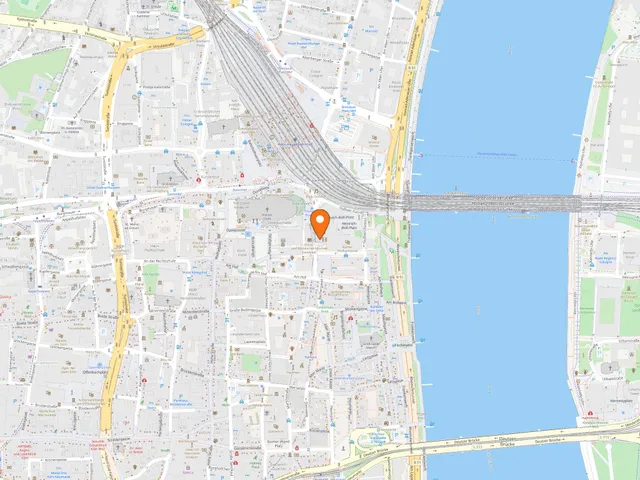
Map
Blue dots: other places nearby — tap to explore.
Contact
You might also like — related or nearby
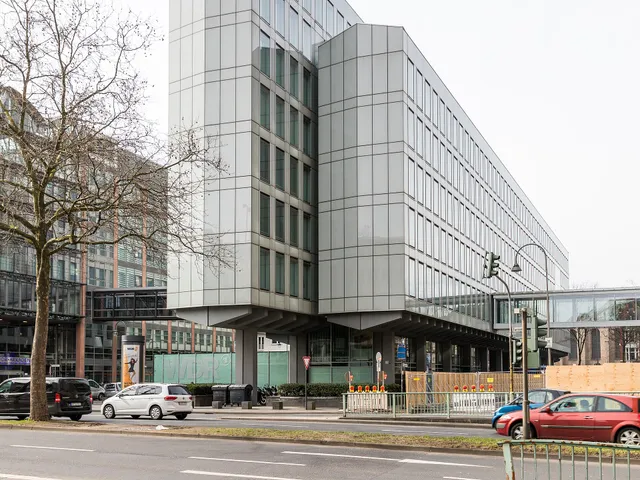
Vierscheibenhaus – WDR Office Building at Appellhofplatz
The Vierscheibenhaus is a striking office building belonging to the West German Broadcasting (WDR) in Cologne's Altstadt-Nord district. Its interior is closed to the public, but the staggered building slabs are well worth viewing from the outside.

Comments
- Loading comments…
Sources & links
- Official website
- Official website (retrieved 2026-06-25)
- Wikidata (retrieved 2026-06-24)
- Wikipedia (retrieved 2026-06-24, rev 252112272)
Auto-generated, last verified: 2026-06-26
How this page is made
This page draws on open sources — Wikipedia, Wikidata, official websites and the city’s open data. Every statement is checked against the sources linked here, and pages are refreshed regularly.
Spotted a mistake anyway? Tell us below — we read every submission.