St. Amandus (Köln-Rheinkassel)
Romanesque church on the Rhine whose twin-towered chancel is a miniature echo of nearby St. Gereon — an extraordinary feature for a rural parish church.
since 1200
St. Amandus is the Roman Catholic church in the Cologne district of Rheinkassel, set directly on the bank of the Rhine. It belongs to the parish of St. Pankratius am Worringer Bruch and is named after Amand of Maastricht, a 7th-century missionary who worked throughout Belgium.
At a Glance
- Type
- Roman Catholic church
- Location
- Merkenich district, Chorweiler borough, on the Rhine
- Style
- Romanesque
- West tower
- c. 1200
- Listed status
- Protected monument in North Rhine-Westphalia
- Highlight
- Twin-towered chancel modelled on St. Gereon
- Bells
- Six (four rung as a peal, two historic bells hung individually)
The choir of the small village church of St. Amandus is a scaled-down copy of Cologne's collegiate church of St. Gereon – an extraordinarily ambitious design for a rural church, built around 1220 to a standard far exceeding what was typical for Cologne's countryside parishes.
Age comparison
Age compared with other places in Cologne.
History
The church's origins can only be pieced together indirectly from historical records. It may have been founded by the Amandus monastery in present-day Saint-Amand-les-Eaux, whose Rhine-area possessions were confirmed by Charles the Simple in 899. From 1156 until secularisation in 1803, the church fell under the authority of Cologne's collegiate church of St. Gereon, which appointed its priests. In 1185, Archbishop Engelbert I formally assigned Rheinkassel to the Gereon chapter.
Architecture
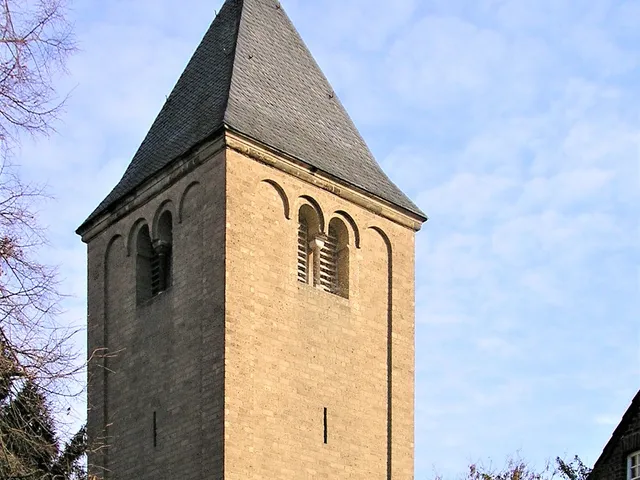
The small Romanesque building grew from an 11th-century hall church, whose foundations were uncovered in 1979. Around 1200, the plain structure gained its west tower — later reduced by one storey in the 17th century. From around 1220, the St. Gereon chapter enlarged the church with two side aisles and an elaborately articulated chancel flanked by two towers that deliberately mirror those of St. Gereon; at the same time the nave received its first vaulting. The present Gothic-revival vault dates from the 17th century. Decorative stonework far exceeds what was typical for rural Cologne churches, with round-arch friezes giving the exterior its distinctive character. The current colour scheme of white and pink reconstructs the medieval appearance based on traces of original pigment discovered on-site.
Interior
Most of the furnishings arrived only in the 19th and 20th centuries. Surviving medieval and early-modern pieces include a 14th-century enthroned Madonna with Child, a 15th-century Crucifixion group, and 17th-century figures of saints — among them St. Amandus himself. A sculpture of St. James by Toni Zenz, acquired in 1997, marks the church's place as a medieval stop on the Düsseldorf St. James' Way. The three chancel windows were made by Dieter Hartmann in 1987. The organ, with 11 stops, traces its origins to a 1789 instrument; parts were reused in a 1981 rebuild, so some pipes are over 200 years old.
Timeline
- 899Charles the Simple confirms monastery possessions on the Rhine (first mention)
- 11. JahrhundertFirst hall church built (foundations uncovered in 1979)
- 1156Settlement over property rights between Knechtsteden monastery and St. Gereon collegiate church
- 1185Rheinkassel definitively assigned to St. Gereon collegiate church by Archbishop Engelbert I
- um 1200West tower built (reduced by one storey in the 17th century)
- um 1220Expansion by St. Gereon collegiate church: side aisles and choir modelled on St. Gereon
- 1789Organ built by Cologne organ maker Johan Georg Arnold
- 1987Choir windows (Trinity) by Dieter Hartmann installed
Map
Blue dots: other places nearby — tap to explore.
Address
Amandusstraße 2
50769 Köln
Hours
Mo: 08:00–19:00
Di: 08:00–19:00
Mi: 08:00–19:00
Do: 08:00–19:00
Fr: 08:00–19:00
Sa: 08:00–19:00
So: 08:00–19:00
Contact
You might also like — related or nearby
Comments
- Loading comments…
Sources & links
- Official website
- Official website (retrieved 2026-06-25)
- Wikidata (retrieved 2026-06-23)
- Wikipedia (retrieved 2026-06-23, rev 263670621)
Auto-generated, last verified: 2026-06-27
How this page is made
This page draws on open sources — Wikipedia, Wikidata, official websites and the city’s open data. Every statement is checked against the sources linked here, and pages are refreshed regularly.
Spotted a mistake anyway? Tell us below — we read every submission.