Alt St. Katharina (Cologne-Niehl)
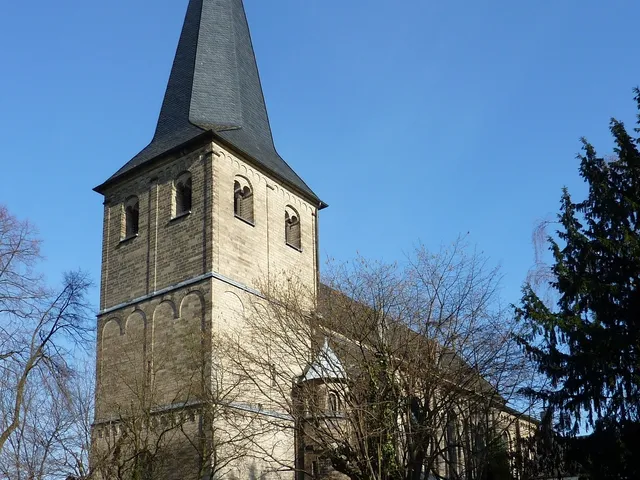
The "Niehler Dömchen": a 12th-century Romanesque basilica on the Rhine riverbank, featuring a Gothic choir and listed heritage status.
In the Cologne district of Niehl stands Alt St. Katharina — affectionately known as the "Niehler Dömchen" (Little Cathedral of Niehl) — a Roman Catholic church whose east-facing structure rises just beside the Rhine, separated from the riverbank only by the Niehler Damm.
At a Glance
- Type
- Roman Catholic church, former parish church
- Architectural style
- Romanesque basilica with a Gothic-remodelled choir
- Built
- 12th century
- Location
- Rhine riverbank, Niehl district (Nippes borough)
- Listed
- Protected monument in North Rhine-Westphalia
- Patron saint
- Catherine of Alexandria
- Nickname
- "Niehler Dömchen"
The church served as the parish church for the entire area from Nippes to Niehl, but was replaced in 1892–94 by a new, larger building because it had simply become too small for the growing population – and has been affectionately nicknamed 'Niehler Dömchen' (Little Cathedral of Niehl) ever since, even though it remains in use to this day.
Things to do here
- Marvel at the little "Niehler Dömchen" on the Rhine bank
- Discover the Romanesque basilica with its Gothic choir
- Admire the historic furnishings such as the pulpit and Madonna
- Take in the colourful choir and nave windows
- Stroll along the Rhine bank and photograph the little church
- Attend the Friday evening Mass
History
Niehl is first mentioned in documents as early as 927. The church traces its origins to a chapel of the Kunibert collegiate foundation, recorded in 1236. In 1260, auxiliary bishop Heinrich I of Montfort dedicated the high altar to Saint Catherine. The parish stretched from Nippes all the way to Niehl.
Architecture
The original 12th-century structure was a three-aisled Romanesque basilica with a west tower. Around the mid-13th century the choir was remodelled in Gothic style, while the south aisle disappeared; the nave received its vaulting around 1400. The sacristy was added around 1600, and in 1894 the north aisle was rebuilt on the original foundations.
New St. Katharina
As the congregation outgrew the old building, Theodor Kremer constructed the larger Neu-St. Katharina between 1892 and 1894 — a new parish church further south, more centrally located in Niehl. Sebastianstraße links the two churches. Several older pieces were transferred to the new building, including a carved Last Supper sculpture dating from around 1430.
Interior
The surviving furnishings include a pulpit bearing a relief of Saint Catherine, dated 1622, a crowned Madonna from the 16th century, and an 18th-century Crucifixion group. Later additions include two bells cast in 1977, choir windows by Vincenz Pieper (1978), nave windows by Dieter Hartmann (1988), and a six-register organ built by Gerd Weyland in 1982.
Today
A Mass is held on Friday afternoons, and on Wednesday mornings the neighbouring primary school holds a school service here. Thanks to volunteer helpers, the church is set to open its doors more frequently in the future.
Timeline
- 927First mention of Niehl in an archiepiscopal donation to the Ursula foundation
- 1080Further mention of Niehl in a donation to the Kunibert foundation
- 1236Chapel documented as a branch of the Kunibert foundation
- 1260Consecration of the main altar to St. Catherine by suffragan bishop Heinrich I.
- 12. JahrhundertConstruction as a three-aisled Romanesque basilica with west tower
- Mitte 13. JahrhundertGothic renewal of the choir, demolition of the southern aisle
- um 1400Vaulting of the central nave
- 1892–1894Construction of New St. Catherine as larger parish church; reconstruction of the northern aisle
Map
Blue dots: other places nearby — tap to explore.
Address
Halfengasse 27
50735 Köln
Contact
You might also like — related or nearby

Comments
- Loading comments…
Sources & links
- Official website
- Official website (retrieved 2026-07-17)
- Wikidata (retrieved 2026-06-26)
- Wikipedia (retrieved 2026-06-26)
Auto-generated, last verified: 2026-06-26
How this page is made
This page draws on open sources — Wikipedia, Wikidata, official websites and the city’s open data. Every statement is checked against the sources linked here, and pages are refreshed regularly.
Spotted a mistake anyway? Tell us below — we read every submission.