Neu St. Katharina
A heritage-listed Neo-Romanesque brick basilica from 1892–1894 in Cologne's Niehl district.
since 1894
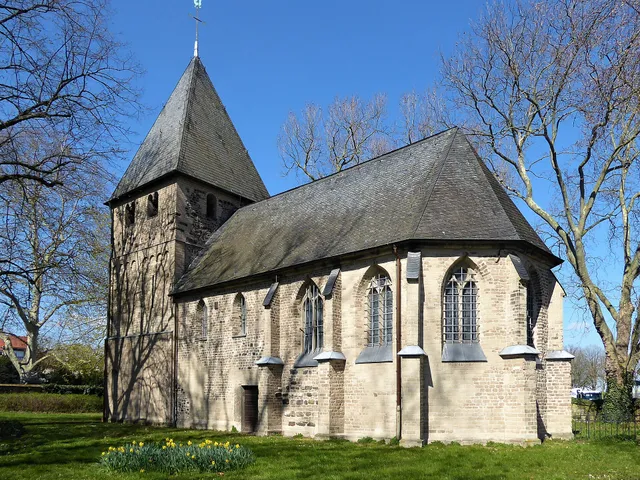
The Catholic parish church of Neu St. Katharina stands in the northern Cologne district of Niehl and belongs to the Archdiocese of Cologne. This Neo-Romanesque brick basilica is a listed monument and shapes the local skyline with the group of three towers on its western front.
At a Glance
- Type
- Roman Catholic parish church, heritage-listed
- Construction
- 1892 to 1894
- Location
- Cologne-Niehl, in the north of the city
- Style
- Neo-Romanesque brick basilica
- Site supervision
- Theodor Kremer
- Consecration
- 5 June 1894 by auxiliary bishop Hermann Joseph Schmitz
- Affiliation
- Archdiocese of Cologne
Age comparison
Age compared with other places in Cologne.
History
Niehl looks back on a long past: the place was already mentioned in 927 in a document of Archbishop Wichfried, and in 1236 a document of provost Buno refers to a chapel. From 1080 onwards the St. Kunibert collegiate church held the right to levy dues on Niehl. With industrialisation and the incorporation into Cologne in 1888, the population grew steadily, so that the old Katharina church soon became too small and a new building was required.
Funding and Construction
On 1 May 1892 the diocesan bulletin called for a collection across all churches of the diocese; the 24,000 marks raised formed the financial foundation. The cornerstone was laid on 2 October 1892, and less than two years later the church could be consecrated. Under the direction of Theodor Kremer, a brick basilica rose between 1892 and 1894, featuring a transept, a semicircular apse and the distinctive group of three towers on its western side.
Alterations in the 20th Century
Towards the end of the 1950s the copper roofing of nave and tower was replaced with slate. From 1960 the remaining war damage was repaired under building official Reusteck. In 1961 the tower received a weathercock, soon followed by three new confessionals, and in 1962 the side doors were clad with copper plates – their handles crafted by goldsmith Dreher. From 1964 the interior was painted and reshaped to suit the liturgy of the Second Vatican Council. The plans came from Rudolf Schwarz together with architect Hermann Pfeifer: the main altar moved into the crossing, and the organ gained two cases on either side of the apse. Anton Wendling designed the altar table and steps, while Hein Wimmer created the tabernacle and cross.
Furnishings
The church brings together works from several centuries. The present altar was made in 1949 by A. Wendling; upon it stands a tabernacle by H. Wimmer bearing the four evangelist symbols, while 24 crowns on the steps recall the 24 elders of Revelation. Today's silver tabernacle rises on a plinth between cross and altar, its sides decorated with enamel depictions of the lamb, the fish and the dove. Above the altar hovers a bronze cross showing Christ as victor – created in 1958 by Hein Wimmer along with two altar candlesticks. Among the older pieces are the eight-seat choir stalls and a wooden Madonna, both from the 16th century. The octagonal font from the 14th century and a carved figure of St. Sebastian from the 17th century come from the predecessor church of Alt St. Katharina. A modern accent was added in 2013, when the Benedictine monk P. Abraham Fischer from Königsmünster Abbey created a wrought-iron Stations of the Cross in a contemporary style.
Good to Know
Some historical furnishings no longer survive. The Cologne sculptor Edmund Mengelberg made the first high altar, whose sandstone mensa rested on three oak steps and whose retable showed the busts of Saints Sebastian, Anthony of Padua, Christina and Katharina. Further altars were added in the 19th century – the St. Joseph altar in 1894 by sculptor Most, the Marian altar in 1897 by Nabbe. A pulpit delivered in 1906 by the workshop of sculptor Eduard Schmitz (Senior) was adorned with the four evangelists and reliefs depicting the power of the keys and the twelve-year-old Jesus in the temple.
Gallery
Map
Blue dots: other places nearby — tap to explore.
Address
Sebastianstraße 126
50735 Köln
Hours
Di: 16:00–18:00
Do: 16:00–18:00
So: 11:00–12:00
Contact
You might also like — related or nearby
Comments
- Loading comments…
Sources & links
- Official website
- Official website (retrieved 2026-07-17)
- Wikidata (retrieved 2026-07-10)
- Wikipedia (retrieved 2026-07-10, rev 255753090)
Auto-generated, last verified: 2026-07-10
How this page is made
This page draws on open sources — Wikipedia, Wikidata, official websites and the city’s open data. Every statement is checked against the sources linked here, and pages are refreshed regularly.
Spotted a mistake anyway? Tell us below — we read every submission.