Heilig Kreuz
Catholic parish church in Köln-Weidenpesch, built in 1931 to plans by Heinrich Bartmann and consecrated in 1934 – a brick building poised between tradition and modernity, and a listed monument since 1983.
since 1931
The parish church of Heilig Kreuz stands in the Cologne district of Weidenpesch and was built in the early 1930s, when the growing population of the quarter – then still called Merheim on the left bank of the Rhine – made a second church necessary alongside St. Stephanus. Its brick construction deliberately moves between traditional forms and modern functionality.
At a Glance
- District
- Köln-Weidenpesch
- Denomination
- Roman Catholic (parish church)
- Architect
- Heinrich Bartmann
- Construction period
- 1931, consecrated 1934
- Patronage
- Holy Cross
- Building material
- brick with tuff-stone details
- Heritage protection
- since 1983 (monument list no. 1249)
The so-called Merheim Madonna was long regarded as a depiction of Saint Anne; only during a restoration in 1937 was it recognised as a Madonna with the Christ Child – and that the Romanesque figure of the Virgin (around 1210) is about two centuries older than the Late Gothic Christ Child (around 1430).
Things to do here
- View the Romanesque–Late Gothic Merheim Madonna in the Lady Chapel
- Discover the medieval Crucifixion group and figures of saints
- See the rose window with the Resurrection of Christ and the coloured round-arched windows
- Experience the three-manual Weyland organ and the six-bell peal
Age comparison
Age compared with other places in Cologne.
History
Because the older church of St. Stephanus was no longer sufficient for the quarter, which had grown considerably through housing development in the 1920s, the parish held an ideas competition open to all of Cologne's Catholic architects. The stipulations were a tight budget of 180,000 marks and the desire for an unmistakably sacred, decidedly modern but not experimental building. Of 88 submitted designs, twelve made the shortlist; Heinrich Bartmann prevailed and also took charge of the construction management. Among the unsuccessful entrants was Dominikus Böhm, who came in fourth.
Construction and Consecration
After the ground-breaking in May 1931, the laying of the foundation stone followed in July and the topping-out ceremony in August. As early as Christmas Eve 1931 the church was blessed for services, but the solemn consecration was not performed until 10 June 1934, by auxiliary bishop Wilhelm Stockums. From 1937 Heilig Kreuz served as an independent parish church. In the Second World War, large parts of the windows were lost in air raids. On 10 January 1983 the building was entered under number 1249 in the monument list of the City of Cologne.
Architecture
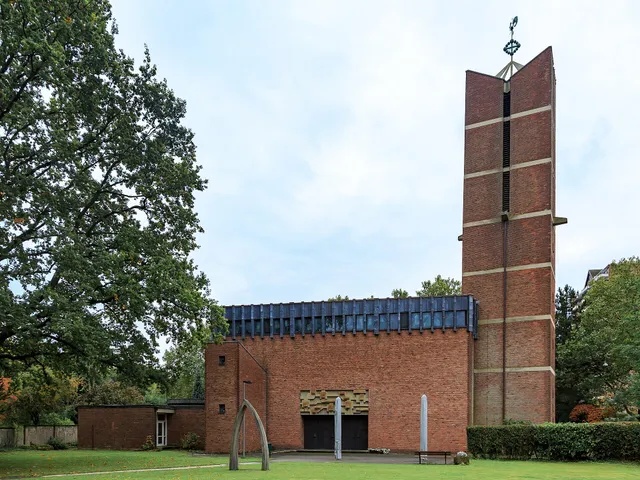
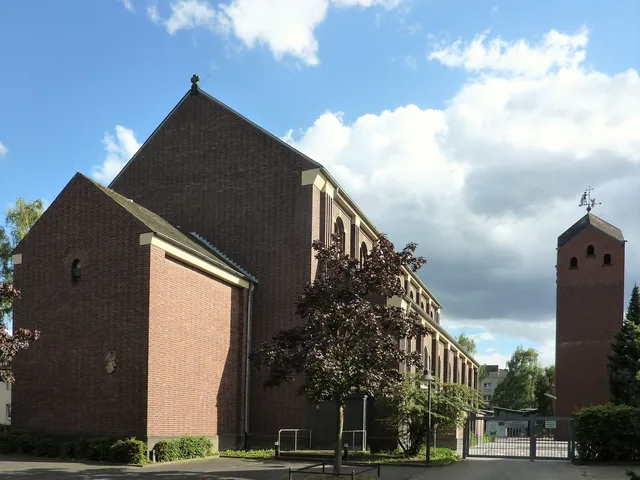
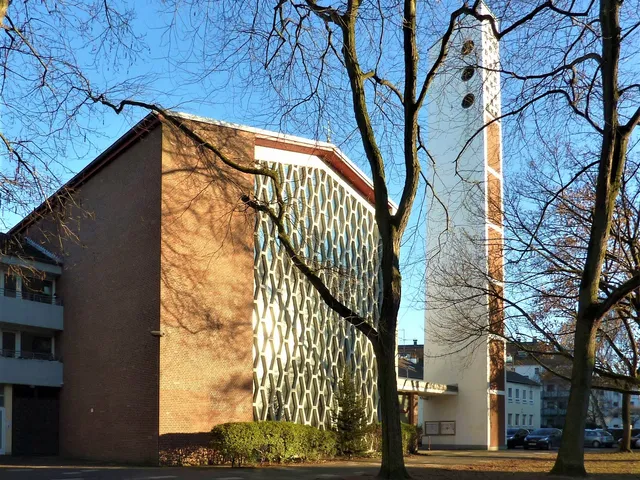
The church, which is not oriented to the east, is composed of massive building volumes, with the broad portal structure to the east standing out most prominently. Behind it rises a tall, basilica-like stepped nave, flanked by single-storey aisles with lean-to roofs. The brick exterior walls are articulated solely by tall, narrow round-arched windows, whose lintels are picked out in tuff stone. A large round window dominates the entrance front, which opens through three round-arched portals. Inside, a white-plastered nave with a continuous beamed ceiling shapes the impression of the space; the chancel is lit indirectly from the side.
Furnishings
The furnishings include several high-quality medieval figures that came to the church in the 1930s. The large Crucifixion group was created around 1410/1420, joined by sculptures of Saints Anthony and Joseph as well as a Baroque Madonna from the circle of Jeremias Geisselbrunn. The windows received several versions: after the loss of Eduard Horst's designs in 1943, chancel and nave windows designed by Anton Wendling were executed in 1952 by Hein Derix; a rose window based on designs by Hans Lohbeck was added in 1953 and depicts the Resurrection of Christ. From 1966 the chancel was remodelled in the spirit of the Second Vatican Council.
Organ and Bells
In 1933 a still fairly new organ was taken over from St. Stephanus and heavily rebuilt during installation so that the rose window above the gallery would remain unobstructed. In the 1970s it was replaced by a three-manual instrument from Weyland Orgelbau, made possible by a fundraising campaign. The peal comprises six bells; the Otto bell of 1931 survives as the only pre-war bell, supplemented among others by a solo bell by Christian Claren from 1861 and three bells from the Eifeler Glockengießerei dating to 1987.
Timeline
- 1931Construction begins with ground-breaking, foundation-stone laying and topping-out ceremony; blessing on Christmas Eve
- 1934Solemn consecration by auxiliary bishop Wilhelm Stockums
- 1937Elevation to an independent parish church
- 1943Destruction of large parts of the windows in air raids
- 1952New chancel and nave windows based on designs by Anton Wendling
- 1966Remodelling of the chancel in accordance with the Second Vatican Council
- 1983Entry in the monument list of the City of Cologne
Gallery
Map
Blue dots: other places nearby — tap to explore.
Address
Floriansgasse 3
50737 Köln
Contact
You might also like — related or nearby
Comments
- Loading comments…
Sources & links
- Official website
- Official website (retrieved 2026-07-17)
- Wikidata (retrieved 2026-07-05)
- Wikipedia (retrieved 2026-07-05, rev 263292964)
Auto-generated, last verified: 2026-07-05
How this page is made
This page draws on open sources — Wikipedia, Wikidata, official websites and the city’s open data. Every statement is checked against the sources linked here, and pages are refreshed regularly.
Spotted a mistake anyway? Tell us below — we read every submission.