St. Engelbert
Cologne's first modern church: Dominikus Böhm's central-plan building with a star-shaped dome, built 1930–1932 in Riehl.
since 1930
St. Engelbert in Riehl is considered Cologne's first modern church and one of the founding works of modern ecclesiastical architecture. That it was built as a central-plan structure with a star-shaped dome was the explicit wish of the parish council.
At a Glance
- Type
- Catholic parish church
- Location
- Riehler Gürtel, Riehl district (Nippes borough)
- Construction
- 1930–1932, consecrated 6 June 1932
- Architect
- Dominikus Böhm
- Style
- Neues Bauen (New Building movement)
- Form
- Central-plan building with star-shaped dome and free-standing tower
- Material
- Cast primarily from pumice concrete
- Listed
- Protected monument in North Rhine-Westphalia
In this church, Cardinal Frings delivered his famous New Year's Eve sermon in 1946, granting Cologne's residents advance absolution for stealing coal out of necessity – which gave rise to the German verb "fringsen", meaning to pilfer out of dire need, named after him.
Age comparison
Age compared with other places in Cologne.
Patron and Predecessor
The patron saint is Engelbert I of Cologne, designated as parish patron around 1900 — until then, no altar in Cologne had been dedicated to him. As Riehl grew rapidly into a suburb in the late 19th century, a temporary church was built in 1897 to a design by Heinrich Krings. It soon proved too small and was deconsecrated in 1932 once the new building was complete; the structure burned down entirely in 1944.
From a Change of Site to the Star Dome
Parish priest Clemens Wirtz had been pushing for a new building since 1921. The original plan called for a Neo-Romanesque church with around 2,150 seats near the rear entrance of the Botanical Garden. Only in 1929 did the archdiocese, in consultation with the city planning office, decide to site the church at the heart of the district on Riehler Gürtel. In January 1930, a limited competition was held among five Cologne architects; the parish council explicitly requested a domed structure and ultimately insisted on a central-plan design. In April 1930, Böhm's proposal — the "star dome project with free-standing tower" — was selected. The diocesan office was initially sceptical and found the design unfamiliar, but approved it after Böhm cited medieval precedents in his architectural statement.
Altar and Furnishings
Böhm himself designed the altar in red Lahn marble. Its form alludes to the open tomb of Christ: "The tombstone has been removed, the holy sepulchre opened." Full symbolic meaning was meant to emerge from a Resurrection fresco planned for the chancel's rear wall — never executed, just as the planned evangelist figures above the portal were never realised.
Decades of Completion
Further work was delayed mainly by lack of funds: the wooden floor was laid in 1935, heating installed in 1939. For many years the church was covered with roofing felt; the metal roof Böhm had designed was not installed until 1979. Since then, the contrast the architect envisioned — between silvery lead and the brick cladding of the outer walls — has finally been visible.
War and the Birth of "Fringsen"
During the Second World War, rooms in the church's base served as air-raid shelters for up to 400 people. The church took several hits during the fighting but was repaired quickly, making St. Engelbert one of the largest usable churches in Cologne in the immediate post-war years. It was here that Archbishop Joseph Cardinal Frings, in his New Year's Eve sermon of 1946, granted pre-emptive absolution for stealing coal and other necessities — giving rise to the German verb fringsen, meaning to pilfer out of dire need.
Timeline
- 1897Temporary church (designed by Heinrich Krings) on Stammheimer Straße consecrated
- 1921Parish priest Clemens Wirtz begins working towards building a new church
- 6. Juni 1932New St. Engelbert church consecrated by Archbishop Karl Joseph Schulte
- 1932Temporary church deconsecrated; burned down completely in 1944
- 21. April 1944Bombing damages and tears open the foundations of the choir rear wall
- 6. März 1945Church hit three times during street fighting; damage quickly repaired
- Silvester 1946Archbishop Frings grants absolution for coal theft in St. Engelbert ('fringsen')
- 1979Böhm's planned metal (lead) roof finally completed
Gallery
Map
Blue dots: other places nearby — tap to explore.
Address
Garthestraße 15
50735 Köln
Hours
Di: 09:00–16:00
Mi: 09:00–16:00
Do: 09:00–16:00
Fr: 09:00–16:00
Sa: 09:00–16:00
So: 10:00–16:00
Contact
You might also like — related or nearby
 © File:St Hildegard in der Au (Köln-Nippes)1.JPG : Chris06 derivative work: Elya · CC0
St. Hildegard in der Au
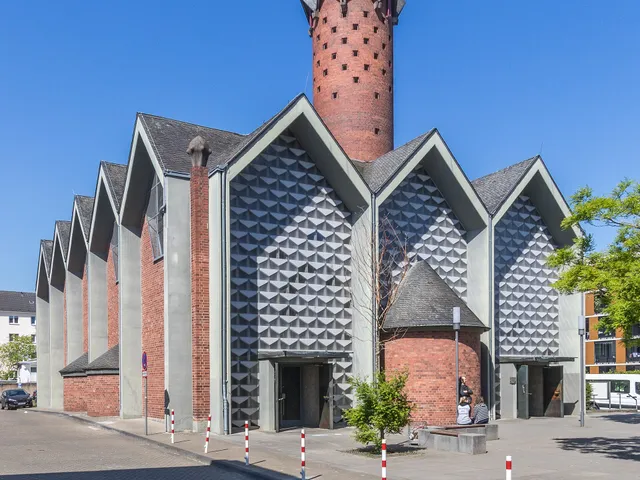
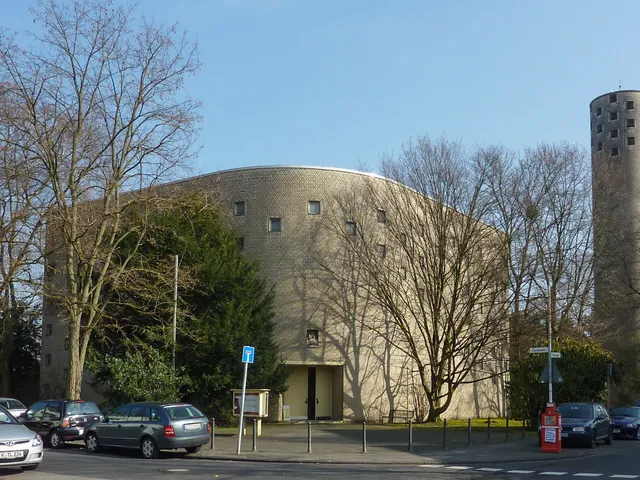
since 1961Former Catholic parish church in Cologne-Nippes, built 1960/61, deconsecrated since 2020 and slated for probable demolition.
Comments
- Loading comments…
Sources & links
- Official website
- Official website (retrieved 2026-07-17)
- Wikidata (retrieved 2026-06-26)
- Wikipedia (retrieved 2026-06-26)
Auto-generated, last verified: 2026-06-27
How this page is made
This page draws on open sources — Wikipedia, Wikidata, official websites and the city’s open data. Every statement is checked against the sources linked here, and pages are refreshed regularly.
Spotted a mistake anyway? Tell us below — we read every submission.