St. Hildegard in der Au
Former Catholic parish church in Cologne-Nippes, built 1960/61, deconsecrated since 2020 and slated for probable demolition.
since 1961
St. Hildegard in der Au is a former Catholic parish church in Cologne's Nippes district, built in 1960/61; it was taken out of service on 20 September 2020 and is expected to be demolished. Social housing is planned on the site of the increasingly dilapidated building.
Source: Wikipedia
At a Glance
- Type
- Former Roman Catholic parish church (deconsecrated)
- Architect
- Stefan Leuer
- Construction
- 1960/1961, consecrated first Advent 1961
- District
- Cologne-Nippes
- Dedication
- Saint Hildegard of Bingen
- Denomination
- Roman Catholic
- Status
- Out of service since 20 September 2020, demolition planned
After deconsecration, the organ and font moved to the Protestant Stephanuskirche in Cologne-Riehl as a "visible sign of ecumenical solidarity" – the organ sounded there again from the third Advent of 2022.
Things to do here
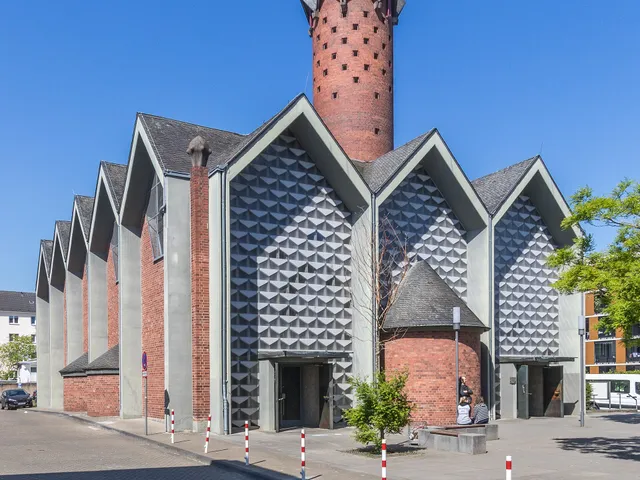
- View the parabolic architecture and free-standing campanile from outside
- Photograph the perforated façade with its 142 small windows
- Spot the Hildegard sculpture in the niche above the portal
- Explore 1960s post-war sacred architecture in the Nippes context
- Visit the organ and font in their new home, the Stephanuskirche in Cologne-Riehl
Age comparison
Age compared with other places in Cologne.
History
The parish was founded on 4 August 1959 alongside plans for a new church. The plot had belonged to the mother parish of St. Bonifatius in Nippes and held an allotment garden – hence the name suffix "in der Au" (in the meadow). After the building permit was granted in late 1959, the young parish took over responsibility for construction itself in March 1960. The foundation stone was laid on 29 May 1960 and the topping-out ceremony held on 20 December. Work on the church, youth centre and tower continued through 1961 until the consecration on 3 December 1961.
Architecture
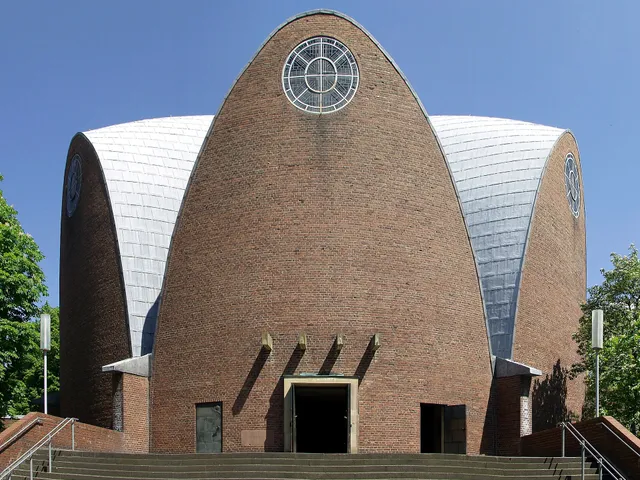
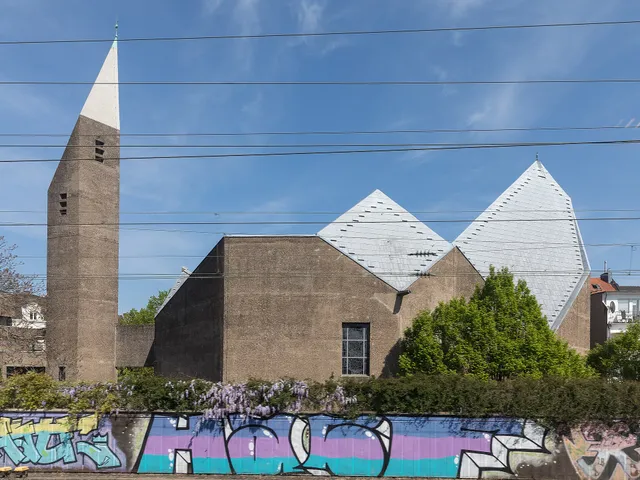
The building rises over a nearly square ground plan with two parabolically rounded corners at a quiet intersection. The square portal sits at the apex of one parabola, while a slender campanile on a circular base stands separately alongside. The parabolic square recurs 530 times in the coffered ceiling. The façade is "perforated" with 142 small square windows that begin with a coloured pane behind the altar and organ gallery and cascade down to the floor towards the corners. Above the entrance, a niche holds a sculpture of the patron saint Hildegard of Bingen. Inside, the entrance area divides beneath an ellipsoidal cantilevered gallery into vestibule and baptistery, and the pews fan out around the raised altar island.
Furnishings
The church was deliberately sparsely furnished and held no valuable artworks, initially for financial reasons. The foundation stone, set into the wall as a relic, comes from the convent of St. Hildegard in Eibingen near Rüdesheim. Klaus Balke created the altar, tabernacle, altar cross and candlestick (1962) and the Stations of the Cross (1964); the tabernacle is modelled on a Jewish Torah shrine. Hubert Schaffmeister made the coloured windows and glass partition, while Jochem Pechau created the Hildegard figure and the font. A two-manual Späth organ with 14 stops was added in 1968, along with a three-bell peal by Petit & Gebr. Edelbrock.
Closure
The dilapidated church was taken out of service with a solemn Mass on 20 September 2020; social housing is planned on its site. As a sign of ecumenical solidarity, the font and organ went to the Protestant Stephanuskirche in Cologne-Riehl, where the organ was inaugurated on the third Advent of 2022 after refurbishment. Beforehand, the Cologne musician group Sono Kollektiv documented the empty church in three videos with live music, premiered at an art event on 2 April 2022.
Timeline
- 1959The parish of St. Hildegard in der Au is founded on 4 August
- 1960Foundation stone laid on 29 May, topping-out ceremony on 20 December
- 1961The church is consecrated on 3 December
- 1968The two-manual Späth organ with 14 stops is acquired
- 2020Taken out of service on 20 September with a solemn Mass
- 2022The organ is re-inaugurated at the Stephanuskirche in Cologne-Riehl on the third Advent
Gallery
Map
Blue dots: other places nearby — tap to explore.
You might also like — related or nearby
Comments
- Loading comments…
Sources & links
Auto-generated, last verified: 2026-08-26
How this page is made
This page draws on open sources — Wikipedia, Wikidata, official websites and the city’s open data. Every statement is checked against the sources linked here, and pages are refreshed regularly.
Spotted a mistake anyway? Tell us below — we read every submission.