Hahnentorburg
Medieval twin-tower gate at Rudolfplatz — Cologne's western gateway, through which crowned kings entered the city after their coronation in Aachen.
since 1220
The Hahnentorburg at Rudolfplatz was one of originally twelve gate towers in Cologne's medieval city wall, securing the western access to the city along the road to Aachen and Jülich.
At a Glance
- Type
- Medieval city gate (twin-tower gate), listed monument in North Rhine-Westphalia
- Location
- Rudolfplatz, Altstadt-Süd district, Innenstadt borough
- City Wall
- Part of the eight-kilometre Cologne city wall (1180–1220)
- Built
- Early 13th century, first documented in 1264
- Today
- Home of the Carnival society EhrenGarde der Stadt Köln 1902
During the Middle Ages, kings freshly crowned in Aachen would enter Cologne through the Hahnentor on their way to the Shrine of the Three Kings in the cathedral – making this gate the official processional entrance for newly crowned rulers of the Holy Roman Empire.
Things to do here
- Marvel at the medieval double-tower gate
- Spot the city coat of arms and the reconstructed siege engines on the tower roofs
- Photograph the historic gatehouse
- Take a break on the lively Rudolfplatz
- Stroll toward Cologne Cathedral in the footsteps of crowned kings
Age comparison
Age compared with other places in Cologne.
History
The gate was built in the early 13th century as a twin-tower gate, similar in design to the surviving Eigelsteintor to the north and the demolished Gereonstor. In the Middle Ages, kings travelling from their coronation in Aachen would enter Cologne via the Aachener Straße through the Hahnentor and proceed to the Shrine of the Three Kings in Cologne Cathedral. The gate tower also served as a prison: in 1528, preachers Adolf Clarenbach and Johann Klopreis were incarcerated here; Klopreis escaped on New Year's Eve 1528, while Clarenbach was burned at the stake at Melaten Cemetery in 1529.
Name and Origin
The origin of the name is uncertain. One interpretation traces it to the 12th-century landowner "Hageno von Anselm"; another derives it from "Hano" ("grove"), suggesting "wood gate" in reference to the forests along the road to Aachen. In Mercator's 1570 city view it was called "Hanenpforts," with the adjoining street labelled "Hanen straiß" — today's Hahnenstraße.
Saved from Demolition
When Cologne began acquiring the fortification grounds in 1881 and dismantling its medieval city wall, the city chose to integrate only a handful of gate towers into the new urban landscape — the Hahnentor among them. City architect Josef Stübben restored it around 1890 and housed the Historical Museum within it, a forerunner of today's City Museum. The square to the west was renamed Rudolfplatz in 1883.
Architecture and Details
On the outer (field) side, the gate bears an eagle or city coat of arms with the inscription "Erneuert 1888" (Renovated 1888). Replica medieval siege engines stand on the tower roofs.
Today
Severely damaged in World War II — the semi-tower on the outer left side was largely destroyed — the gate later served as an exhibition venue. Since 1988 it has housed the EhrenGarde der Stadt Köln 1902 carnival society and a casino. The Hahnentorburg is one of four surviving gate towers of Cologne's medieval fortifications, alongside the Severinstorburg, Ulrepforte, and Eigelsteintorburg.
Timeline
- Anfang 13. Jh.Construction of Hahnentorburg as a double-tower gate
- 1264First documented mention of the gate
- 1528Adolf Clarenbach and Johann Klopreis imprisoned in the tower
- 1529Clarenbach and Peter Fliesteden burned at Melaten cemetery
- 1877Opening of Cologne's first horse tram line at the Hahnentor
- 1881City of Cologne acquires the fortress grounds from the military
- 1888Restoration by city architect Josef Stübben
- 1988EhrenGarde der Stadt Köln 1902 moves into the gate building
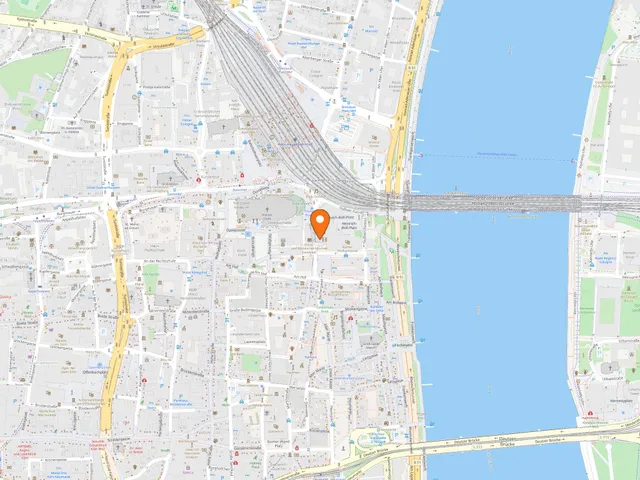
Map
Blue dots: other places nearby — tap to explore.
You might also like — related or nearby
Comments
- Loading comments…
Sources & links
- Official website
- Official Instagram (@ehrengarde.koeln)
- Official website (retrieved 2026-06-25)
- Wikidata (retrieved 2026-06-24)
- Wikipedia (retrieved 2026-06-24, rev 266187524)
Auto-generated, last verified: 2026-06-26
How this page is made
This page draws on open sources — Wikipedia, Wikidata, official websites and the city’s open data. Every statement is checked against the sources linked here, and pages are refreshed regularly.
Spotted a mistake anyway? Tell us below — we read every submission.