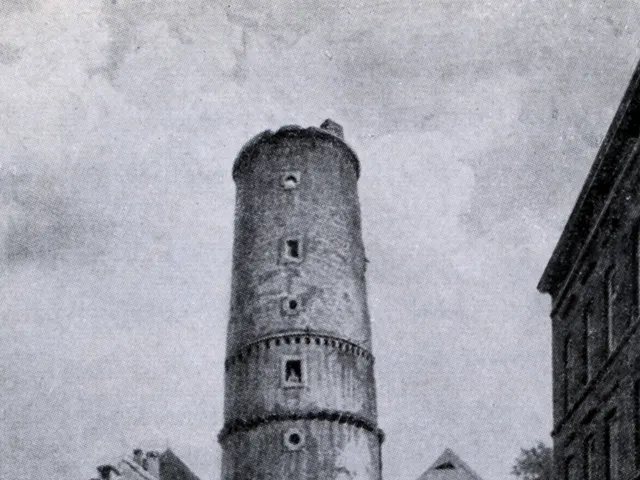
Schaafentor
A gate in Cologne's western ring wall from the second quarter of the 13th century, named after the local sheep farming, torn down in 1882.
since 1225
The Schaafentor (in the Cologne dialect "Schaafepooz") was one of Cologne's medieval city gates in the western ring wall, built in the second quarter of the 13th century. It stood at what is today the junction of Schaafenstraße and Habsburger Ring and was torn down in 1882.
Source: Wikipedia
At a Glance
- Built
- second quarter of the 13th century, first mentioned between 1235 and 1251
- Location
- western ring wall, junction of Schaafenstraße and Habsburger Ring
- Purpose
- a field gate and defensive structure; access to the western pastures for the sheep flocks
- Notable
- used in peacetime for tower imprisonment with three prison rooms; from 1475 also for "painful questioning" (torture)
- Demolished
- 1882
- Name
- from the local sheep farming (porta ovina), whose wool supplied Cologne's weavers' guild
Age comparison
Age compared with other places in Cologne.
Name and Surroundings
Adam Wrede described the area around the Schaafentor as rural country where sheep farming was highly valued as a source of meat and milk, but above all as a supplier of wool to Cologne's weavers' guild. The gate was accordingly called "porta ovina" — the Schaafentor (sheep gate). The "platea ovina" (today's Schaafenstraße) led out through the gate into open country toward Kloster Weiher, the early settlements of Lind, and on to Bachem.
Field Gate and Demolition
The Schaafentor was one of the city's five field gates (alongside the Severins, Weyer, Friesen, Hahnen and Eigelstein gates), which had so-called Bauerbänke attached to them. Their Bauermeister settled minor offences in the fields and regulated paths and cattle droving. In the late Middle Ages the gate mattered above all as access to the western pastures, into which larger sheep flocks were driven. As Cologne's population grew sharply in the 19th century, the city acquired the Prussian fortifications of the inner ring by contract in 1881 — for 11.794 million marks. That agreement ultimately led to the demolition of the Schaafentor in 1882.
Map
Blue dots: other places nearby — tap to explore.
You might also like — related or nearby

Comments
- Loading comments…
Sources & links
- Official website (retrieved 2026-08-17)
- Wikidata (retrieved 2026-08-17)
- Wikipedia (retrieved 2026-08-17)
Auto-generated, last verified: 2026-08-17
How this page is made
This page draws on open sources — Wikipedia, Wikidata, official websites and the city’s open data. Every statement is checked against the sources linked here, and pages are refreshed regularly.
Spotted a mistake anyway? Tell us below — we read every submission.