Köln Messe/Deutz Station
A two-level interchange station at Cologne's trade fair grounds: local trains cross the Hohenzollern Bridge above, while high-speed ICE services call on the lower level.
Until November 2004, the station was known as Köln-Deutz. Its roots go back to 1845, when the first station on the right bank of the Rhine was built for the line to Düsseldorf.
Auf einen Blick
- Type
- Deutsche Bahn two-level crossing station
- Location
- Deutz district on the right bank of the Rhine, Innenstadt borough
- Forecourt
- Ottoplatz
- Tracks
- ten platform tracks
- Opened
- 11 November 1913 (basic structure)
- Classification
- one of 21 stations in the top price category 1 of DB InfraGO
- Heritage protection
- parts of the tunnel facilities and the entire Ottoplatz
The Dombrücke built between Deutz and Cologne in 1859 was the first fixed bridge across the Rhine since Roman times, and was popularly nicknamed the „Muusfall“ (mousetrap).
Two Levels, Two Functions
The station is built on two levels. Trains on the elevated section, which includes its own stop for S-Bahn services, continue across the Hohenzollern Bridge to Cologne Central Station. At the lower level, normally only long-distance services call, running directly onto the Cologne–Rhine/Main high-speed line and bypassing the central station. This role as an ICE station goes back to concepts the City of Cologne developed from 1988 onward as part of the planned high-speed line to Frankfurt.
Changing Trains at the Trade Fair
The station serves as the main railway stop for the nearby Koelnmesse trade fair. Passengers switch here between Intercity-Express, regional trains, Regional-Express and S-Bahn services. An underground link leads to the nearby Deutz/Messe stop on the Cologne Stadtbahn. A cable car across the Rhine as a direct connection to the central station is discussed time and again.
From Four Stations to One
The first station, opened in 1845, was a terminus of the Cologne-Minden Railway Company, southwest of today's site near the Rhine. In 1859, the Dombrücke, popularly known as the "Muusfall" (mousetrap), became the first permanent bridge across the Rhine since Roman times. The new building, opened in 1913 to designs by Karl Biecker and Hugo Röttcher, gradually replaced the four passenger stations of the rival Cologne-Minden and Bergisch-Märkisch railway companies.
A Place of Deportation
During the Nazi era, almost all Jews living in Cologne were deported via Deutz-Tief station. The first transport left in October 1941, the last known one on 1 October 1944 to the Theresienstadt concentration camp. The trade fair halls served as the assembly camp.
After the War
The three-aisled platform hall of iron and glass was destroyed in the Second World War. Concrete platform canopies took its place.
Timeline
- 1845Terminal station of the Cologne-Minden Railway opened (20 December)
- 1859Dombrücke built; station becomes start of the Deutz-Gießen railway
- 1886Platforms of the Cologne-Minden terminal station closed (1 October)
- 1911–1913Construction of the Deutzerfeld marshalling and storage yard
- 1913New Deutz main station opened (11 November)
- 1941First deportation transport of Cologne Jews departs from Deutz (October)
- 1944Last known transport to Theresienstadt (1 October)
- 1988City of Cologne begins planning Deutz as ICE station
Gallery
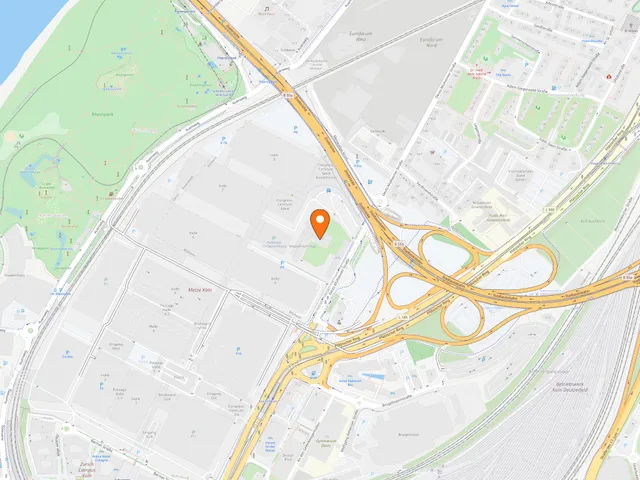
Map
Blue dots: other places nearby — tap to explore.
Address
Deutz
50679 Köln
You might also like — related or nearby
Comments
- Loading comments…
Sources & links
- Official website
- Official website (retrieved 2026-10-21)
- Wikidata (retrieved 2026-10-21)
- Wikipedia (retrieved 2026-10-21, rev 271490193)
Auto-generated, last verified: 2026-10-21
How this page is made
This page draws on open sources — Wikipedia, Wikidata, official websites and the city’s open data. Every statement is checked against the sources linked here, and pages are refreshed regularly.
Spotted a mistake anyway? Tell us below — we read every submission.