Reichenspergerplatz Court Building
Cologne's largest historic courthouse, opened in 1911 and still home to the Higher Regional Court – with an air-raid shelter beneath the forecourt, rediscovered in 2009 and open for visits on the first Sunday of each month.
since 1911
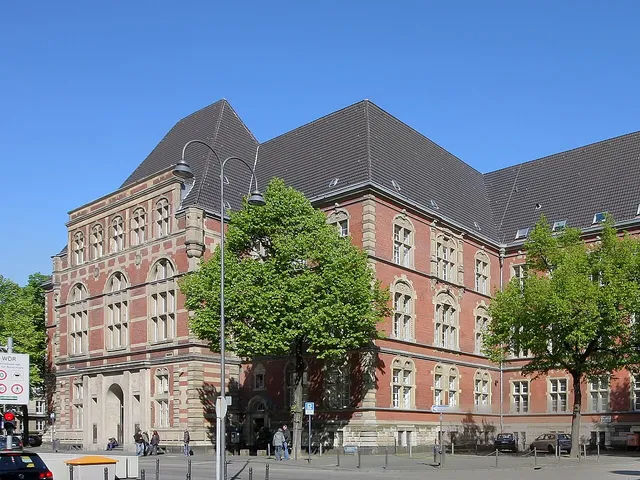
This imposing courthouse on Reichenspergerplatz in the Neustadt-Nord district has filled an entire city block since 1911. The Cologne judiciary still works behind its sweeping façade – and beneath the lawn out front lies a walkable bunker.
At a glance
- Location
- Reichenspergerplatz 1, 50670 Cologne (Neustadt-Nord)
- Opened
- 7 October 1911
- Architect
- Paul Thoemer (Prussian Ministry of Public Works)
- Style
- Historicism, Neo-Baroque idiom
- Current use
- Higher Regional Court of Cologne, Prosecutor General's Office, parts of the Local Court
- Status
- listed heritage building
- Highlight
- 1942 air-raid shelter, open for visits every 1st Sunday of the month
Age comparison
Age compared with other places in Cologne.
History
The Higher Regional Court of Cologne traces back to the Rhenish Court of Appeal, founded in 1819 by King Frederick William III; it has carried its present name since 1879. When the older court building on Appellhofplatz proved too small as early as 1907, a new building at Reichenspergerplatz was planned. Excavation began in October 1907, and four years later the building was handed over to its purpose. At its inauguration it was regarded as the largest court building in Germany and was strikingly modern for its time – equipped with electric lighting, a telephone system, a lift and electric dust extraction.
The Second World War left it a ruin. The 1950s reconstruction did without large parts of the façade decoration. During an extensive renovation in the 1980s and 1990s, the main staircase and its dome were restored to their original form.
Architecture
The five-storey building takes up a whole block and is framed by five streets. The main façade facing Reichenspergerplatz – named after the jurist and politician August Reichensperger – curves as a concave quarter-arc. A richly decorated central projection holding the main portal is flanked by two forward-curving side wings; columns, pilasters, capitals, consoles and sculptures make up the ornament. Above the portal, a frieze depicts Justitia, the goddess of justice. A 72-metre roof turret, added at the request of Emperor Wilhelm II, was destroyed in the war and never rebuilt.
Inside
Beyond the portal opens a lofty entrance hall whose open, symmetrical flights of stairs form the design highlight – as in many courthouses of the era. The central staircase with its skylight leads up to the courtrooms and offices; seven further staircases sit at the corners and mid-corridors. The corridors add up to more than four kilometres in length, linking the wings of the building, which is lit by three large and four small interior courtyards. Originally the plans called for a plenary hall, 35 courtrooms and 400 offices. On the first upper floor (corridor H) a memorial commemorates the court staff who fell in the First World War.
The bunker beneath the square
Hidden under the lawn in front of the building is an air-raid shelter from 1942: a repeatedly angled, M-shaped tube 1.50 m wide and 2.20 m high, covering around 200 m². Its unreinforced concrete ceiling, only about 30 centimetres thick, sits just below the level of the lawn; officially the shelter was approved for 180 people. The court used it as a records store until 1979, after which it was forgotten. Only in 2009 was the bunker rediscovered – and it has been open for visits on the first Sunday of each month ever since.
Gallery
Map
Blue dots: other places nearby — tap to explore.
Address
Reichenspergerpl. 1
50670 Köln
You might also like — related or nearby
Comments
- Loading comments…
Sources & links
Auto-generated, last verified: 2026-08-20
How this page is made
This page draws on open sources — Wikipedia, Wikidata, official websites and the city’s open data. Every statement is checked against the sources linked here, and pages are refreshed regularly.
Spotted a mistake anyway? Tell us below — we read every submission.