Flora Köln
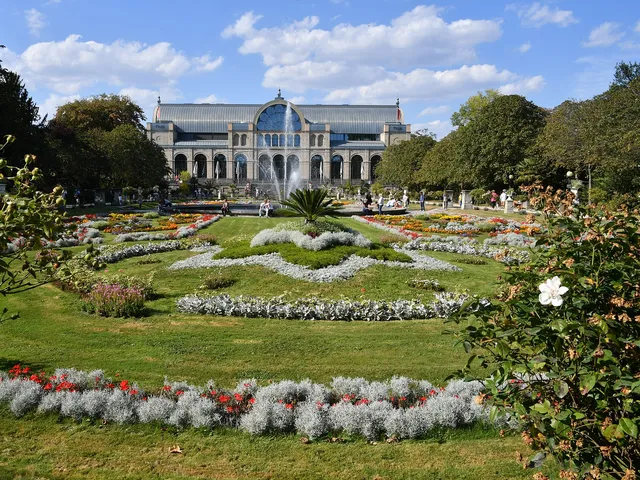
A palm house inspired by London's Crystal Palace, opened in 1864 in Cologne's Botanical Garden and reborn as an event hall with its historic silhouette.
Behind the Flora's historic silhouette lies an event hall that has been newly built since 2014. Today the building is used for conferences, concerts and social events.
At a Glance
- Type
- palatial building in the Historicist style
- Location
- Cologne Botanical Garden, Riehl district, Nippes borough
- Total area
- 1,870 m²
- Rooms
- 6
- Festive hall
- on the ground floor, for up to 900 people
- Heritage listing
- since June 1980
Cologne's Flora was originally built as a palm house with a cast-iron glass roof. After World War II the barrel roof was removed, and only the 2011–2014 renovation gave it a barrel roof again, this time made of metal instead of glass.
The 1864 Design
The Flora was designed by the Cologne architects Max Nohl and Joseph Felten, who took the Crystal Palace in London as one of their models. Their design combined Arabic and Moorish elements with Romanesque round arches and Renaissance touches. Conceived as a palm house, the building had a large glass roof carried by a barrel-shaped cast-iron structure. It opened on 14 August 1864.
War Damage and the Postwar Years
The building was badly damaged in the Second World War, and the cast-iron barrel roof was removed afterwards. The Flora was left with a single storey under a tiled hipped roof, and the outer towers received small pavilion roofs. On three sides, the first-floor façade survived largely intact. In 1995 the side rooms were renovated and the catering area was extended with a so-called Parksalon.
New Management and Closure
In June 2006 the Cologne city council handed the running of the Flora to KölnKongress, now Koelncongress. In April 2008 the VdK North Rhine-Westphalia social association awarded it the plaque "Unseren Dank dem Bauherrn" for exemplary, barrier-free construction. A year later, in 2009, it was closed because of structural defects.
Full Renovation, 2011 to 2014
After the closure, the city council decided on a complete renovation. From 2011 to 2014 the building was gutted and rebuilt and extended along historical lines, creating an event hall with a historic silhouette. The Flora again has a crossed barrel roof, though now as a closed metal roof rather than a glass dome.
Timeline
- 1864Flora opens as a palm house with a glass roof (14 August)
- 1980Listed as a protected monument (June)
- 1995Side rooms renovated, restaurant area extended by a park salon
- 2006City council hands operation to KölnKongress GmbH (June)
- 2008VdK plaque awarded for exemplary barrier-free construction (April)
- 2009Closed due to structural defects
- 2011–2014Complete renovation: rebuilt and extended following the historical model
Map
Blue dots: other places nearby — tap to explore.
Address
Am Botanischen Garten 1a
50735 Köln
Contact
You might also like — related or nearby
Comments
- Loading comments…
Sources & links
- Official website
- Official website (retrieved 2026-10-26)
- Wikidata (retrieved 2026-10-26)
- Wikipedia (retrieved 2026-10-26, rev 265613950)
Auto-generated, last verified: 2026-10-26
How this page is made
This page draws on open sources — Wikipedia, Wikidata, official websites and the city’s open data. Every statement is checked against the sources linked here, and pages are refreshed regularly.
Spotted a mistake anyway? Tell us below — we read every submission.