Bastei
Expressionist observation restaurant (1924) on a Prussian caponier — superstructure cantilevers 8 m beyond its footprint; closed since 2019.
since 1924
Right on the Rhine riverbank, at the northern end of Cologne's ring roads, the Bastei rises on the site of a former Prussian fortification.
At a Glance
- Type
- Building, former observation restaurant
- Location
- Cologne-Neustadt-Nord, northern end of the Kölner Ringe on the Rhine riverbank
- Architect
- Wilhelm Riphahn
- Opened
- 22 October 1924
- Style
- Expressionism
- Size
- 300 m² floor space, capacity up to 200 people
- Status
- Listed building; operations ceased since 2019
In 1932, the poet Joachim Ringelnatz dedicated a poem to the Bastei in which he whimsically wished the building would "spin like a carousel" – a testament to how the unusual rooftop restaurant fired the imagination of well-known writers.
Things to do here
- Admire the expressionist building on the Rhine bank
- Photograph the striking architecture with its cantilevered upper structure
- Stroll along the northern end of Cologne's Ringe
- Let your gaze wander over the Rhine and its bridges
- Spot the illuminated trident on the rooftop peak
Age comparison
Age compared with other places in Cologne.
Origin and Construction
Until the 1880s, this was the entrance to Cologne's security harbour, in existence since 1813 and abandoned around 1880. A 7.5-metre-high caponier was built at the access point in 1891, its basement levels reaching eleven metres below ground; a naming competition gave it the name Bastei. Riphahn expanded this Prussian substructure towards the street and placed a lightweight steel upper storey on top.
Architecture
The superstructure cantilevers eight metres beyond its footprint. Above the jagged roof sits a pointed cupola open on the inside; the post-war restored Bastei bears an illuminated trident at its apex. The building marked Riphahn's stylistic and professional breakthrough. Initially controversial among Cologne residents who feared it would harm the city's skyline, it won widespread approval after completion.
Legacy and Literature
Architecture critic Heinrich de Fries wrote in 1926 that the building merged with the landscape, river and bridges, appearing almost detached from its base. Joachim Ringelnatz, a frequent visitor to Cologne, dedicated his 1932 poem "Cologne Seen from the Bastei" to it, expressing the wish that the Bastei might spin like a carousel.
War and Reconstruction
In 1943 the building suffered severe war damage. Riphahn restored it in 1958 to its 1927 appearance, and Lord Mayor Theo Burauen reopened it. Hans Herbert Blatzheim opened a restaurant here on 4 December 1958 that went on to earn a Michelin star. A renovation costing around 1.5 million marks followed in 1985.
Closure
Regular restaurant operations ended in 1997; thereafter the Bastei could only be hired for private events. Building defects — including fire safety violations, asbestos and rust — forced its closure in March 2019, with renovation costs estimated at over ten million euros. Since early 2022 the structure has been propped up externally. A 2022/2023 study by the Technical University of Braunschweig revealed significant deformations, structural weakening and corrosion in the load-bearing framework above the Prussian substructure, requiring the dismantling of the supporting construction.
Timeline
- 1813Cologne security harbour established
- um 1880Security harbour abandoned
- 1891Caponier built on former harbour entrance, named Bastei
- 1924Opened as panorama restaurant (22 October), architect Wilhelm Riphahn
- 1927Building modified by Riphahn
- 1943Severe war damage
- 1958Restored by Riphahn and reopened; restaurant awarded Michelin star
- 1985Major renovation for around 1.5 million marks
- 1997Regular restaurant operations ceased, venue rented for events only
- 2019Operations permanently ceased due to structural deficiencies (March)
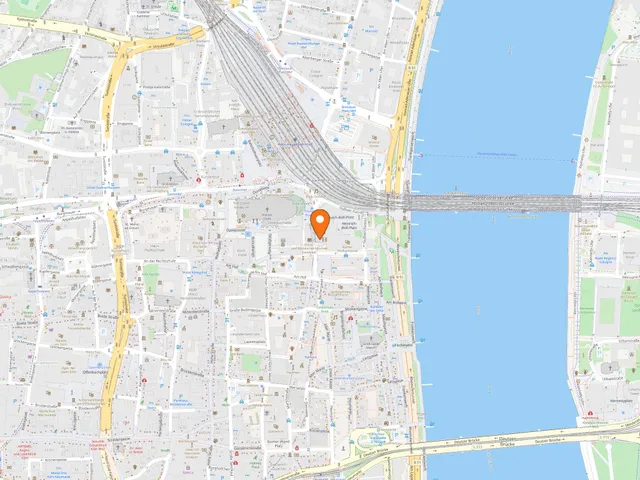
Map
Blue dots: other places nearby — tap to explore.
Address
Konrad-Adenauer-Ufer
50668 Köln
You might also like — related or nearby
Comments
- Loading comments…
Sources & links
- Official website
- Wikipedia (retrieved 2026-07-30)
- Official website (retrieved 2026-06-25)
- Wikidata (retrieved 2026-06-24)
Auto-generated, last verified: 2026-06-25
How this page is made
This page draws on open sources — Wikipedia, Wikidata, official websites and the city’s open data. Every statement is checked against the sources linked here, and pages are refreshed regularly.
Spotted a mistake anyway? Tell us below — we read every submission.