Bahnhof Köln-Dellbrück
Around 1900, eight or nine extra trains brought Sunday day-trippers to Dellbrück. Today the S 11 stops at the station on the line to Bergisch Gladbach.
The old station building served more than the railway: the people of Dellbrück also used it for celebrations.
At a Glance
- Type
- Station on the Cologne–Bergisch Gladbach railway line
- Location
- Dellbrück district, Mülheim borough, Cologne east of the Rhine
- Line
- Opened in 1868 by the Bergisch-Märkische Eisenbahn-Gesellschaft
- Current building
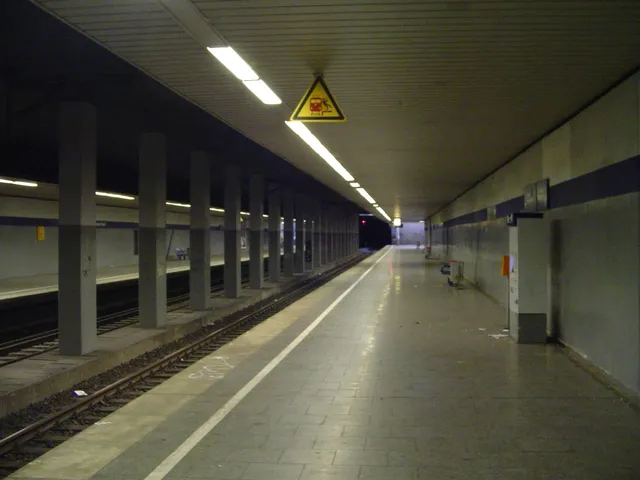
- Glass and exposed-concrete structure, completed by 1981
- Platforms
- Each 232 metres long and 76 cm high
- Connections
- S-Bahn line 11, three bus routes
When the football club Preußen Dellbrück reached the semi-final of the German championship in 1950, several special trains from Reutlingen, Mannheim and Offenbach brought fans to Dellbrück station on Sundays.
The Old Station Building
The station building was inaugurated in 1870 on a plot that the municipal council had provided free of charge. The two-storey building, in the late Neoclassical round-arch style with a floating gable, housed a restaurant alongside the railway facilities. According to the press, a banquet was held there on 24 March 1881 for Emperor Wilhelm I's birthday, and Bengal fireworks lit up the decorated building. The neighbouring level crossing on the Dellbrücker Hauptstraße / Diepeschrather Straße axis initially had no barriers. Black-and-white signs told pedestrians, riders and drivers of livestock and pack animals to stop when a train approached, and threatened punishment for violations.
Commuters, Day-Trippers and Football Fans
On weekdays, Dellbrück workers travelled from here to the factories in Deutz, Kalk and Mülheim. On Sundays the crowds were even bigger, as day-trippers arrived from the nearby cities. In 1902 a freight yard was built east of the passenger station, after industrial and craft businesses had been attracted with inexpensive building land. A second track and a road underpass followed in 1908. When the football club Preußen Dellbrück reached the semi-finals of the German Championship in 1950, several special trains from Reutlingen, Mannheim and Offenbach arrived on Sundays.
Change of Ownership, War and Demolition
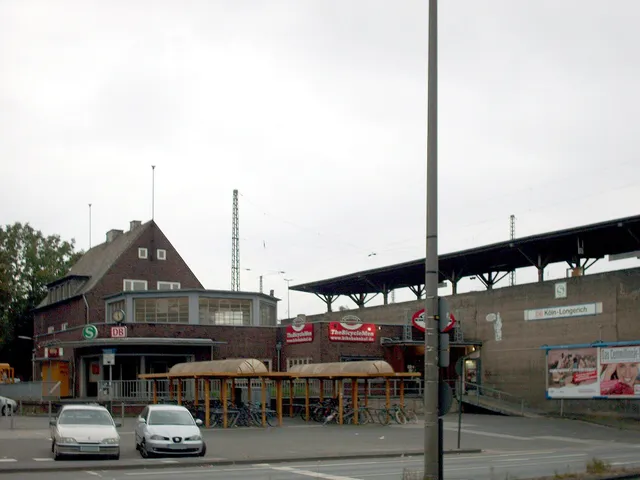
On 1 June 1882 the station passed to the Kingdom of Prussia when the Bergisch-Märkische Eisenbahn-Gesellschaft was nationalised. During an air raid on the night of 22–23 August 1943, the roof structure of the station building was badly damaged. In 1979 the old building was demolished and replaced with a functional building in the style of the time.
Tracks and Platforms
The S-Bahn stops at two electrified through tracks: at a side platform on track 1 and an island platform between tracks 2 and 3. The platforms are staggered and face each other directly over only a good 120 metres. Because of the platform height, step-free boarding into the Class 423 multiple units is not possible. North of the platform towards Cologne lies another electrified platform track, which passengers can use over 210 metres. Just under 500 metres to the east, a single-track section begins and continues to Bergisch Gladbach.
Services and Interchange
The S 11 runs every 20 minutes Monday to Saturday and every 30 minutes on Sundays. The RB 24 (Eifel-Bahn), which otherwise runs between Kall, Euskirchen and Köln-Deutz, uses the additional platform track: a single morning service is extended to Dellbrück on school days and returns from here to Köln Hbf. Freight trains of Häfen und Güterverkehr Köln (HGK) pass through the station on their way to the Bergisch Gladbach freight yard. Passengers can change to three bus routes: line 154 of the Kölner Verkehrs-Betriebe and lines 435 and 436 of Wupsi. Two of these connect to light rail lines 3 and 18 at the Dellbrück Hauptstraße stop. Regular buses to Köln-Dünnwald, Köln-Porz and Bergisch Gladbach depart from the small bus station south of the westbound platform, which leads to the bus bays without any change in level.
Timeline
- 1868Opening of the Mülheim–Bergisch Gladbach line by the Bergisch-Märkische Railway
- 1870Station building inaugurated
- 1882Nationalisation: station passes to the Kingdom of Prussia on 1 June
- 1902Freight yard established east of the passenger station
- 1904Station building extended
- 1908Further extension, second track and road underpass
- 1943Bomb damage to the roof of the station building (22/23 August)
- 1979Old station building demolished; replacement completed by 1981
Map
Blue dots: other places nearby — tap to explore.
You might also like — related or nearby
Comments
- Loading comments…
Sources & links
- Official website
- Official website (retrieved 2026-10-25)
- Wikidata (retrieved 2026-10-25)
- Wikipedia (retrieved 2026-10-25, rev 264967200)
Auto-generated, last verified: 2026-10-25
How this page is made
This page draws on open sources — Wikipedia, Wikidata, official websites and the city’s open data. Every statement is checked against the sources linked here, and pages are refreshed regularly.
Spotted a mistake anyway? Tell us below — we read every submission.