Hardtmühle
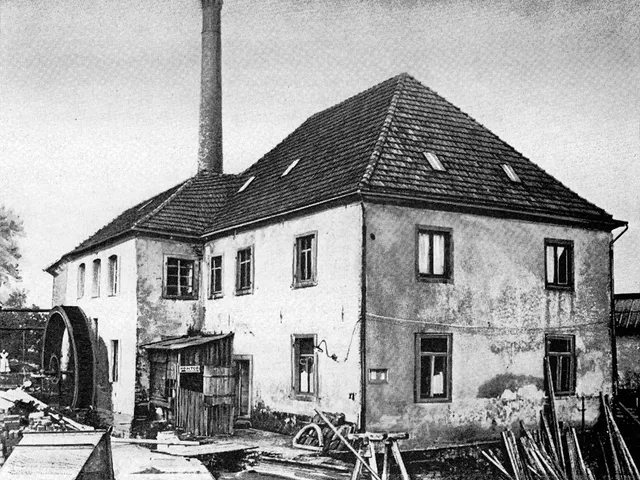
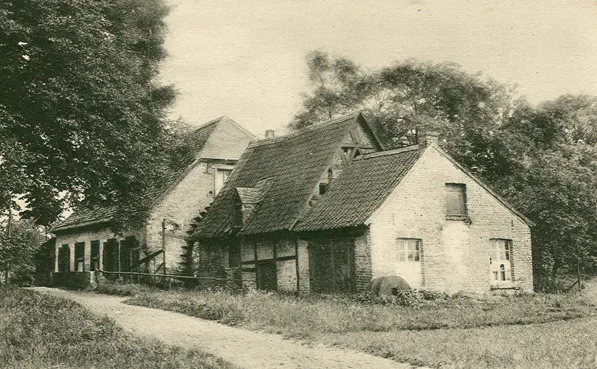
Die Hardtmühle in Köln-Dellbrück war nacheinander Pleiß-, Öl- und Gipsmühle und erzeugt heute Strom, wenn die Strunde genug Wasser führt.
The Hardtmühle belonged to the Hardthof, whose oldest known name is "Mühlenhof" (Mill Farm). That name, along with "Mühlenstatt" (mill site) for the plot, suggests that a mill already stood here before 1340.
Source: Wikipedia
Auf einen Blick
- Type
- Water mill on the Strunde
- Location
- Köln-Dellbrück, Mülheim borough
- Former owner
- Johanniterkommende Herrenstrunden (Knights Hospitaller commandery)
- Destruction
- Fire in October 1811
- Drive after rebuilding
- Undershot water wheel
- Today
- Converted for power generation
Over the centuries the Hardtmühle on the Strunde was successively a polishing mill for armour, an oil and gunpowder mill, a coal mill and finally a plaster mill, producing plaster used for saint figures for Maria Laach Abbey, among other things; today it generates electricity when the Strunde carries enough water.
Under the Hospitallers
The farm was part of the Herrenstrunden commandery's holdings. Gobelin von Gierath and his wife Udela had received the mill site and three-quarters of a Morgen of arable land from the order as a hereditary lease. On 24 June 1340, they committed to building a mill there for grain of all kinds. A document from 1532 mentions a burnishing mill (Pleißmühle) where armor was polished. From 1597, the tenant Johann Reinhard von Malmentier ran an oil and gunpowder mill here; since the powder mill is no longer mentioned after 1668, it was most likely a pure oil mill by then.
Fire and Rebuilding
After the commandery was dissolved during secularization in 1806, the mill passed into state ownership. A fire reduced it to ashes in 1811. The domain administration sold the building plot to the highest bidder on condition that a new mill be built. From 1814, it belonged to Heinrich Moll of Mülheim, who built another oil mill, equipped with two oil presses.
Changing Owners
In 1854, Moll gave the mill to his six children, who had it auctioned off after their parents died in 1863. Co-heir Eduard Moll bought it and in 1873 sold it, together with fittings, residential buildings and land, to the file manufacturer Eduard Karl Kind of Strunden. Kind first had black meal made from coal there, which proved unprofitable.
Plaster and Alabaster
In 1875, Kind leased the mill to Karl Paffrath, a Cologne citizen, who used it as a plaster and alabaster mill. Kind, however, reserved the right to run a grinding shop during the night hours, from seven in the evening until seven in the morning. Until after the Second World War, the Paffrath family produced plaster for making figures of saints, for example at the Benedictine monastery of Maria Laach. Later they switched to high-quality plasters for dental technology and bandages. The plant continued to operate as a plaster mill until the 1980s.
Power from the Strunde
After plaster production ended, the mill was converted to generate electricity. When the Strunde carries enough water, power is still produced there today.
Timeline
- 1340Gobelin von Gierath receives the mill site and commits to building a mill
- 1532Mill mentioned as a polishing mill for armour
- 1597Re-leased to Johann Reinhard von Malmentier; oil and powder mill
- 1806Commandery dissolved; mill passes into state ownership
- 1811Fire destroys the mill completely
- 1814Heinrich Moll becomes owner and builds a new oil mill
- 1873Sold to Eduard Karl Kind; initially a coal mill
- 1875Leased to Karl Paffrath; run as gypsum and alabaster mill
Map
Blue dots: other places nearby — tap to explore.
You might also like — related or nearby
Comments
- Loading comments…
Sources & links
Auto-generated, last verified: 2026-11-08
How this page is made
This page draws on open sources — Wikipedia, Wikidata, official websites and the city’s open data — plus basic place data and photos from Google Maps where a place is listed there. Every statement is checked against the sources linked here, and pages are refreshed regularly.
Spotted a mistake anyway? Tell us below — we read every submission.