Leverkusen Rhine Bridge
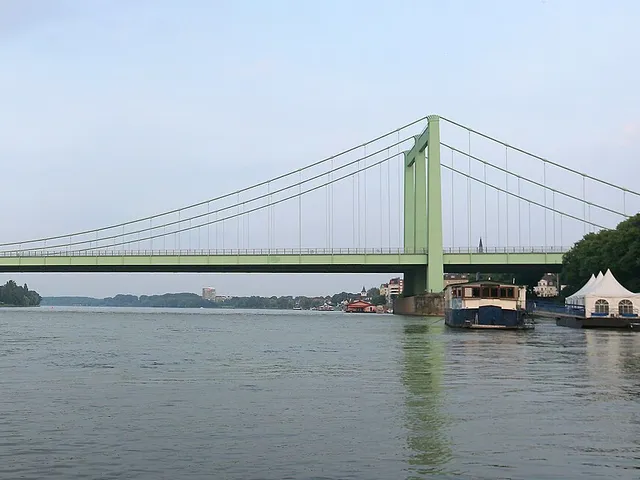
Cable-stayed bridge carrying the A1 motorway across the Rhine at Leverkusen — replacing the demolished 1965 bridge that could no longer handle modern traffic.
since 1965
The Leverkusen Rhine Bridge carries the A1 — the northern section of Cologne's motorway ring — across the Rhine. It replaces the earlier 1965 bridge, which could no longer cope with dramatically increased traffic volumes.
Source: Wikipedia
At a Glance
- Type
- Cable-stayed bridge (main river span) with an adjoining approach viaduct
- Location
- Leverkusen, Wiesdorf district, Borough I
- Function
- Rhine crossing for the A1 / northern Cologne motorway ring
- Length per structure
- 1,065.65 m (688.70 m main span + 376.95 m approach viaduct)
- Pylon height
- 57 m above the carriageway
- First bridge opened
- 4 February 2024
- Cycle and pedestrian path
- 3.50 m wide, separated by transparent noise barriers
The A-shaped pylons of the new cable-stayed bridge are accessible from within: for inspection purposes, the hollow steel pylon legs contain staircases and even an elevator — allowing workers to ascend 57 metres inside a bridge pylon by lift.
Things to do here
Length comparison
Longest bridge in Cologne
Length compared with other Cologne bridges.
Age comparison
Age compared with other places in Cologne.
Why a New Bridge?
By 2012 it was clear that the 1965 bridge could no longer handle traffic volumes that had tripled, and the decision was made to demolish it entirely. Alongside the new build, the A1 section between the Köln-Niehl junction and the Leverkusen-West interchange is being widened to eight continuous lanes. Engineering was led by Grassl Beratende Ingenieure Bauwesen, with architectural input from Firmhofer + Günther Architekten.
Design and Structure
The crossing consists of two mirror-image structures, one for each direction of travel. Each combines a double-pylon cable-stayed main span with a western approach viaduct. When fully complete, each structure will carry four through lanes, two lanes for on- and off-ramps, a hard shoulder, and a separate cycle and pedestrian path. The deck is supported by two A-shaped steel pylons, from whose upper halves eight stay cables extend on each side.
How It Was Built
The two halves of the main span grew from each bank using the free-cantilever method: vessels brought prefabricated segments, which were lifted into position by crane and welded together. The final segments of the first half were installed on 5 September 2023, and the first structure opened to traffic on 4 February 2024. Until the second structure — planned for 2027 — is complete, all traffic uses this single bridge.
Approval and Funding
Planning approval was granted by the Cologne Regional Authority on 10 November 2016. Legal challenges, including one from the citizens' initiative NGL (Network against Noise, Fine Dust and Other Harmful Emissions), were dismissed by the Federal Administrative Court in October 2017. The groundbreaking ceremony took place on 14 December 2017, with the federal government contributing €740 million to the project.
Timeline
- 1965Opening of the original Leverkusen Rhine Bridge
- 2012Assessment: bridge unable to handle tripled traffic volume
- 2015Law to accelerate construction: complaints restricted to Federal Administrative Court
- 10. November 2016Planning approval decision issued by Cologne Regional Government
- 11. Oktober 2017Federal Administrative Court dismisses all objections to the new bridge
- 14. Dezember 2017Official groundbreaking ceremony for the new bridge
- 5. September 2023Final segments of the first bridge half installed
- 4. Februar 2024First bridge structure opened to traffic
Gallery
Map
Blue dots: other places nearby — tap to explore.
You might also like — related or nearby
Comments
- Loading comments…
Sources & links
Auto-generated, last verified: 2026-06-27
How this page is made
This page draws on open sources — Wikipedia, Wikidata, official websites and the city’s open data. Every statement is checked against the sources linked here, and pages are refreshed regularly.
Spotted a mistake anyway? Tell us below — we read every submission.