Museum of Applied Arts (MAKK)
Cologne museum of applied arts and design in the Schwarz-Bernard building — once dismissed as sterile, later celebrated as a 'third way' in postwar architecture.
since 1888
The Museum für Angewandte Kunst Köln (MAKK) is dedicated to applied arts from the Middle Ages to the present day, spanning medieval craftsmanship to contemporary design. Its current home is a building whose critical reputation has reversed entirely over the decades.
At a Glance
- Type
- Museum of applied arts and design
- Location
- An der Rechtschule 7, Altstadt-Nord (city centre)
- Collection
- European decorative arts from the Middle Ages to today — jewellery, porcelain, weapons, furniture and architecture
- Former name
- Kunstgewerbemuseum (until 1987)
- Award
- Cologne Architecture Prize 1967 for the current building
The entire museum building on Hansaring was destroyed on June 29, 1943, during World War II – yet nearly all of the collections were saved and temporarily housed in the medieval Eigelstein Gate Tower.
Things to do here
- Stroll through the collection of applied art from the Middle Ages to today
- Marvel at craftwork like jewelry, porcelain and furniture
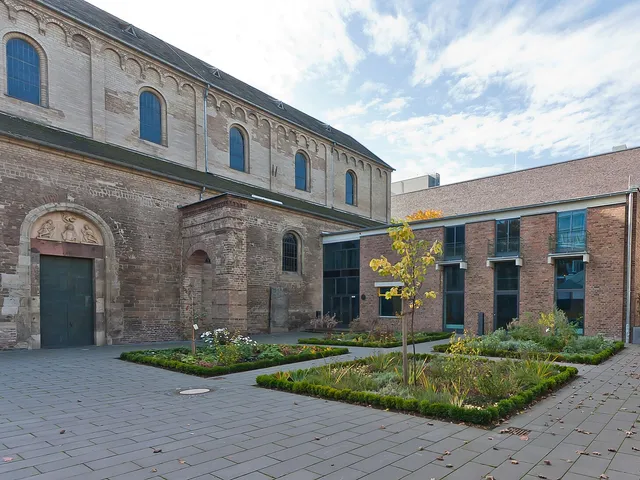
- Discover the square inner courtyard with its preserved late-Gothic windows
- Take in the striking brick architecture of the Schwarz-Bernard building
- Admire modern design and photograph your favorite pieces
Age comparison
Age compared with other places in Cologne.
History
The museum traces its origins to 1888, when citizens came together through the Kölnisches Kunstgewerbe-Verein (today the Overstolzengesellschaft) to establish a museum for applied arts. The founding collection was built around the holdings of scholars Ferdinand Franz Wallraf and Matthias Joseph de Noël, rapidly expanded through donations. A neo-Gothic building on Hansaplatz opened in 1900, its centrepiece the Pallenberg Hall — designed by Melchior Lechter and named after its donor, Jakob Pallenberg. The building was destroyed in the Second World War in 1943, though nearly the entire collection was saved. From 1961 to 1986, the holdings were housed in the Romanesque Overstolzenhaus on Rheingasse.
The Schwarz-Bernard Building
Since 1989 the MAKK has occupied a building in the city centre that previously housed the Wallraf-Richartz-Museum and Museum Ludwig. Rudolf Schwarz and Josef Bernard built it between 1953 and 1957; Walter von Lom later adapted it discreetly for exhibition use. The floor plan echoes the Minorite monastery once on the same site: four wings enclose a square inner courtyard recalling the shape of the former cloister. Late Gothic triple windows from the cloister survive on the west side, and a late Gothic church rises to the south.
Architecture and Reception
The three-storey, block-like structure is built from red brick with symmetrically arranged rectangular windows; parallel pitched roofs evoke historicising pointed gables. Its austerity was read as a twentieth-century response to the ideals of the medieval mendicant orders. The glazed north wall of the inner courtyard forms a display window into the museum, with a generous entrance hall beyond. After its opening the building was criticised for its "factory-like sobriety" and its large hall dismissed as wasted space. In retrospect it has come to be seen as a successful synthesis of the inherited and the newly created — celebrated as a "third way" between grand modernist gesture and mere restoration of the past.
Timeline
- 1888Foundation of the Cologne Arts and Crafts Association; museum established
- 1900Opening of the neo-Gothic arts and crafts museum at Hansaplatz (2 May)
- 1943Building at Hansaplatz destroyed in World War II (29 June)
- 1953–1957New building constructed by Rudolf Schwarz and Josef Bernard
- 1961Collection moves into the Overstolzenhaus on Rheingasse
- 1967Schwarz-Bernard building awarded the Cologne Architecture Prize
- 1987Renamed to Museum für Angewandte Kunst Köln (MAKK)
- 1989Move into the current building (former Wallraf-Richartz/Museum Ludwig)
Gallery
Map
Blue dots: other places nearby — tap to explore.
Address
An d. Rechtschule 7
50667 Köln
Hours
Di: 10:00–18:00
Mi: 10:00–18:00
Do: 10:00–18:00
Fr: 10:00–18:00
Sa: 10:00–18:00
So: 10:00–18:00
You might also like — related or nearby
Comments
- Loading comments…
Sources & links
- Official website
- Wikidata (retrieved 2026-06-24)
- Wikipedia (retrieved 2026-06-24, rev 267796632)
- Official website (retrieved 2026-06-24)
Auto-generated, last verified: 2026-06-26
How this page is made
This page draws on open sources — Wikipedia, Wikidata, official websites and the city’s open data. Every statement is checked against the sources linked here, and pages are refreshed regularly.
Spotted a mistake anyway? Tell us below — we read every submission.