Rautenstrauch-Joest-Museum
Cologne's ethnological museum with over 65,000 objects from around the world, exploring human cultures under the theme "The Human Being in Their Worlds."
since 1901
The Rautenstrauch-Joest-Museum – Cultures of the World is Cologne's ethnological museum and the only civic institution of its kind in North Rhine-Westphalia. Since 2010, it has been located in the Kulturquartier at Neumarkt in Cologne's city centre.
At a Glance
- Type
- Ethnological (anthropological) museum
- Location
- Cäcilienstraße, Altstadt-Süd, city centre
- Collection
- more than 65,000 objects from Oceania, Africa, Asia, and the Americas
- Reopened
- 22 October 2010 in the Kulturquartier at Neumarkt
- Original building
- Ubierring 45, opened 12 November 1906
- Concept
- thematic departments rather than geographic divisions
- Landmark piece
- a rice barn from Sulawesi, over 7.5 metres tall, displayed in the foyer
The museum's landmark exhibit is a rice barn from Sulawesi, Indonesia (ca. 1935), standing over 7.5 meters tall and faithfully reconstructed right in the entrance foyer – making the largest exhibit the first thing visitors encounter.
Age comparison
Age compared with other places in Cologne.
Collection and Origins
The museum's foundation is the estate of Cologne geographer and ethnologist Wilhelm Joest (1852–1897). After his early death during a research expedition, his sister Adele Rautenstrauch and her husband, the merchant Eugen von Rautenstrauch, donated his collection of around 3,400 objects to the City of Cologne. Adele Rautenstrauch also funded the construction of the first museum building on Ubierring with a donation of 250,000 marks. The collection ranks among the ten largest ethnographic collections in Germany and includes, among other highlights, an extensive Cameroon collection.
The Buildings
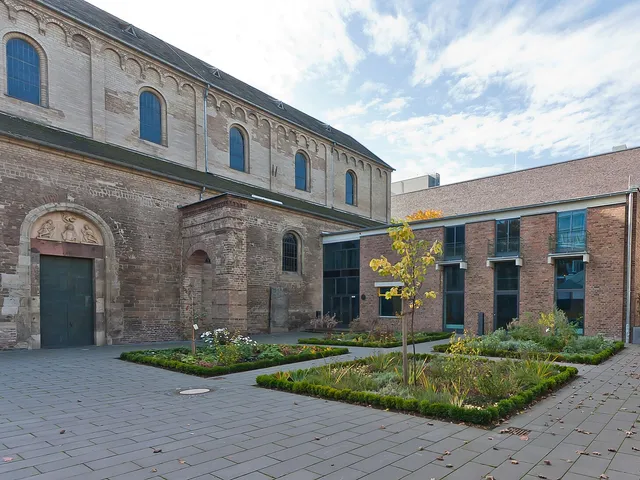
The original building on Ubierring was partially destroyed by two bomb hits during the Second World War and closed in early 1945, reopening in 1967. From 2002, a new building was constructed at Neumarkt to plans by the Braunschweig firm Schneider + Sendelbach; its completion was repeatedly delayed due to the city's financial situation. Since 2010, the museum has shared the Kulturquartier with the Museum Schnütgen; the two buildings are connected by a passageway displaying medieval stained glass.
The Exhibition
With the reopening, the displays were reorganised from broad geographic regions into a thematic framework. Under the motto "The Human Being in Their Worlds," the permanent exhibition is structured around themes such as housing, clothing and jewellery, religions, rituals, and death and the afterlife. This cross-cultural approach also includes European culture, inviting visitors to reflect on their own perspectives.
Worth Knowing
The museum's largest exhibit is a decorated rice barn from Sulawesi (c. 1935), reassembled in its entirety in the foyer. Since November 2011, a video guide in sign language has been available for the permanent collection — the first Cologne museum to offer this. In 2018, following a city council resolution, the museum repatriated a Māori skull to the Museum of New Zealand Te Papa Tongarewa.
Timeline
- um 1899Adele Rautenstrauch donates Joest's ~3,400-object collection to the city of Cologne
- 12. November 1906Opening of the museum at Ubierring 45 (plans by Erwin Crones)
- 1918British occupation converts the building into a military hospital
- 28. Februar 1945Museum closed after bomb strike
- 1966Acquisition of the Clausmeyer collection (Oceanic and African art)
- 7. Juli 1967Reopening at Ubierring
- 2002Demolition of Josef-Haubrich-Kunsthalle; construction of new museum building begins
- 22. Oktober 2010Reopening in the Kulturquartier at Neumarkt (Cäcilienstraße)
Gallery
Map
Blue dots: other places nearby — tap to explore.
Address
Cäcilienstraße 29-33
50676 Köln
Hours
Di: 10:00–18:00
Mi: 10:00–18:00
Do: 10:00–20:00
Fr: 10:00–18:00
Sa: 10:00–18:00
So: 10:00–18:00
You might also like — related or nearby
Comments
- Loading comments…
Sources & links
- Official website
- Official Instagram (@rautenstrauchjoestmuseumkoeln)
- Wikidata (retrieved 2026-06-23)
- Wikipedia (retrieved 2026-06-23, rev 265689984)
- Official website (retrieved 2026-06-24)
Auto-generated, last verified: 2026-06-27
How this page is made
This page draws on open sources — Wikipedia, Wikidata, official websites and the city’s open data. Every statement is checked against the sources linked here, and pages are refreshed regularly.
Spotted a mistake anyway? Tell us below — we read every submission.