Museum Schnütgen
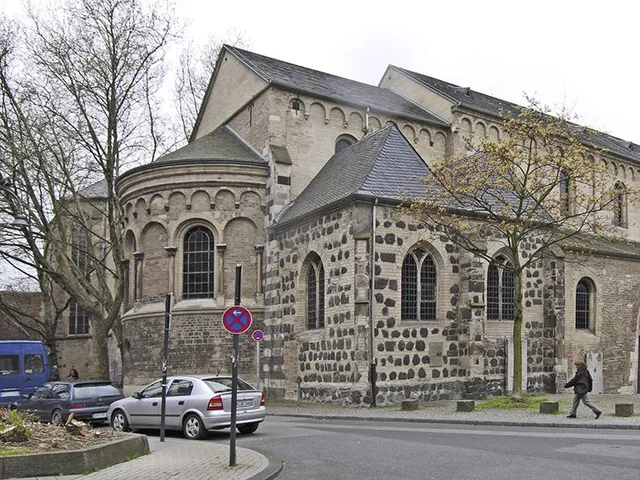
One of Europe's richest medieval collections, housed in the Romanesque basilica of St. Cecilia in Cologne's historic city centre.
since 1910
Museum Schnütgen holds one of the finest and most comprehensive collections of medieval Christian art in Europe — ranking alongside the Cloisters in New York and the Musée de Cluny in Paris.
At a Glance
- Type
- Museum of Christian art
- Location
- Altstadt-Süd, city district Innenstadt
- Building
- Romanesque basilica of St. Cecilia, museum home since 1956
- Extension
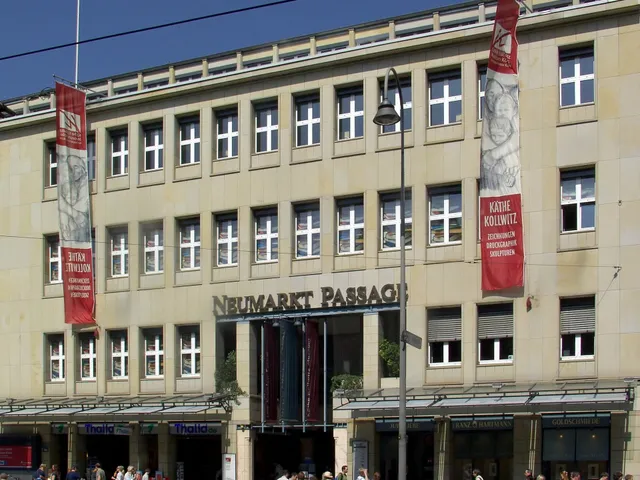
- additional gallery space in the "Kulturquartier am Neumarkt" since 2010
- Collection focus
- Rhenish Middle Ages, 11th–15th century
- Also on show
- Early Modern, Baroque, 19th century, and other European cultures including Byzantium
- Opening hours
- Tue–Sun 10am–6pm, Thu until 8pm, closed Monday
During World War II, the medieval St. George Crucifix – today one of the museum's most famous pieces – was temporarily hidden inside a savings bank vault before being moved to a secure depot, an unusual refuge for a work of art more than a thousand years old.
Things to do here
- Wander through one of Europe's richest medieval art collections
- Marvel at Christian art from the 11th to 15th centuries
- Experience the Romanesque basilica of St. Cecilia as a unique exhibition space
- Seek out the famous medieval St. George crucifix
- Pause in the atmospheric church interior and soak up the ambiance
Age comparison
Age compared with other places in Cologne.
Collection and Scholarship
Thanks to its holdings and research programme, the museum is recognised as a leading centre of medieval studies. Among its most celebrated pieces is the medieval St George Crucifix, which was evacuated during the Second World War — first to a bank vault, then to the Hohenzollern art depot — before returning to Cologne.
History
In 1906, cathedral canon Alexander Schnütgen donated his collection of sacred art to the city of Cologne, on the condition that a dedicated wing be added to the then Applied Arts Museum on Hansaring. Opened in 1910 as the "Sammlung Schnütgen", it was renamed Schnütgen-Museum in 1918. In 1932 it relocated to the rebuilt Abbey of St Heribert in Deutz, a building that was destroyed by wartime action by 1945.
A New Home in St. Cecilia
After the war, the museum reassembled its scattered collection and reopened in 1956 in the restored basilica of St. Cecilia — the first of Cologne's museums to reopen after the war. The former convent had been secularised in 1802 and returned to the city in 1805. The arrangement was initially seen as temporary, with a 20-year use agreement in place with the Archdiocese.
Church and Museum in One
Shortly before the reopening, Cardinal Joseph Frings reconsecrated the church. To this day, St. Cecilia serves a dual purpose as both museum and place of worship, with services held on St Cecilia's Day (22 November) and at Christmas.
Timeline
- 1906Alexander Schnütgen donates his collection to the city of Cologne
- 1910Opening of the annex at the Kunstgewerbemuseum as 'Sammlung Schnütgen'
- 1918Renamed 'Schnütgen-Museum'; death of founder Alexander Schnütgen
- 1932Move to Heribertkloster in Deutz (2,000 m² new exhibition concept)
- 1939Closure at the start of World War II, exhibits evacuated
- 1953Hermann Schnitzler becomes director and rebuilds the museum
- 1956Reopening in the Romanesque basilica of St. Cecilia
- 2010Significant expansion of exhibition space at the Kulturquartier am Neumarkt
Treasures & artworks
A few highlights from the collection.
Stained-glass fragment (c. 1320) from a Magi window in Cologne Cathedral, now held by Museum Schnütgen.
Stained-glass window (c. 1300) from the Liebfrauenkirche in Trier (inv. M 524), depicting the stoning of St. Stephen.
Stained-glass panel (1441, inv. M 532) showing Eve holding the apple.
A cycle of two medieval church windows depicting the death and coronation of the Virgin Mary.
Stained-glass panel (c. 1450–1460, inv. M 521) showing the Virgin and Child beside St. Ursula.
Gallery
Map
Blue dots: other places nearby — tap to explore.
Address
Cäcilienstraße 29-33
50667 Köln
Hours
Di: 10:00–18:00
Mi: 10:00–18:00
Do: 10:00–20:00
Fr: 10:00–18:00
Sa: 10:00–18:00
So: 10:00–18:00
You might also like — related or nearby
Comments
- Loading comments…
Sources & links
- Official website
- Official Instagram (@museumschnuetgen)
- Wikidata (retrieved 2026-06-24)
- Wikipedia (retrieved 2026-06-24, rev 268069619)
- Official website (retrieved 2026-06-24)
Auto-generated, last verified: 2026-06-27
How this page is made
This page draws on open sources — Wikipedia, Wikidata, official websites and the city’s open data. Every statement is checked against the sources linked here, and pages are refreshed regularly.
Spotted a mistake anyway? Tell us below — we read every submission.