Klein St. Martin
A lone tower surviving from a demolished Cologne parish church — once crowned with a tall Gothic spire visible across the Rhine skyline, today capped by a flat pyramid.
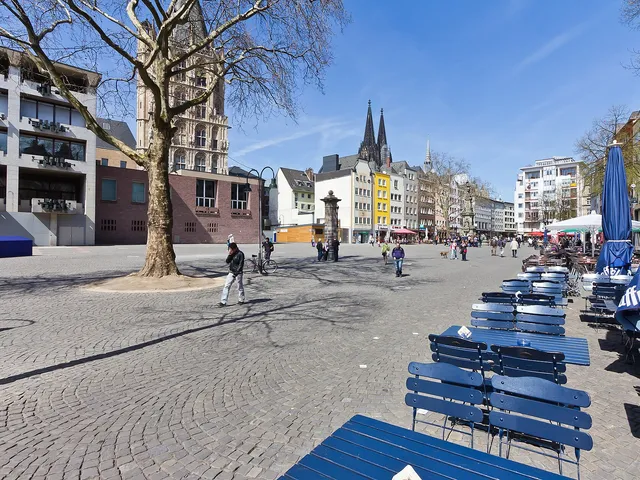
In the heart of Cologne's old town stands the tower of Klein St. Martin — the sole remnant of a former parish church whose nave was demolished around 1824, leaving only its four-storey tower behind.
Source: Wikipedia
At a Glance
- Type
- Tower of a former parish church (listed monument in North Rhine-Westphalia)
- Location
- Altstadt-Nord, Innenstadt district, between Pipinstraße and Augustinerstraße
- Architectural style
- Gothic
- Named after
- Martin of Tours
- Part of
- Cologne's Rhine panorama
- Notable
- Has housed the bells of St. Maria im Kapitol since 1637
The organ of Klein St. Martin, built in 1554 by master craftsman Vitus ten Bendt, survived the secularization and was transferred to the parish church of St. Bartholomäus in Porz-Urbach after the church closed, where it was partially renewed as late as 1962 – an instrument from the 16th century that outlasted the church itself by nearly 160 years.
Age comparison
Age compared with other places in Cologne.
History
The exact founding date of the church is unknown; it first appears in records through entries in the Schreinsakten between 1130 and 1140, and by name in documents from 1172 in connection with the consecration of its crypt. To distinguish it from the collegiate church of Groß St. Martin, the name Klein St. Martin — meaning "Little St. Martin" — quickly took hold. Between roughly 1460 and 1486 the church was rebuilt as a five-aisled hall church with a new west tower; in 1489 the master builder Johann von Langenberg added its vaulted ceilings.
Secularisation and Demolition
Klein St. Martin remained in use until Napoleon's secularisation in 1802. The congregation was reassigned to the neighbouring church of St. Maria im Kapitol, and Klein St. Martin closed. Its nave was sold at auction and passed into secular hands, eventually being torn down around 1824 due to structural decay. The tower alone was allowed to stand: after the west front of St. Maria im Kapitol had collapsed in 1637, its bells had been moved into the spacious tower of Klein St. Martin, which has kept them ever since.
From Tall Spire to Flat Cap
In Anton Woensam's 1531 panoramic view of Cologne, the tower appears with a tall Gothic kink spire and formed a prominent landmark on the Rhine skyline. It burned out during the Second World War. When rebuilt as part of the restored Rhine panorama, it received a blunt Romanesque cap in the form of a low pyramid that barely clears the riverfront roofline. At the very top, a weathervane by Elmar Hillebrand depicts St. Martin of Tours.
Chapel in the Base
In 1954 a devotional chapel was created in the tower's ground floor. Its bronze portal from 1963 and the tabernacle are both the work of Heribert Calleen.
Timeline
- 2. Hälfte 10. Jh.First church of St. Martin built as the Rhine suburb was enclosed within the city walls
- 1130–1140First documented evidence in the register deeds
- 1172–1176First charters; consecration of the crypt
- um 1460–1489Complete rebuilding as a five-aisled Gothic hall church; vaulted in 1489
- 1637Five bells from St. Maria im Kapitol transferred to the tower after its westwork collapsed
- 1802Church suppressed under Napoleonic secularisation
- um 1824Nave demolished due to dilapidation; tower left standing
- 1954Chapel of devotion established in the tower's ground floor after wartime reconstruction
Map
Blue dots: other places nearby — tap to explore.
You might also like
Comments
- Loading comments…
Sources & links
Auto-generated, last verified: 2026-06-26