Reformationskirche
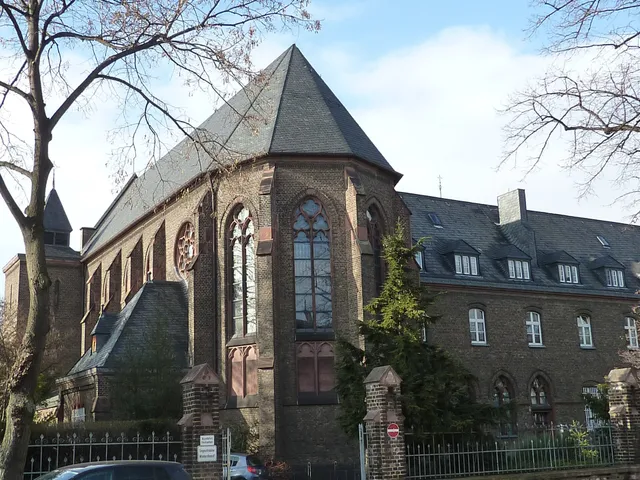
Protestant church in Cologne-Marienburg famed for its 15-metre concrete-glass window depicting creation striving toward Christ.
The church serves the Protestant parish of Bayenthal, part of the Cologne-Left of Rhine deanery.
At a Glance
- Type
- Protestant church building
- Location
- Marienburg district, Rodenkirchen borough (Cologne)
- Built
- 1903–1905, designed by Otto March
- Rebuilt
- 1958–1961, chancel has faced south ever since
- Highlight
- 15-metre concrete-glass window by Eugen Keller (1961)
During reconstruction after severe wartime damage (1958–1961), the church's orientation was changed: since then the chancel has faced south instead of its original direction.
History
The church was constructed between 1903 and 1905 to designs by architect Otto March. It suffered severe damage from bombing during the Second World War. During reconstruction from 1958 to 1961, the orientation was altered, so the chancel has faced south ever since.
Concrete-Glass Window
Created by Eugen Keller in 1961, the 15-metre-high concrete-glass window depicts creation striving toward Christ. In the upper section, Christ is shown seated on a rainbow with the globe at his feet. The lines of the concrete framework guide the movement of creation—people, animals, moon and stars—toward him.
Organ
The instrument was built in 1954 by Cologne organ builder Willi Peter, originally for the Martin-Luther-Haus in Cologne-Bayenthal, before being installed on the west gallery of the Reformationskirche in 1965. It originally comprised 34 stops across three manuals and pedal. The Hauptwerk and pedal division sit in the two pedal towers flanking the rose window, the Schwellwerk beneath the rose, and the Rückpositiv in the gallery balustrade. In 2016, Freiburger Orgelbau restored the instrument and adapted its voicing to the room's dry acoustics. A further expansion is planned, adding four stops to the Hauptwerk and a seven-stop Auxiliaire division on the opposite gallery, which would bring the organ to 45 stops across three manuals and pedal.
Church Music
Organists and choir directors have included Paul Kube (1964–1971), Hans Martin Corrinth (1971–1975), Mary Sherburne (1976–1980), Wolfram Gehring (1980–1988), Christian Collum (1988–2008) and Marc Jaquet (2008–2016). Samuel Dobernecker has held the post since 2016. Paul Kube had earlier served from 1936 to 1964 as organist and choir director at the parish's Martin-Luther-Haus, the original home of today's organ.
Timeline
- 1903–1905Church built according to plans by Otto March
- 1958–1961Rebuilt after war damage, altar area reoriented to the south
- 1954Organ built by Willi Peter for the Martin-Luther-Haus
- 196115-metre concrete glass window created by Eugen Keller
- 1965Organ installed on the west gallery of the church
- 2016Organ restored and expanded by Freiburger Orgelbau
Gallery
Map
Blue dots: other places nearby — tap to explore.
Address
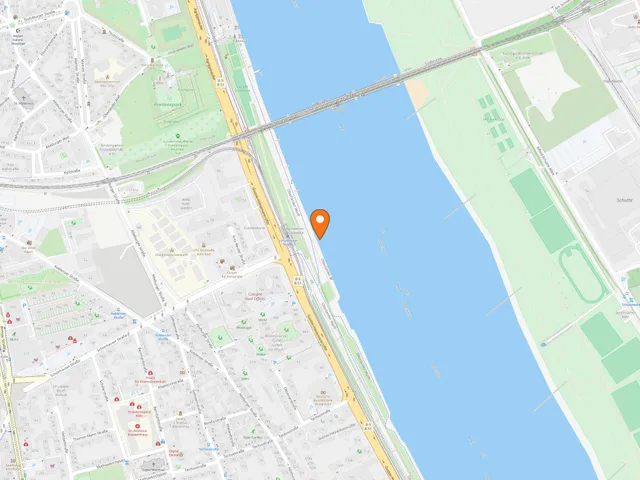
Mehlemer Str. 29
50968 Köln
You might also like — related or nearby
Comments
- Loading comments…
Sources & links
- Official website
- Official website (retrieved 2026-10-17)
- Wikidata (retrieved 2026-09-04)
- Wikipedia (retrieved 2026-09-04)
Auto-generated, last verified: 2026-09-04
How this page is made
This page draws on open sources — Wikipedia, Wikidata, official websites and the city’s open data. Every statement is checked against the sources linked here, and pages are refreshed regularly.
Spotted a mistake anyway? Tell us below — we read every submission.