Alteburger Mühle
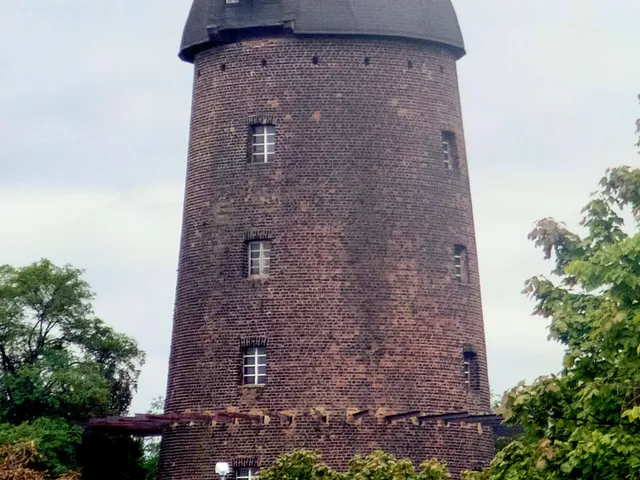
Marienburg's oldest surviving building: a former windmill atop a medieval tower, now part of the Polish Consulate General.
Just under 100 m west of the Rhine bank on the Oberländer Ufer stands a building whose history stretches from a Roman fleet fort through an excursion inn to a diplomatic mission.
Source: Wikipedia
At a Glance
- Type
- Former windmill (gallery smock mill), listed monument
- Location
- An der Alteburger Mühle 6, in the far northeast of Köln-Marienburg (Rodenkirchen district)
- Built
- Late 18th century
- Foundation
- Medieval round tower, probably from the 12th/13th century
- Current use
- Trade and Investment Section of the Polish Consulate General
- Heritage protection
- Entered in Cologne's list of monuments on 20 December 1983
The Alteburg Mill was built in the late 18th century on the remains of a medieval round tower within the area of a Roman fleet fort; from 1835 it served for a time as a bone-stamping mill for a lime and bone-burning works, and today it houses the trade department of the Polish consulate general.
From Tower to Mill
The origin is probably a round tower of basalt lava and other stone, mentioned in 1209 together with a nearby chapel on the site of the former Roman fleet fort of Alteburg. Its masonry resembles that of Cologne's city wall of the same period. The fortress known as "Aldeburch" may have been razed in 1474 during the Cologne Diocesan Feud. The merchant Johann Wilhelm Huybens, who had a 20-Morgen English garden laid out in 1782, presumably had the windmill built on the tower stump a few years later.
Construction
The medieval stump was built up with new masonry and topped with a brick gallery. Above it rose a three-storey brick mill tower that narrows toward the top, crowned with a cap for the sails. The jambs are framed in sandstone.
Changing Uses
From 1835, under Ludwig Böcking, the mill served as a bone-crushing mill for a lime and bone kiln; a fire damaged it in 1858. Shortly after 1870, the Kölnische Maschinenbau-AG of Bayenthal set up a restaurant inside and opened the gallery as a viewing balcony via a wide staircase. The restaurant ceased operating by the First World War at the latest. In the Second World War the tower burned out and was subsequently restored; in 1950/51 a residential extension was added and the gallery was removed.
Home of a Foreign Mission
Since 1977 the Polish trade mission has used the building, initially as the office of the embassy's trade counsellor in Bonn. For this purpose, a one- to five-storey ensemble with the mill tower at its core was built in 1977/78 to plans by Helmut Plück and Manfred Walther. The round tower now houses reception and office rooms. Since 2014 the Consulate General has hosted its "Marienburger Matineen" here. Since 2013 the mill has been the only remaining foreign mission in Marienburg.
Timeline
- 1209Round tower and chapel near the Alteburg fort first mentioned
- 1474Castle complex possibly razed during the Cologne Stiftsfehde
- 1782Huybens lays out English garden; windmill built a few years later
- 1835Used as bone-crushing mill under Ludwig Böcking
- 1858Mill partially destroyed by fire
- nach 1870Machine-building company opens restaurant in the mill
- 1950/51Restored after wartime fire, extension added, gallery removed
- 1977Polish embassy trade office moves into the mill
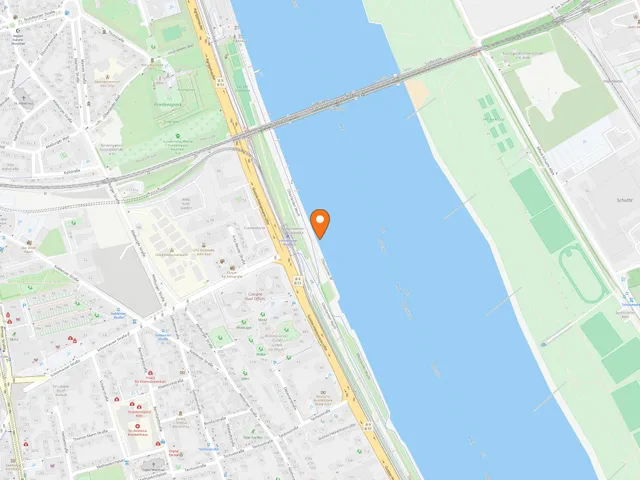
Map
Blue dots: other places nearby — tap to explore.
You might also like — related or nearby
Comments
- Loading comments…
Sources & links
Auto-generated, last verified: 2026-10-19
How this page is made
This page draws on open sources — Wikipedia, Wikidata, official websites and the city’s open data. Every statement is checked against the sources linked here, and pages are refreshed regularly.
Spotted a mistake anyway? Tell us below — we read every submission.