Langeler Auwald
A Cologne nature reserve along a Rhine river bend in the Langel district, with remnants of floodplain forest, a flood dyke and a breeding ground for numerous rare bird species.
since 1989
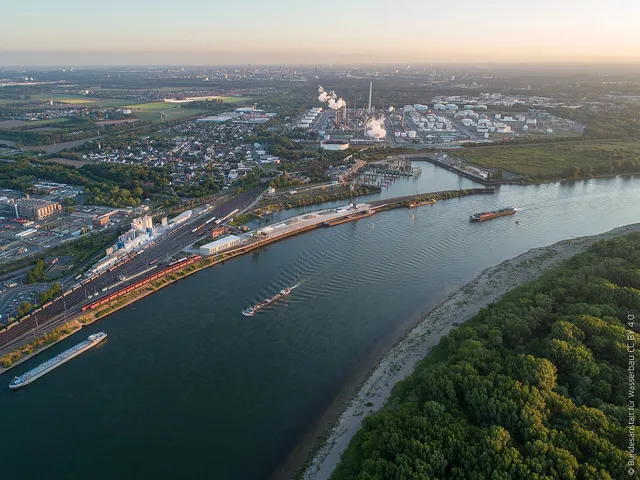
The Langeler Auwald is a nature reserve on the right bank of the Rhine in Cologne's south, stretching along a bend of the river in the district of Langel. Across a good 22 hectares, riverbank zones, remnants of floodplain woodland and grazed grassland alternate here — a refuge for numerous, and in some cases rare, bird species.
At a Glance
- Location
- Langel district, Porz borough, right-bank southern Cologne
- Protection status
- nature reserve with the designation K-018
- Area
- roughly 22.43 hectares (digitised)
- Landscape
- Rhine bank on the Wesseling river bend, with a remnant of floodplain forest and a flood dyke
- Wildlife
- breeding ground for 19 Red List bird species, plus seven bat species
- Neighbourhood
- lies opposite the Godorf harbour on the far side of the Rhine
Area comparison
Area compared with other Cologne parks and green spaces.
Age comparison
Age compared with other places in Cologne.
Location & Landscape
The reserve runs along the slip-off slope of the Rhine, where the river makes a broad sweep near Wesseling. Its defining feature is a gravel strip 50 to 100 metres wide along the bank, periodically flooded and carrying the flotsam-line vegetation typical of such sites. Further inland lies a flood dyke covered with nutrient-poor grassland.
Habitats
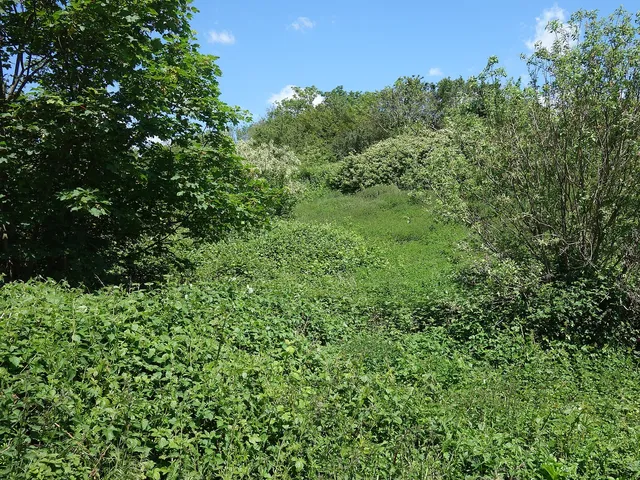
Between the surviving willow-poplar softwood floodplain forest and the dyke, a patchwork of different land uses lines up side by side: intensively managed grassland, an open stand of poplars with shrubs grazed by horses, ponies and cattle, an abandoned orchard, a newly planted orchard with short-mown turf, and an arable field with a copse. Channels running parallel to the river thread through the grazed poplar stand, where a mixed ash-poplar stand thrives alongside nutrient-loving tall-herb vegetation — the ash trees here reaching trunk diameters of 50 to 90 centimetres.
Wildlife
The variety of habitats is mirrored in the fauna: alongside numerous plant species, many birds live here, some of them rare, such as the cuckoo, grey partridge and little ringed plover. Nineteen of the breeding bird species appear on the Red List. Added to these are seven species of bat, a rich insect world of butterflies and grasshoppers, and various amphibians.
Map
Blue dots: other places nearby — tap to explore.
Hours
So: 00:00–24:00
You might also like — related or nearby
Comments
- Loading comments…
Sources & links
Auto-generated, last verified: 2026-08-09
How this page is made
This page draws on open sources — Wikipedia, Wikidata, official websites and the city’s open data. Every statement is checked against the sources linked here, and pages are refreshed regularly.
Spotted a mistake anyway? Tell us below — we read every submission.