Baadenberger Senke, Stöckheimer See and Große Laache
A sprawling nature reserve of former gravel pits in Cologne's north-west – now a landscape of lakes, woodland and one of the most important amphibian spawning grounds west of the Rhine.
since 2007
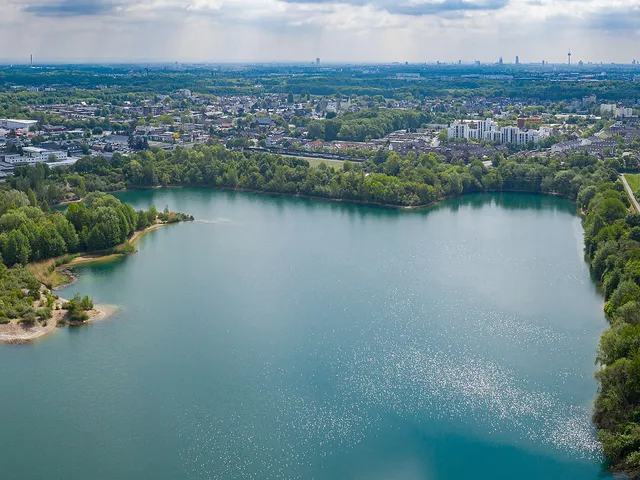
In the north-west of Cologne, between the districts of Auweiler and Mengenich and bordering the Rhein-Erft district, lies a roughly 74-hectare mosaic of former quarry lakes, woodland and grassland. Disused gravel and sand pits have given rise here to a valuable secondary habitat.
At a Glance
- Location
- north-west Cologne, between Auweiler and Mengenich, east of Pulheim (between the A 1 and B 59)
- Protection status
- nature reserve, reference K-022 (established)
- Area
- about 74 ha (official), 72.97 ha digitised
- Designation
- in force since 2007, legally binding in 2011
- Highlight
- one of the most important amphibian spawning grounds in Cologne west of the Rhine
- Habitats
- quarry lakes, reed beds, wet woodland, orchards, extensive grassland
Things to do here
Area comparison
Area compared with other Cologne parks and green spaces.
Age comparison
Age compared with other places in Cologne.
Setting & Landscape
The reserve stretches east of Pulheim between the districts of Auweiler and Mengenich, framed by the A 1 to the east and the B 59 to the south. It forms the only contiguous woodland in this otherwise farmland-dominated landscape and continues into the neighbouring Rhein-Erft district. As a stepping-stone biotope, it links habitats for the wildlife of the surrounding fields. Geologically notable is the middle-terrace escarpment with an alluvial channel in front of it.
Lakes from Gravel Extraction
At its heart is the Stöckheimer See, a large lake that emerged from a quarry east of the Stöckheimer Hof. Gravel extraction has ceased and there is no fishing use; the water is clear and the banks are partly lined with narrow strips of reed and reedmace. On the northern shore, a steep bank about two metres high offers potential nesting sites for the sand martin. South of the farmstead lie further quarry waters of the so-called Baadenberger Senke: the western lake is used for angling and is surrounded by embankments up to 15 metres high with species-rich vegetation, while the eastern lake, with its roughly three-metre steep bank, remains undisturbed. Many marsh frogs were recorded here in 1998. The waters form part of a network of quarry lakes between Cologne-Pesch and Pulheim.
Wildlife & Plants
The open water surfaces are an important habitat and resting place for waterfowl such as the common pochard, grey heron and cormorant. Species listed on the NRW Red List include the highly endangered whinchat and the nightingale. Along the banks and in the reed beds grow broadleaf cattail, blue-green rush and soft rush. Extensively sheep-grazed grassland north of the substation on Stöckheimer Weg provides a refuge for insects and small mammals.
Stöckheimer Hof & Ancient Trees
Around the Stöckheimer Hof, with its stables and horse paddocks, the scene is shaped by richly structured field copses, including old oaks up to a metre in trunk diameter and plenty of deadwood. A path south of the farmstead is lined with old sweet chestnuts. The overgrown park to the south-east, with its high proportion of old trees, is especially significant for cavity-nesting birds. At its edge stands a row of giant sequoias designated as a natural monument, whose roots are partly affected by the adjacent gravel extraction.
Gallery
Map
Blue dots: other places nearby — tap to explore.
Hours
So: 00:00–24:00
You might also like — related or nearby
Comments
- Loading comments…
Sources & links
- Official website
- Official website (retrieved 2026-08-10)
- Wikipedia (retrieved 2026-08-10, rev 205530451)
- Wikidata (retrieved 2026-08-10)
- nsg.naturschutzinformationen.nrw.de (retrieved 2026-08-10)
Auto-generated, last verified: 2026-08-10
How this page is made
This page draws on open sources — Wikipedia, Wikidata, official websites and the city’s open data. Every statement is checked against the sources linked here, and pages are refreshed regularly.
Spotted a mistake anyway? Tell us below — we read every submission.