Dombrücke
Cologne's first permanent Rhine crossing since Roman times and direct predecessor of the Hohenzollern Bridge — nicknamed the 'Mousetrap' by locals.
since 1859
The Dombrücke once spanned the Rhine in Cologne as a combined railway and road bridge, serving as the direct predecessor of today's Hohenzollern Bridge. Locals affectionately called it the "Mousetrap."
At a Glance
- Type
- Combined railway and road bridge over the Rhine (no longer standing)
- Location
- Along the central axis of Cologne Cathedral, at Rhine kilometre 688.5
- Opened
- 3 October 1859
- Built by
- Cologne-Minden Railway Company
- Navigation spans
- Four, each 99 metres wide
- Width
- 16.73 m (8.16 m railway, 8.47 m road)
- Succeeded by
- Hohenzollern Bridge
The Dombrücke was the first permanent Rhine crossing between Basel and the Netherlands since a Roman bridge from the 4th century – meaning for over 1,500 years, people had relied solely on ferries or pontoon bridges at this stretch. Due to its cage-like lattice girders and heavy iron gates at each end, locals nicknamed it the "Mousetrap" (Kölsch: "Muusfall").
Things to do here
- Stand on the Rhine bank in line with the cathedral, where the bridge once began
- Let your gaze wander to the Hohenzollern Bridge that crosses the Rhine here today
- Picture the story of the first permanent Rhine crossing since Roman times
- Trace the curious nickname "Mousetrap" back to its cage-like ironwork
- Watch the lively riverside bustle of boats and the promenade
Age comparison
Age compared with other places in Cologne.
Construction and Opening
Before the bridge was built, the rail lines on either bank of the Rhine simply ended at the water's edge with no connection between them — travellers and freight alike depended on pontoon bridges or ferries. In 1847 Cologne's city council approached King Frederick William IV, who commissioned Prussian master builder Lentze with the design. Lentze planned a twin structure: a road bridge on the upstream side and a double-track railway bridge on the downstream side. Work began in 1855 and the bridge was inaugurated in 1859 alongside Cologne's first central station. The sandstone bridge portals, designed by Heinrich Strack, are said to have been completed only after the opening.
The "Mousetrap" Nickname
The latticework sides of the bridge were formed from tightly interlocking diagonal bars, giving the structure the appearance of a cage. Because the entrances at both ends could also be sealed with heavy iron gates, the bridge earned its popular nickname — "Mousetrap" (in Kölsch dialect: "Muusfall").
Significance
The Dombrücke was the first permanent Rhine crossing between Basel and the Netherlands since a Roman bridge in the 4th century. Throughout the Middle Ages a swing ferry ("flying bridge") and later, under Prussian rule, the Deutz pontoon bridge had served as the only crossings.
Reconstruction and Replacement
When the city's railway tracks were elevated from 1890 onwards, the bridge had to be partially rebuilt to match. The new main station, completed in 1894, brought traffic volumes the bridge could no longer handle. After roughly five decades of service, it was replaced in 1911 by the Hohenzollern Bridge — whose southern span now runs approximately where the railway portion of the Dombrücke once stood.
Timeline
- 1847Cologne city council petitions King Frederick William IV to approve bridge construction
- 18556 June: groundwork begins
- 18553 October: foundation stone laid
- 18593 October: inauguration of the Dom Bridge and opening of the central station
- 1890Track elevation in the city area requires partial reconstruction of the bridge
- 1894New main station built; Dom Bridge no longer meets growing traffic demands
- 1911Replaced by the newly opened Hohenzollern Bridge after ~50 years of operation
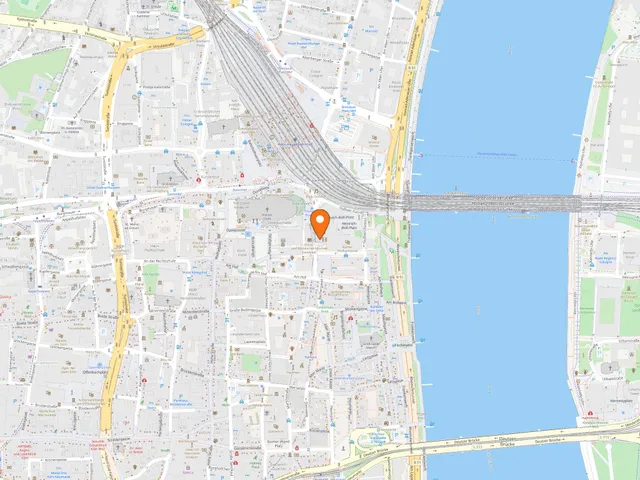
Map
Blue dots: other places nearby — tap to explore.
You might also like — related or nearby
Comments
- Loading comments…
Sources & links
- Official website
- Official website (retrieved 2026-06-25)
- Wikidata (retrieved 2026-06-23)
- Wikipedia (retrieved 2026-06-23, rev 263824653)
Auto-generated, last verified: 2026-06-26
How this page is made
This page draws on open sources — Wikipedia, Wikidata, official websites and the city’s open data. Every statement is checked against the sources linked here, and pages are refreshed regularly.
Spotted a mistake anyway? Tell us below — we read every submission.