Flittarder Rheinaue
A four-kilometre stretch of protected Rhine floodplain on Cologne's northern edge, rich in birdlife and criss-crossed by paths for walkers and cyclists.
since 1991
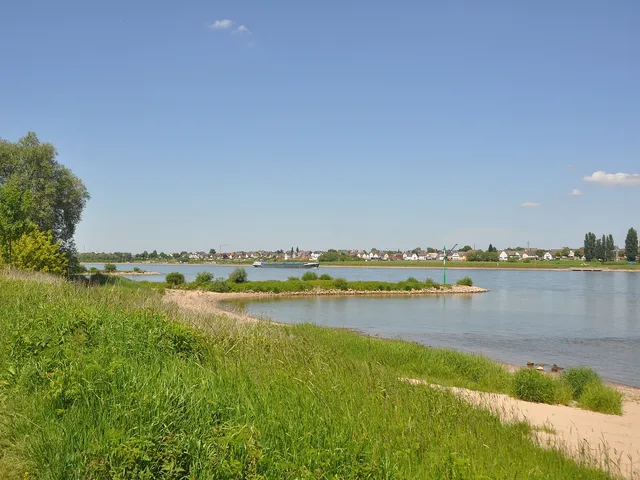
On Cologne's northern city limit, in the Flittard district, the Flittarder Rheinaue is a four-kilometre ribbon of Rhine floodplain wedged between the river and its industrial neighbours. Since 1991 this slip-off slope of the Rhine has been a designated nature reserve, home to a shifting mosaic of water, meadow and woodland.
At a Glance
- Location
- Flittard district, on Cologne's northern city boundary
- Length
- About 4 kilometres along the Rhine
- Protection status
- Nature reserve since 1991
- Size
- Around 180 hectares of protected floodplain
- Highlight
- An old Rhine channel and reed-fringed banks alive with birds
- Accessibility
- Combined foot- and cycle path along the flood dyke, plus small trails through the meadows
Things to do here
Area comparison
Area compared with other Cologne parks and green spaces.
Age comparison
Age compared with other places in Cologne.
Location & Landscape
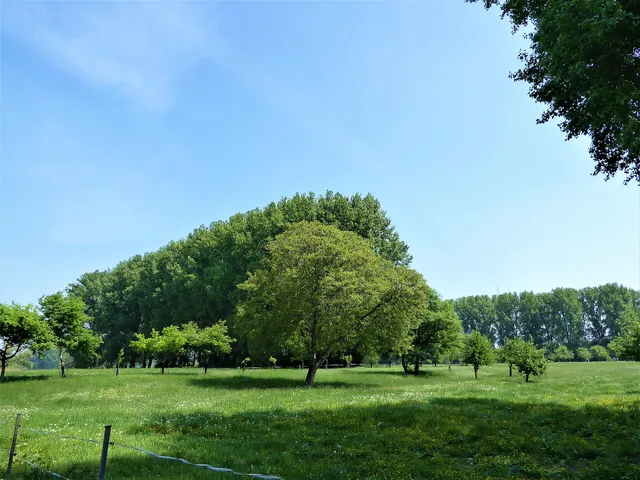
The reserve sits on a slip-off slope of the Rhine, framed on the land side by a flood dyke around three metres high and reaching out to the river itself. Between dyke and water lies a floodplain up to 475 metres wide that can take up the Rhine's high water and so shields the built-up parts of the city from flooding. Within it you find large arable fields, meadows around the well galleries, small pastures, a long pond and a loose stand of poplars. The constant play of flooding, wetting and drying out is what keeps creating fresh habitats here.
The Old Rhine Channel
In the northern part of the floodplain lies an old arm of the Rhine — a still, regularly flooded body of water of particular ecological value and an important refuge for birds and other animals. It began as an island that was later joined to the bank, a change made to keep the Rhine as navigable as possible.
Wildlife
Along the reed-grown banks, herons and cormorants hunt for food. The floodplain is a breeding ground for many bird species, among them little ringed plovers, great crested grebes, coots and moorhens, cuckoos and golden orioles. In winter they are joined by visitors such as goldeneyes, teal, goosanders and Canada geese. Several species of bat also make their home in the reserve, while dragonflies dart over the meadows in the warmer months.
Plant Life
The woody flora ranges from silver willows, limes and elder to poplars, elms, ash, oak and large walnut trees, along with the traditional pollarded willows. On the floodplain meadows bloom wild clover, red poppy, pink soapwort and yellow tansy, and the path edges carry arable wildflowers such as sand poppy and wild dill.
Paths & Recreation
The Flittarder Rheinaue serves as a local recreation area for walkers and cyclists. A combined foot- and cycle path runs along the top of the flood dyke, with smaller trails leading off into the floodplain itself.
Habitat Management
Since March 2014 the BUND district group in Cologne has tended the reserve's pollarded willows, fruit trees and meadows on behalf of the City of Cologne. Towards the end of winter the pollarded willows are cut back regularly to keep their characteristic shape.
Map
Blue dots: other places nearby — tap to explore.
Address
Hubertusstraße
51061 Köln
Hours
So: 00:00–24:00
You might also like — related or nearby
Comments
- Loading comments…
Sources & links
Auto-generated, last verified: 2026-08-09
How this page is made
This page draws on open sources — Wikipedia, Wikidata, official websites and the city’s open data. Every statement is checked against the sources linked here, and pages are refreshed regularly.
Spotted a mistake anyway? Tell us below — we read every submission.