Am Grünen Kuhweg
A restored former gravel pit on Cologne's northern edge in Flittard, protected as a nature reserve since 1991 — a species-rich habitat of open water, sandy dry grassland and rare plants and animals.
since 1991
On Cologne's northern city boundary, in the district of Flittard, lies the "Am Grünen Kuhweg" nature reserve — a former gravel pit that has grown into a richly varied habitat. Across a good 26 hectares, open stretches of water, steep banks and lean sandy grassland alternate with one another.
At a Glance
- Location
- Flittard district, on Cologne's northern city boundary
- Protection status
- Nature reserve, designated in 1991
- Area
- around 26.6 hectares
- What makes it special
- species-rich vegetation and valuable waters for wildfowl
- Care
- NABU Cologne (tending the waters and the northern edge)
Area comparison
Area compared with other Cologne parks and green spaces.
Age comparison
Age compared with other places in Cologne.
Location & Landscape
The former gravel pit still shapes the scene today: long, steep banks covered in hardy ruderal vegetation surround a level floor. Along the dam, on raised mounds and at the western edge run strips of deciduous woodland, in places with some of the rarer native broadleaf species. The Mutzbach stream runs along the northern edge, straightened and deeply incised along its entire length; its north-eastern bank is affected by an adjoining arable field.
Waters & Shoreline
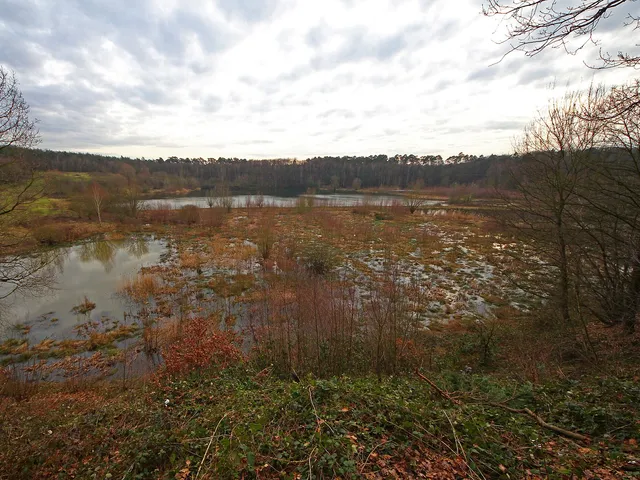
A large expanse of water stretches across the northern part of the site, ringed by gravelly, stony banks that are largely bare of vegetation; a sand and gravel bar was created in the south-east. Just to the north-east, a shallow pool has formed that dries out from time to time, and in the recently levelled southern half of the pit further shallow waters have appeared. These wetlands are valuable habitats for wildfowl. Even a former asphalted storage yard on contaminated ground south of the Grüner Kuhweg has been transformed: after the subsided surface was filled in with stones and gravel, gravelly pools and a water channel emerged, where — helped along by planting — natural vegetation took hold.
Wildlife & Plants
The variety of habitats is mirrored in the flora and fauna. Among sea buckthorn and silver birch grow species such as sheep's-bit, felwort, wild strawberry and common bulrush, and in damp spots the likes of jointed rush and water pepper. The waters and open ground draw in a wealth of animals: grey heron, mute swan, little grebe, lapwing and, on occasion, osprey make use of the site, while on land and in the water live the natterjack toad, sand lizard, blue-winged grasshopper and the southern hawker dragonfly, among others.
Land Management
To keep the open areas from becoming overgrown, NABU Cologne looks after the northern edge of the reserve. The dry sandy grassland is mown each year and bramble scrub is cut back. An adjoining former car park is also deliberately kept open: small pools have formed in its undulating, sealed ground, serving amphibians as spawning grounds — trees and shrubs are removed here year after year so that the creatures of the open landscape keep their habitat.
Map
Blue dots: other places nearby — tap to explore.
Address
Grüner Kuhweg
51069 Köln
You might also like — related or nearby
Comments
- Loading comments…
Sources & links
- Official website
- Official website (retrieved 2026-08-10)
- Wikipedia (retrieved 2026-08-09, rev 258180243)
- Wikidata (retrieved 2026-08-09)
Auto-generated, last verified: 2026-08-09
How this page is made
This page draws on open sources — Wikipedia, Wikidata, official websites and the city’s open data. Every statement is checked against the sources linked here, and pages are refreshed regularly.
Spotted a mistake anyway? Tell us below — we read every submission.