Dünnwalder Wald
Cologne's urban forest in the northeast: a wildlife park with European bison, an arboretum with giant sequoia and cedar, and a former gravel pit turned bird sanctuary.
Where trees stand today, the Dünnwald and Thurn heaths once lay, the common heathlands of the surrounding villages. The forest came into being through the afforestation of these open heath areas.
Source: Wikipedia
At a Glance
- Type
- Urban forest, part of the Bergisch Heath Terrace (Bergische Heideterrasse)
- Size
- Around 410 hectares
- Location
- In northeast Cologne, mostly within the district of Dünnwald (Mülheim borough); borders Höhenhaus and Dellbrück
- Extent
- Reaches into the municipal areas of Bergisch Gladbach and Leverkusen
- Significance
- Together with the Königsforst, part of Cologne's green belt on the right bank of the Rhine
- Facilities
- Well-kept paths and a number of shelters
Until the 19th century, today's Dünnwalder Wald was largely open heathland: by 1893, large parts had been planted with Scots pine, which is not native to the Lower Rhine Bay, in a strictly organised, military-style campaign. As late as the 1970s, the area was still considered one of North Rhine-Westphalia's most important grasshopper habitats.
From Heath to Forest
The Prussian original survey of 1844 still shows wide stretches of open heath here. By the time of the Prussian resurvey of 1893, large parts had already been planted in regimented rows with Scots pine, a tree not native to the Lower Rhine Bay. Farming and military use kept pockets of open, species-rich habitat intact until the second wave of afforestation after the war, for example in the Dellbrücker Heide nature reserve and around the Schlebusch dunes. Building development, afforestation, gravel extraction and later recultivation destroyed almost all of these areas as well by the 1980s at the latest.
Lost Grasshopper Populations
As late as the 1970s, parts of the Dünnwald and Thurn heaths were considered one of the most important grasshopper habitats in North Rhine-Westphalia. Species included the red-winged grasshopper, the field cricket and the wart-biter. Today these species have disappeared, and their habitats are gone.
Reforestation and Conversion
In 1956, Cologne's city administration and the Schutzgemeinschaft Deutscher Wald (German Forest Protection Association) launched an afforestation programme for the right-bank part of the city to shield residential areas from exhaust fumes and dust. Because the soil of the right-bank middle terrace consists mainly of sand and gravel, the first plantings were mostly mixed woodland with many conifer stands; pines and birches grow best on such poor soils. Several decades later, the forestry authority began gradually converting the woodland into broadleaf forest. Since natural nesting sites are scarce, many nest boxes were put up. A forest fire on 21 April 1996 affected only a small part of the woods, which have since fully recovered.
Wildlife Park and Arboretum
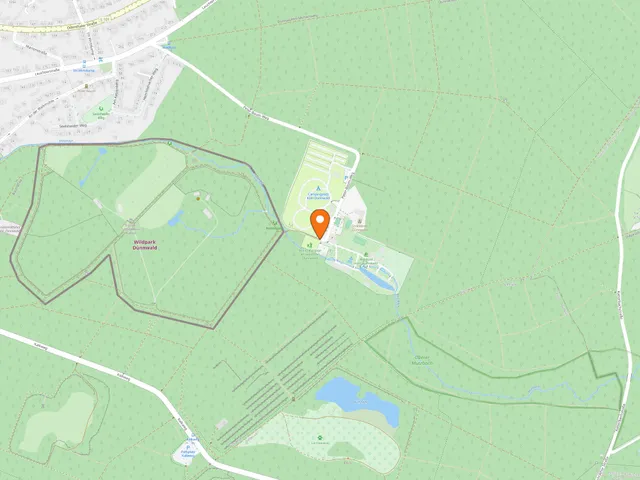
At the edge of the forest, close to the residential areas of Dünnwald, lies the freely accessible wildlife park, founded at the same time as the afforestation. Across roughly 20 hectares, enclosures hold wild boar, fallow deer, European mouflon and European bison resettled from Poland. Free guided tours start on the second Wednesday of each month at 2 p.m. near the Kalkweg / Dünnwalder Mauspfad entrance. Nearby, on the other side of the Dünnwalder Mauspfad, the Schutzgemeinschaft Deutscher Wald has used a 4.3-hectare arboretum since the early 1960s as a collection of trees and shrubs. It displays temperate-zone woody plants not otherwise found in German forests, such as the dove tree, magnolia, tulip tree, southern beech, giant sequoia and cedar. One aim of the site is to test whether such trees can be planted in German forests.
Nature Reserves in the Forest
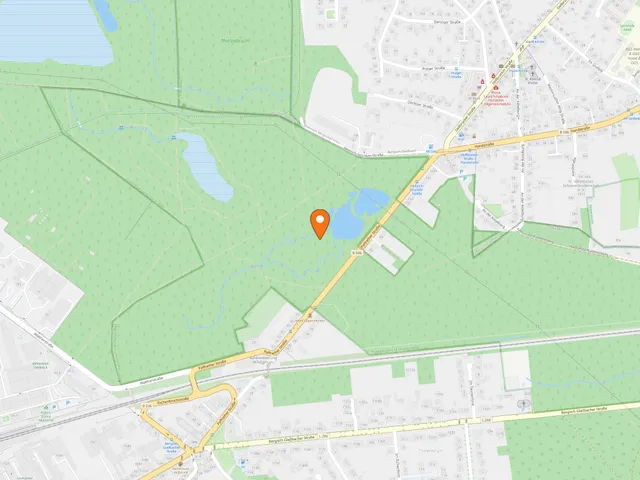
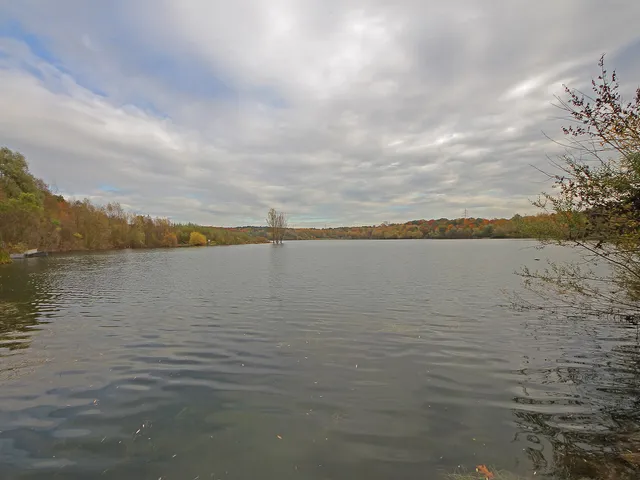
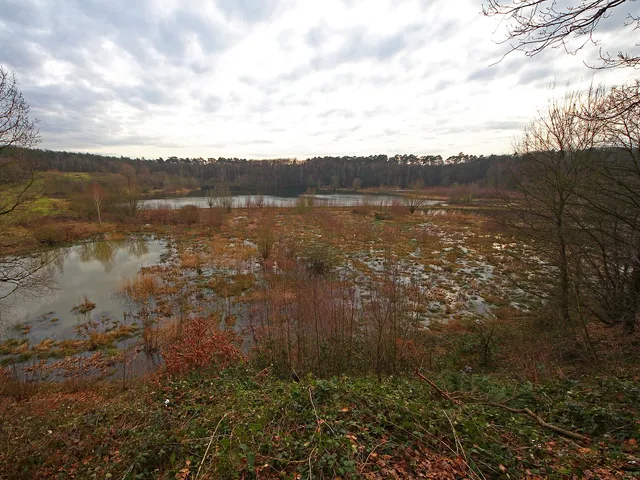
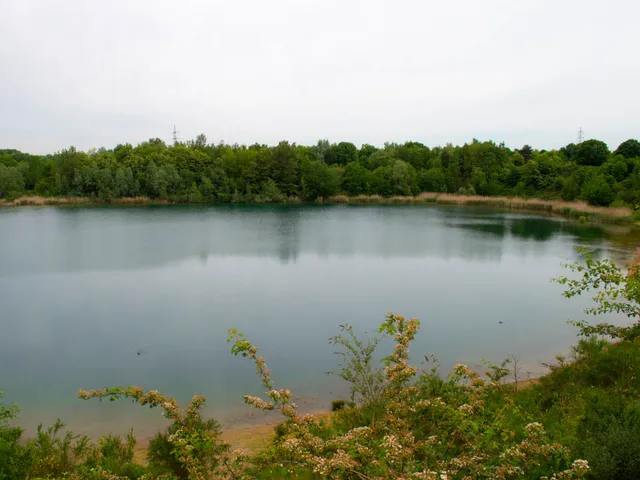
On the northern edge of the forest, near the city boundary with Leverkusen-Schlebusch, lies the "Am Hornpottweg" nature reserve. This former gravel pit developed in the 1980s, a few years after it was decommissioned, into a habitat for numerous animal species, especially birds. Alongside resident birds, many migratory species use the pit as a resting place. A circular path runs around it and offers good观察 points for birdwatching. In Bergisch Gladbach, near the district of Schildgen, the "Nittum-Hoppersheider Bruch" is another nature reserve within the Dünnwalder Wald.
Timeline
- 1844Prussian original survey still shows extensive open heathland
- 1893Prussian re-survey: large parts of the heath afforested with Scots pine
- 1956Cologne and Schutzgemeinschaft Deutscher Wald set up an afforestation programme
- Anfang der 1960erArboretum begins to be used by the Schutzgemeinschaft Deutscher Wald
- 1980erFormer gravel pit Am Hornpottweg develops into a valuable biotope
- 1996On 21 April a forest fire burns a small part of the forest
Gallery
Map
Blue dots: other places nearby — tap to explore.
You might also like — related or nearby
Comments
- Loading comments…
Sources & links
Auto-generated, last verified: 2026-10-18
How this page is made
This page draws on open sources — Wikipedia, Wikidata, official websites and the city’s open data. Every statement is checked against the sources linked here, and pages are refreshed regularly.
Spotted a mistake anyway? Tell us below — we read every submission.