Swing Bridge in the Rheinauhafen
Cologne's oldest crossing over Rhine water: a listed swing bridge from 1896 that pivots aside using hydraulics powered from the Malakoff Tower.
since 1896
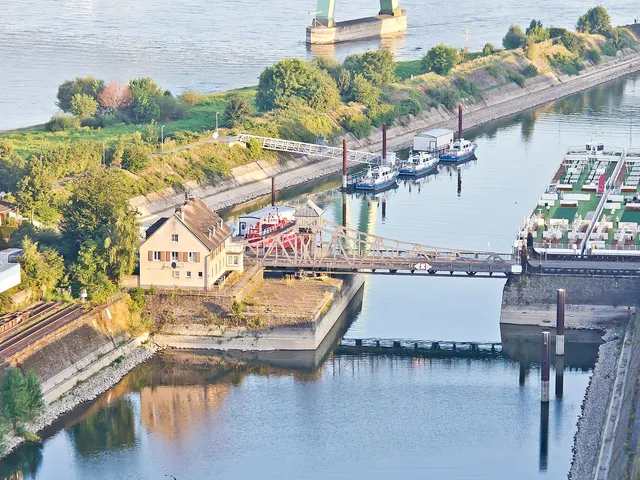
On the left bank of the Rhine between the Malakoff Tower and the Chocolate Museum, the listed swing bridge rotates its structure to the side, allowing boats to enter the Rheinauhafen.
At a Glance
- Type
- Listed swing bridge (steel truss girder)
- Location
- Altstadt-Süd, Innenstadt district, on the left bank of the Rhine
- Opened
- 5 August 1896
- Spans
- 28.334 m (long arm), 18.30 m (short arm)
- Width
- 10 m, of which 5 m carriageway
- Clearance height
- 8.20 m above Cologne gauge
To balance the unequal weight of its two arms, the shorter arm was paved with heavy stone and the longer arm with lighter wood – a clever engineering solution ensuring the bridge stays balanced when rotating.
Things to do here
- Marvel at the historic swing bridge from 1896
- Stroll across the bridge between the Malakoff Tower and the Chocolate Museum
- Photograph the delicate steel truss and the Cologne bridge green
- With a bit of luck, watch the structure swing aside for boats entering and leaving
- Enjoy the view over the Rheinau Harbour with its sport and yacht boats
Age comparison
Age compared with other places in Cologne.
History
The bridge opened on 5 August 1896 alongside the expansion of the Rhine side channel into a harbour and is considered Cologne's oldest crossing over Rhine water. In 1986/87 the industrial monument underwent a full overhaul. It is now assigned to the Chocolate Museum Foundation, which it also provides with a direct access route.
Engineering and Construction
The rotation mechanism is controlled electro-hydraulically at a pressure of 5 MPa, generated inside the Malakoff Tower of 1850. This pressure was originally supplied by a power plant built for the harbour expansion between 1892 and 1898. Every rotation is preceded by a lift of 11.2 cm. Because the two arms differ in weight, the short arm was surfaced with stone and the long arm with wood.
Today
The structure is painted in the traditional Cologne bridge green. Anyone wishing to enter the Rheinauhafen — now used predominantly by leisure and yacht boats — must contact the harbourmaster; between 8 am and 8 pm the bridge is opened on request.
Did You Know
As early as 1984, repairs to the hydraulics cost close to one million Deutschmarks. A restoration of this cultural monument is planned for 2026 under the Kulturinvest programme, with federal funding of around 3.3 million euros set to preserve one of the few remaining structures of this kind still standing in Germany.
Timeline
- 1850Construction of the Malakoff Tower, later housing the bridge's hydraulic mechanism
- 1892–1898Expansion of the Rhine harbour, including a power plant for the hydraulic system
- 1896-08-05Opening of the swing bridge on 5 August 1896
- 1984Hydraulic repair costing nearly 1 million DM
- 1986–1987General overhaul of the industrial monument
- 2026Planned renovation with public funding (Kulturinvest, approx. 3.3 million EUR federal grant)
Map
Blue dots: other places nearby — tap to explore.
Address
Drehbrücke
50676 Köln
Hours
So: 00:00–24:00
You might also like — related or nearby
Comments
- Loading comments…
Sources & links
Auto-generated, last verified: 2026-06-26
How this page is made
This page draws on open sources — Wikipedia, Wikidata, official websites and the city’s open data. Every statement is checked against the sources linked here, and pages are refreshed regularly.
Spotted a mistake anyway? Tell us below — we read every submission.