Rheinauhafen
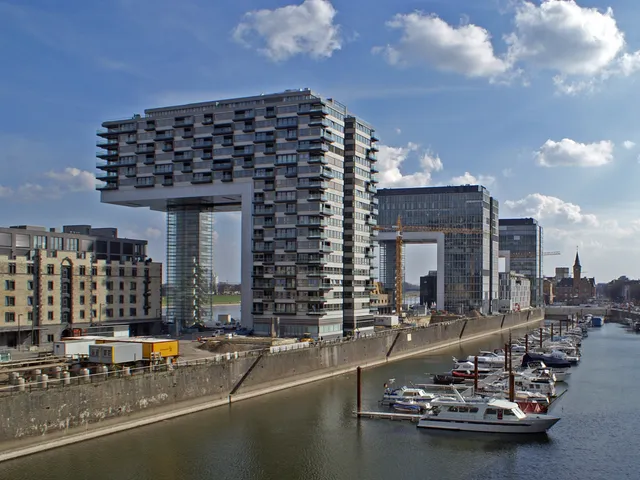
Former Cologne harbour with the iconic Crane Houses – today a residential and commercial quarter on the 'Werthchen' peninsula in Altstadt-Süd.
Rheinauhafen is a former harbour district in Cologne's Altstadt-Süd, now used for residential, office, service, and commercial purposes. The 'Werthchen' peninsula on the left bank of the Rhine is defined by its iconic Crane Houses.
At a Glance
- Type
- Former harbour, now a residential and commercial district
- Location
- Altstadt-Süd district, Innenstadt borough; Werthchen at Rhine kilometre 687.5
- Area
- 15.4 hectares of land, 5.7 hectares of water; total site 235,000 m²
- Use
- 51% offices/services, 31% residential, 18% arts and culture
- Figures
- around 2,200 jobs, approximately 1,500 residents
The entire harbour district was built on a former Rhine island called 'Werthchen' – 720 metres long and up to 40 metres wide – which was artificially connected to the left bank of the Rhine from 1847 onwards, turning the island into a peninsula.
Things to do here
Location and Streets
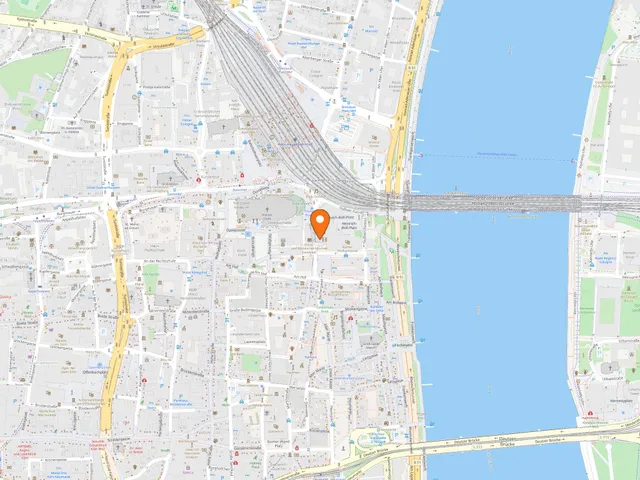
The street Im Zollhafen runs across the peninsula, where the Crane Houses stand. Its southern continuation is called Anna-Schneider-Steig, followed further south by Agrippinawerft. The Rheinuferstraße (B 51) runs parallel along the riverbank, and the Severinsbrücke bridge spans the peninsula. The area no longer serves any harbour function.
The Harbour in the Middle Ages
In Anton Woensam's 1531 panorama of Cologne, the harbour stretched along the entire left bank wall of the Rhine; the Rhine island of 'Werthchen' also hosted harbour and shipyard activity. Loading and unloading was carried out using cranes, overseen by a harbourmaster who collected berth fees. Ships from upriver moored south of the Salzgassen Gate, while larger Dutch vessels anchored to the north. Arnold Mercator's 1570 panorama again depicts the island — ships lie along the bank near the Holzmarkt, though no harbour activity is visible on the island itself.
From Safety Harbour to Peninsula
After severe ice flooding in February 1784, Cologne's merchants and boatmen demanded a winter harbour for their vessels. At Napoleon's instigation, construction of a safety harbour began in 1811; it was in use by 1813 but not fully completed until 1840. It silted up and was difficult for larger vessels to access. As river transport shifted from towpath haulage to steam navigation, cargo volumes grew sharply and a new harbour became necessary. In 1847, city architect Bernhard Wilhelm Harperath and fortifications engineer Carl Schnitzler planned to connect the southern tip of the Rhine island to the bank, creating today's peninsula — work began that same year. In 1848, Johann Anton Wallé designed a safety harbour at Werthchen whose basin was completely enclosed by dock walls.
Timeline
- 1531First large Cologne city view (Woensam) shows busy Rhine harbour
- 1784Extreme ice flood; merchants demand construction of a winter harbour
- 1811Construction of safety harbour begun at Napoleon's initiative
- 1816First English steamship 'Defiance' reaches Cologne
- 1826Bank Sal. Oppenheim founds Prussian-Rhenish Steamship Company
- 1840Safety harbour at Theodor-Heuss-Ring completed
- 1847Planning and construction begin: Werthchen island connected to the riverbank
- 1848Wallé designs safety harbour at Werthchen (new harbour basin)
Gallery
Map
Blue dots: other places nearby — tap to explore.
Address
Rheinauhafen
Köln
You might also like — related or nearby

Comments
- Loading comments…
Sources & links
Auto-generated, last verified: 2026-06-27
How this page is made
This page draws on open sources — Wikipedia, Wikidata, official websites and the city’s open data. Every statement is checked against the sources linked here, and pages are refreshed regularly.
Spotted a mistake anyway? Tell us below — we read every submission.